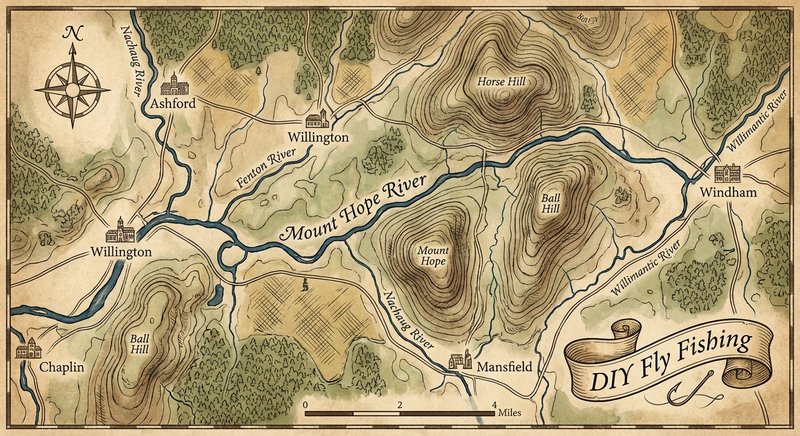
Mount Hope River
Fly fishing in Connecticut · Beginner · Best seasons: Spring, Summer, Fall
Target Species
Brown Trout, Brook Trout
About This Water
Tolland County stream with wild trout. Flows through state park.
Fishing Recommendations
Welcome to the Mount Hope River in northeastern Connecticut. As a guide who has spent years traversing the freestone streams of New England, I can tell you that the Mount Hope is a quintessential "Quiet Corner" gem. It offers a classic technical small-stream experience that rewards stealth and precision.
Here is your comprehensive guide to fly fishing the Mount Hope River.
🎣 Location Overview
The Mount Hope River is a beautiful freestone stream located primarily in Ashford and Mansfield. It eventually flows into Mansfield Hollow Lake, contributing to the Natchaug River system.
What makes this river special is its intimate character. It isn't a wide, sweeping river like the Farmington; it is a brushy, technical, and often secluded waterway. You’ll find a mix of tumbling pocket water, deep undercut banks, and slow-moving "flat water" sections. Because it is heavily forested, the canopy provides excellent shade, which helps maintain cooler water temperatures longer into the season than other un-dammed streams in the region.
🐟 Target Species & Behavior
- Brown Trout: The mainstay of the river. The CT DEEP stocks the Mount Hope heavily with retired broodstock and yearlings. These fish tend to hold in the "guts" of the deeper pools and tight against the undercut banks.
- Brook Trout: You will find stocked brookies in the main stem, but the real prizes are the wild, native Brook Trout found in the upper reaches (above Route 44) and in the small feeder tributaries.
- Behavior: In this smaller water, fish are incredibly "spooky." A heavy footstep or a shadow cast over a pool will shut the fishing down for an hour. They feed primarily on caddis larvae, stoneflies, and opportunistic terrestrial drops from the overhanging trees.
📅 Best Times to Fish
Spring (Late March – June)
The "Prime Time." This coincides with the heaviest stocking schedules and the most prolific insect hatches. Water levels are usually high but manageable.
- Window: Late April through May is the sweet spot for dry fly action.
Summer (July – August)
The Mount Hope is a freestone stream, meaning it relies on rain and groundwater. In dry years, it can get very low and warm.
- Window: Fish early mornings (6 AM – 10 AM) or late evenings. Pro Tip: Bring a thermometer; if the water is over 68°F, head to a different spot to avoid stressing the fish.
Fall (September – November)
As temperatures drop, the remaining Brown Trout become aggressive and territorial before spawning. The foliage in Mansfield Hollow is world-class during this time.
- Window: Mid-day fishing is best as the sun warms the water slightly, activating the bugs.
🪰 Recommended Flies & Techniques
Dry Flies
- Elk Hair Caddis (Size 14-18): The Mount Hope is a caddis-heavy river. Tan and olive are the go-to colors.
- Adams (Size 16-20): A perfect general imitation for the various mayflies.
- Light Cahill (Size 14-16): Essential for late May evenings.
- Terrestrials: In Summer, a Size 14 Foam Ant or Cricket dropped tight to the bank is deadly.
Nymphs
- Pheasant Tail (Size 16-18): Best for mimicking the natural mayfly nymphs found under rocks.
- Zebra Midge (Size 18-22): Excellent for the slower, deeper pools when fish are being picky.
- Prince Nymph (Size 14-16): A great "searcher" pattern for the faster pocket water.
Streamers
- Woolly Bugger (Black or Olive, Size 8-12): Swing these through the deep holes near Route 89 bridges.
Technique Tip
Because the river is narrow and brushy, Roll Casting is a mandatory skill here. Overhand casting will often result in "decorating the trees." Use a 7.5-foot to 8.5-foot 3-weight or 4-weight rod for the best experience.
💡 Pro Tips & Local Knowledge
- The "Mansfield Hollow" Stretch: Focus on the area within the Mansfield Hollow State Park. This stretch has more structure and receives less pressure than the spots right next to the main road crossings.
- Stealth is Strategy: Don't wear bright colors. Wear earth tones to blend into the forest. Approach a pool from downstream and stay low to the ground.
- Look for "Micro-Eddies": In the faster stretches, even a rock the size of a toaster creates a pocket of soft water. Drop your fly right behind it—trout in the Mount Hope love these small resting spots.
- The Ashford Upper Reaches: If you want native Brookies, go north of Route 44. The water gets smaller, the hiking gets harder, but the fish are pristine.
⚠️ Important Information
Access
- Route 89: Much of the river parallels Route 89 (Westford Rd). There are various pull-offs between Ashford and Mansfield.
- Mount Hope Park: A great easy-access point for families or beginners.
- Mansfield Hollow State Park: Offers miles of hiking trails that follow the river to its confluence.
Regulations
- License: A valid Connecticut Fishing License and a Trout & Salmon Stamp are required for all anglers 16 and older.
- Seasons: Connecticut recently moved to a year-round trout season, but some areas remain "Catch and Release only" from March 1st to the second Saturday in April. Always check the CT DEEP Digital Fishing Guide for the most current updates.
Safety
- Ticks: This area of CT is high-risk for Lyme Disease. Wear long pants tucked into socks and use a repellent with DEET or Permethrin.
- Wading: The rocks here can be incredibly slippery. Felt-soled boots or studs are highly recommended.
Guide’s Final Word: The Mount Hope isn't about trophy-sized fish; it's about the beauty of the New England woods and the challenge of a perfect cast in tight quarters. Slow down, enjoy the scenery, and keep your tip up!
Tight lines!
Bug Hatches & Matching Flies
| Hatch | Type | Peak months | Time of day | Hook sizes | Matching flies |
|---|---|---|---|---|---|
| Quill Gordon Epeorus pleuralis | mayfly | April | Midday | #12-14 | Quill Gordon Dry #12-14, Hare's Ear #12-14 |
| Hendrickson Ephemerella subvaria | mayfly | April, May | Afternoon | #12-14 | Hendrickson Pink Lady #12-14, Pheasant Tail #12-16, Hendrickson Emerger #14 |
| Blue-Winged Olive Baetis | mayfly | April, May, September, October | Midday/Afternoon | #18-22 | RS2 #20-22, BWO Parachute #18-22 |
| Tan Caddis Hydropsyche | caddis | May, June | Evening | #14-18 | Elk Hair Caddis #14-16, LaFontaine's Deep Sparkle Pupa #14-18 |
| March Brown Maccaffertium vicarium | mayfly | May, June | Afternoon/Evening | #10-12 | March Brown Parachute #10-12, Gold Ribbed Hare's Ear #10-12 |
| Light Cahill Stenacron interpunctatum | mayfly | June, July | Evening | #12-14 | Light Cahill #12-14, Cahill Wet Fly #14 |
| Yellow Sally Isoperla | stonefly | June, July | Late Afternoon/Evening | #14-16 | Yellow Stimulator #14-16, Little Yellow Stone Nymph #16 |
| Terrestrials (Ants/Beetles) Formicidae/Coleoptera | terrestrial | July, August, September | All Day | #14-18 | Cinnamon Ant #16-18, Black Foam Beetle #14-16 |