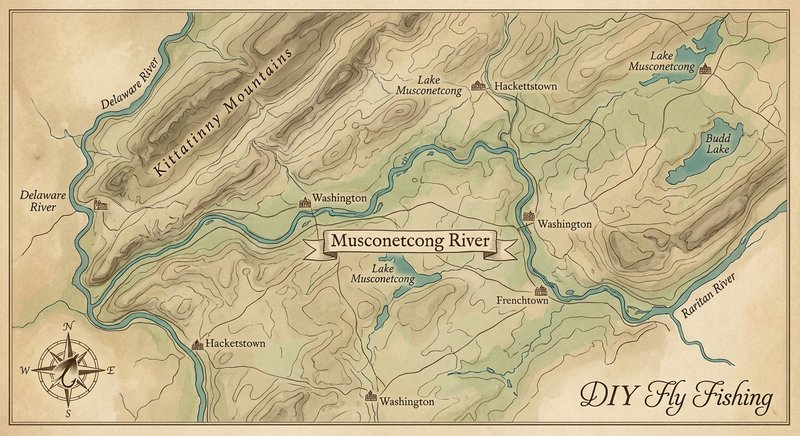
Musconetcong River
Fly fishing in New Jersey · beginner · Best seasons: spring, summer, fall
Target Species
Brown Trout, Rainbow Trout
About This Water
Historic trout river flowing through Warren and Hunterdon counties. Multiple public access points with stocked and wild trout.
Fishing Recommendations
Tighten your wading belt and grab your 5-weight; we’re heading to "The Musky." As one of New Jersey's premier trout streams and a designated National Wild and Scenic River, the Musconetcong offers a classic freestone experience with a distinct limestone influence that keeps it productive when other NJ rivers falter.
🎣 Location Overview
The Musconetcong River flows for 42 miles through the scenic Highlands of Northwest New Jersey. What makes it special is its limestone influence. While technically a freestone river, it is fed by limestone springs and outflows from Lake Hopatcong, providing a rich mineral base that supports incredible insect biomass.
Anglers love the "Musky" for its diversity. You’ll find everything from plunging pocket water and brawling rapids to glassy, technical limestone-style flats. It feels like a piece of Montana tucked into the most densely populated state in the country.
🐟 Target Species & Behavior
- Rainbow Trout: These are the river's workhorses. Mostly stocked by the state, they are aggressive and tend to hold in faster, highly oxygenated water (riffles and the heads of pools). They are often the primary targets during the heavy spring hatches.
- Brown Trout: You will find both stocked browns and a surprising population of "holdover" or wild-reared fish. These fish are far more selective and wary. They hold in undercut banks, deep woody debris, and the "tail-outs" of pools during low light.
- Behavioral Note: Because of the river's rich bug life, fish here become very "top-water oriented" during the spring but will transition to "bottom-hugging" nymphing tactics as soon as the summer sun hits the water.
📅 Best Times to Fish
Spring (April – June)
- The Window: This is the "Golden Era" on the Musky. Water temps are in the 50s and 60s.
- Conditions: High water in April transitions to perfect flows in May.
- Time of Day: Late morning through evening. The "Evening Rise" in late May is legendary.
Summer (July – Early September)
- The Window: Early mornings only.
- Conditions: Water temperatures can spike. Pro Guide Warning: If the water hits 70°F, stop fishing to protect the trout. Focus on the cooler stretches near Point Mountain or below spring confluences.
Fall (Late September – November)
- The Window: The river gets a "second life" with state fall stocking.
- Conditions: Crisp air and lower, clearer water.
- Time of Day: Mid-day when the sun warms the water slightly, triggering Blue Winged Olive hatches.
🪰 Recommended Flies & Techniques
Dry Flies
- Hendricksons (April): Red Quills and Hendrickson Duns (#12-14).
- Sulphurs (May-June): This is the main event. Use #16-18 Sulphur duns and emergers.
- Tan Caddis (#14-16): A staple throughout the year.
- Terrestrials (Summer): Ants and beetles are mandatory in the hemlock-lined stretches.
Nymphs (The "Bread and Butter")
- Pheasant Tail (#14-18): Mimics almost everything in the river.
- Zebra Midge (#18-20): Essential for picky fish in slow water.
- Walts Worm/Sexy Walt: Very effective in the higher-gradient pocket water.
Streamers
- Woolly Bugger (Black or Olive): Best after a rain when the water has some "color."
- Small Sculpin patterns: Fish these deep near the bank undercuts for the big browns.
Presentation Tip
The Musky has complex currents. Mending is everything. Use a "Reach Cast" to get a drag-free drift on the technical flats, or use "Euro Nymphing" techniques in the heavy pocket water around Point Mountain.
💡 Pro Tips & Local Knowledge
- The Point Mountain Stretch: This is the crown jewel. It features a "Trout Conservation Area" (TCA) with year-round fishing and specific lure/fly restrictions. It has the best habitat for holdover fish.
- Beat the Crowd: The Musky gets crowded on weekends in April. If you want solitude, hike a half-mile away from the bridge access points. Most NJ anglers stay within 200 yards of their cars.
- The "Hatch Clock": In late May, the Sulphur hatch moves upstream. If the bugs are popping at Saxton Falls today, they’ll likely be heavy a few miles upstream at Point Mountain in a day or two.
- Check the Gauge: Check the USGS gauge at Hackettstown. Ideal flows for wading are between 150cfs and 300cfs. Anything over 500cfs becomes difficult and potentially dangerous to wade.
⚠️ Important Information
- Access: Numerous public access points exist. Look for "Green Acres" signs and NJ Fish & Wildlife parking areas. Key spots: Saxton Falls, Point Mountain, Penwell, and Asbury.
- Regulations:
- General Water: Follow standard NJ Trout seasons (closed for stocking periods in spring).
- TCA (Trout Conservation Area): Point Mountain has a Year-Round TCA stretch. Only one fish over 15" may be kept, and you must use artificials only.
- Permits: You need a New Jersey Fishing License and a Trout Stamp. These can be purchased online via the NJ DEP website.
- Wading Safety: The rocks in the Musky are notoriously slippery (covered in "didymo" or rock snot at times). Studded wading boots are highly recommended.
Tight lines, and remember to pinch your barbs—especially on those wild browns!
Bug Hatches & Matching Flies
| Hatch | Type | Peak months | Time of day | Hook sizes | Matching flies |
|---|---|---|---|---|---|
| Blue-Winged Olive Baetis spp. | mayfly | March, April, October, November | Mid-day/Afternoon | #18-24 | RS2 #20-22, BWO Sparkle Dun #18-22, Pheasant Tail Nymph #18-20 |
| Hendrickson Ephemerella subvaria | mayfly | April, May | Afternoon | #12-14 | Red Quill #12-14, Hendrickson Emerger #12-14, Gold Ribbed Hare's Ear #12-14 |
| Sulphur Ephemerella invaria/dorothea | mayfly | May, June | Evening | #14-18 | Sulphur Parachute #14-18, Comparison Dun #16-18, Sulphur CDC Emerger #16-18 |
| Tan Caddis Hydropsyche spp. | caddis | April, May, June | Evening | #14-18 | Elk Hair Caddis #14-16, LaFontaine's Deep Sparkle Pupa #14-16, Holy Grail #14-18 |
| Trico Tricorythodes spp. | mayfly | July, August, September | Early Morning | #22-26 | Trico Spinner #22-24, Sunken Trico Spinner #22-24 |
| Isonychia Isonychia bicolor | mayfly | June, September | Late Afternoon/Evening | #10-12 | Iso Parachute #10-12, Zug Bug #10-12, Prince Nymph #10-14 |
| Light Cahill Stenonema ithaca | mayfly | June, July | Evening/Dusk | #12-14 | Light Cahill #12-14, Cream Usual #14 |
| Little Black Stonefly Taeniopteryx burksi | stonefly | February, March | Mid-day | #14-18 | Early Girl Stonefly #16-18, Copper John (Black) #14-16 |
| Midges Chironomidae | midge | January, February, March, December | All Day | #18-24 | Zebra Midge #18-22, Griffith's Gnat #18-22, Mercury Midge #20-22 |
| Ants and Beetles Formicidae / Coleoptera | terrestrial | July, August, September | All Day | #12-20 | Chernobyl Ant #12-14, Black Foam Beetle #14-18, Flying Ant #16-20 |