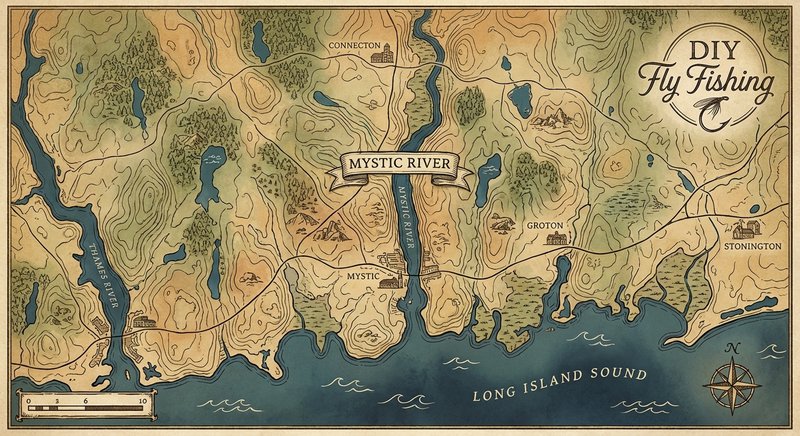
Mystic River
Fly fishing in Connecticut · Beginner · Best seasons: Spring, Summer, Fall
Target Species
Striped Bass, Bluefish, Scup
About This Water
Historic seaport estuary with striped bass. Scenic downtown fishing.
Fishing Recommendations
The Mystic River is one of Connecticut’s most storied bodies of water. While famous for its maritime history and the Seaport, for a fly angler, it is a premier destination for pursuing "Linesiders" (Striped Bass) and "Yellow-eyed Devils" (Bluefish) in a classic New England estuarine setting.
🎣 Location Overview
The Mystic River is technically a tidal estuary, flowing roughly five miles from the outskirts of Old Mystic down into Fishers Island Sound. What makes it special is the diversity of structure: you have expansive salt marshes in the upper river, a high-current "pinch point" at the famous Bascule Bridge, and a rocky, boulder-strewn mouth near Noank and Masons Island.
Anglers love the Mystic because it offers "big water" opportunities accessible to both boaters and shore-bound fly fishers. The mix of tidal flats, deep channels, and shadow-casting docks creates a perfect laboratory for saltwater fly fishing.
🐟 Target Species & Behavior
Striped Bass (Rockfish)
The undisputed king of the Mystic.
- Behavior: Bass use the river as a highway. In the spring, they push up into the marshes to feed on cinder worms and grass shrimp. In the summer, they hold in the deep, cooler channels or under docks.
- Holding Spots: Look for "shadow lines" created by the bridges and docks at night, and the edges of the main channel during the day.
Bluefish
- Behavior: These are aggressive predators. They enter the river in "blitzes" following schools of Menhaden (bunker) or silversides.
- Holding Spots: They are often found in the faster water near the mouth of the river (Noank) or patrolling the deeper holes near the Seaport.
Scup (Porgy)
- Behavior: Often overlooked by fly fishers, Scup are hard-fighting panfish of the sea.
- Holding Spots: They congregate around rocky bottoms, bridge pilings, and pier supports. They are "nibblers" and require smaller flies and a very sensitive touch.
📅 Best Times to Fish
- Spring (May – June): This is the Prime Window. This coincides with the "Cinder Worm Hatch" in the upper river salt marshes. It is one of the few times saltwater fishing feels like trout fishing, with bass rising to sip tiny worms off the surface.
- Summer (July – August): Best at night or pre-dawn. The water temperature in the river can get high, pushing larger fish to the cooler, oxygenated water at the mouth of the river near Noank.
- Fall (September – October): The "Fall Blitz." As baitfish migrate out of the marshes toward the sound, bass and blues wait in ambush. This is the time for large flies and aggressive takes.
- Tidal Flow: The outgoing tide is generally preferred. As the tide drops, it flushes bait out of the marshes and concentrates it in the main river channel.
🪰 Recommended Flies & Techniques
Top Fly Patterns
- Cinder Worm Fly: (Size 10-14) Red, pink, or orange body with a black head. Essential for late May.
- Chartreuse & White Clouser Minnow: The "all-purpose" fly for the Mystic. It gets deep and mimics silversides perfectly.
- Hollow Fleyes / Beast Fleyes: For the fall season when you need to mimic large Atlantic Menhaden (Bunker).
- Gurglers and Bob’s Bangers: Topwater patterns for low-light conditions. There is nothing like a Striper smashing a Gurler in the shallows.
- Small Shrimp Patterns: (Size 6-8) Effective for Scup and schoolie Bass along the marsh edges.
Techniques & Presentation
- The "Low and Slow" Strip: For Striped Bass, use an intermediate sinking line. Cast toward structure, let it sink, and use a 6-inch twitching retrieve.
- The Burn: For Bluefish, strip as fast as you physically can. They are triggered by speed.
- Sight Casting: On the flats around Masons Island, look for "muds" or shadows during a rising tide.
💡 Pro Tips & Local Knowledge
- The Bridge Strategy: The Bascule Bridge in downtown Mystic creates a massive shadow line at night. Stripers sit just inside the darkness, waiting for bait to float through the light. Cast your fly into the light and strip it into the shadow.
- The Noank "Rip": The mouth of the river near the Noank shipyards has significant current. Use a heavy sinking tip line (250-350 grain) here to get your fly down to the bigger "cows" sitting on the bottom.
- Kayak Advantage: The Mystic is one of the best kayak-fishing rivers in New England. Launching at Beebe Cove allows you to access the "back door" of Masons Island, where boat traffic is minimal and the flats are pristine.
- Match the Hatch: If you see "swirls" but no hits, the fish are likely on Cinder Worms. Switch to a floating line and a tiny red fly—stop stripping and let it drift.
⚠️ Important Information
Access Information
- Public Access: Shore access is available at the Mystic River Park (downtown), though it gets crowded.
- Noank Village: Several small street-end access points exist, but parking is extremely tight.
- Boat Launch: The state boat launch at Barn Island (just to the east) or the local ramps in Noank are your best bets.
Regulations & Permits
- License: A Connecticut Marine Waters Fishing License is required for all anglers age 16 and older.
- Striped Bass: CT follows the Atlantic States Marine Fisheries Commission (ASMFC) slot limit. Currently, it is one fish between 28" and less than 31" (check current year regs as these change frequently).
- Gear: For the Mystic, an 8-weight rod with a saltwater-grade reel is the standard "do-it-all" setup.
Special Considerations
- Boat Traffic: During July and August, the river is a highway for massive yachts and tourists. For your safety and sanity, fish early (before 8:00 AM) or late (after 7:00 PM).
- Wading Safety: The mud in the upper marshes can be "boot-pulling" deep. Stick to the gravelly sections or fish from a craft if possible.
Bug Hatches & Matching Flies
| Hatch | Type | Peak months | Time of day | Hook sizes | Matching flies |
|---|---|---|---|---|---|
| Cinder Worm Alitta succinea | midge | May, June | Evening | #10-14 | Red Cinder Worm #12-14, Page's Cinder Worm #10-12 |
| Blue-Winged Olive Baetis | mayfly | April, May, September, October | Afternoon | #18-22 | RS2 #20, BWO Sparkle Dun #18-20 |
| Sulphur Ephemerella invaria | mayfly | May, June | Evening | #14-18 | Sulphur Parachute #16, Pheasant Tail #14-16 |
| Tan Caddis Hydropsyche | caddis | May, June, July | Evening/Night | #14-16 | Elk Hair Caddis #14-16, LaFontaine's Deep Sparkle Pupa #16 |
| Common Midge Chironomidae | midge | March, April, October, November | Morning/Afternoon | #20-26 | Zebra Midge #20-22, Griffith's Gnat #22-24 |
| Light Cahill Stenacron canadense | mayfly | June, July | Evening | #12-14 | Light Cahill #14, Gold Ribbed Hare's Ear #12-14 |
| Black Carpenter Ant Camponotus pennsylvanicus | terrestrial | July, August | Afternoon | #12-16 | Black Foam Ant #14-16, Fur Ant #16 |
| Little Winter Stonefly Allocapnia | stonefly | February, March | Afternoon | #16-18 | Early Brown Stone #16, Prince Nymph #16-18 |