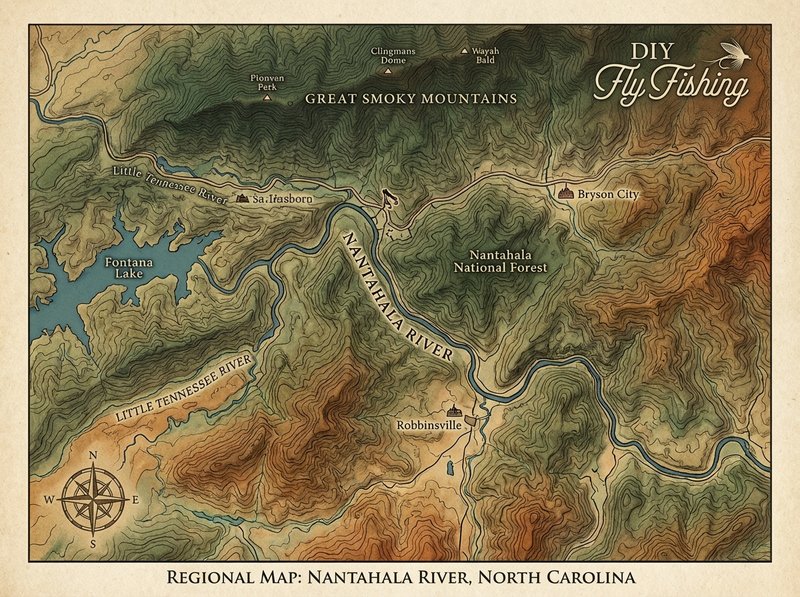
Nantahala River
Fly fishing in North Carolina · Beginner · Best seasons: Spring, Summer, Fall, Winter
Target Species
Brown Trout, Rainbow Trout
About This Water
Popular western NC river with excellent trout fishing below the dam. Cold tailwater fishery.
Fishing Recommendations
Welcome to one of the most unique and diverse fisheries in the Blue Ridge Mountains. As your guide, I can tell you that the Nantahala River is a crown jewel of North Carolina fly fishing. It offers two very different experiences: a high-elevation, "delayed harvest" freestone stream upstream, and a powerful, tailwater-influenced lower section that stays cold even in the heat of July.
Here is your comprehensive guide to fishing the Nantahala.
🎣 Location Overview
The Nantahala River, located near Bryson City, NC, is a river of dual personalities.
- The Upper Nantahala: Above the Duke Energy power plant, this is a classic mountain freestone stream. It features plunges, deep pools, and pocket water. A significant portion is managed under "Delayed Harvest" regulations, ensuring high fish densities.
- The Lower Nantahala: Below the powerhouse, the river is a tailwater. Cold water is released from the bottom of Nantahala Lake, traveling through a pipe to the powerhouse. This keeps the lower river in the 50s year-round. While famous for whitewater rafting, it is also a trophy trout factory.
What makes it special is the consistency. While other NC rivers get too warm in August, the Nantahala remains a "refrigerator," providing stable habitat for trout and active fishing when everything else is shut down.
🐟 Target Species & Behavior
- Rainbow Trout: These are the acrobats of the river. In the Upper Nantahala, they are prolific and often hold in faster riffles and at the heads of pools. In the Lower River, they grow thick and strong due to the constant cold water and high oxygen levels.
- Brown Trout: The Nantahala is famous for its wild Brown Trout, especially in the lower sections and the "Standing Indian" area of the upper river. These fish are more predatory. They hold in "soft water" behind mid-stream boulders, under undercut banks, and in deep, dark slots.
- Behavior: During the day, fish often hold in the "seams" (where fast and slow water meet). During low light or high water, the big Browns move into the shallows to hunt sculpins and smaller trout.
📅 Best Times to Fish
Spring (March – May)
- Window: This is prime time for the Upper Nantahala. The Delayed Harvest section is loaded with fish, and the natural hatches (Quill Gordons, March Browns) begin.
- Conditions: Water levels can be high from rain, but the fishing is electric.
Summer (June – August)
- Window: Focus on the Lower Nantahala.
- Timing: You must fish early morning or late evening to avoid the "plastic hatch" (the thousands of rafters and kayakers). Once the rafters are off the water at 5:00 PM, the river belongs to the anglers.
Fall (September – November)
- Window: The best time for trophy Brown Trout.
- Timing: As they prepare to spawn, Browns become aggressive. October is spectacular for dry-fly fishing on the Upper river with Blue Winged Olives and Terrestrials.
Winter (December – February)
- Window: Sunny afternoons.
- Conditions: Because the Lower river is a tailwater, it stays warmer than the air. You can find active fish here even in January when other mountain streams are iced over.
🪰 Recommended Flies & Techniques
Top Fly Patterns
- Nymphs: Frenchie (size 14-18), Pheasant Tail, Sexy Walt’s Worm, and Girdle Bugs (Pat’s Rubber Legs) in coffee/black.
- Dry Flies: Yellow Stimulator (great for the Upper river), Parachute Adams, Elk Hair Caddis, and small Blue Winged Olives (size 18-22) for winter/fall.
- Streamers: Black or Olive Woolly Buggers, and the Game Changer for the lower river if you are hunting trophy Browns.
Techniques
- Euro Nymphing: This is the most effective way to fish the Nantahala's pocket water. Using a long rod and a thin leader allows you to get deep in the fast currents where the big fish sit.
- Dry-Dropper: Perfect for the Upper Nantahala. Hang a small pheasant tail 18 inches below a buoyant Stimulator.
- Streamer Stripping: On the lower river, cast toward the banks and "strip-pause" back through the eddies.
💡 Pro Tips & Local Knowledge
- The "Rafter" Strategy: On the lower river, don't be discouraged by the rafts. Trout are used to them and often feed on the insects dislodged by paddles hitting rocks. However, for the best experience, fish before 10:00 AM or after 5:00 PM.
- The Powerhouse Schedule: Check the Duke Energy release schedule. If they are "generating," the lower river is high and treacherous to wade. If they are not generating, the water is low and much easier to fish.
- Shadow Management: The Nantahala Gorge is deep and narrow. The sun hits the water late and leaves early. Use this to your advantage—trout feel more secure in the shadows and are more likely to rise to dry flies.
- Stealth on the Upper: The Upper Nantahala is crystal clear. Wear earthy tones and move slowly upstream to avoid spooking wild fish.
⚠️ Important Information
Access
- Upper Nantahala: Accessed via Forest Service Road 67 (off Hwy 64). There is miles of public access in the Nantahala National Forest.
- Lower Nantahala: Follow Hwy 19/74 through the gorge. There are numerous pull-offs along the road.
Regulations
- Delayed Harvest (Upper): From the mouth of Whiteoak Creek to the Duke Energy powerhouse. Catch and release only (single hook, artificial only) from Oct 1 to the first Saturday in June.
- Hatchery Supported: Certain sections are closed in March and have different creel limits.
- Licensing: You need a North Carolina Fishing License with a Trout Privilege. You can buy these online via the NCWRC website.
Safety
The rocks in the Nantahala are notoriously slippery (known as "Nantahala Ice"). Felt-soled boots or studs are highly recommended. If you are fishing the lower river, keep an eye on the water level; if it starts rising rapidly, the powerhouse has started generating—get to the bank immediately.
Bug Hatches & Matching Flies
| Hatch | Type | Peak months | Time of day | Hook sizes | Matching flies |
|---|---|---|---|---|---|
| Blue Winged Olive Baetis spp. | mayfly | March, April, October, November | Late Morning/Afternoon | #18-22 | RS2 #18-22, Parachute Adams #18-22, Pheasant Tail Nymph #18-20 |
| Quill Gordon Epeorus pleuralis | mayfly | March | Mid-day | #12-14 | Quill Gordon Dry #12-14, Quill Gordon Wet #12-14 |
| Tan Caddis Hydropsyche | caddis | April, May, June | Evening | #14-16 | Elk Hair Caddis #14-16, Holy Grail #14-16, Pupa-style Caddis #14-16 |
| Yellow Sally Isoperla spp. | stonefly | May, June, July | Late Afternoon/Evening | #14-16 | Yellow Sally Dry #14-16, Iron Lotus #16 |
| Hendrickson Ephemerella subvaria | mayfly | April | Afternoon | #12-14 | Hendrickson Parachute #12-14, Red Quill #14 |
| Light Cahill Stenonema/Stenacron | mayfly | May, June, July | Evening | #12-14 | Light Cahill Dry #12-14 |
| Golden Stonefly Acroneuria spp. | stonefly | June, July | Morning/Evening | #8-12 | Pat's Rubber Legs #8-12, Stimulator (Yellow/Orange) #8-12 |
| Midges Chironomidae | midge | January, February, March, December | All Day | #20-24 | Zebra Midge #20-22, Griffith's Gnat #20-24 |
| Terrestrials Formicidae / Coleoptera | terrestrial | July, August, September | All Day | #12-18 | Cinnamon Ant #14-18, Black Foam Beetle #12-16 |