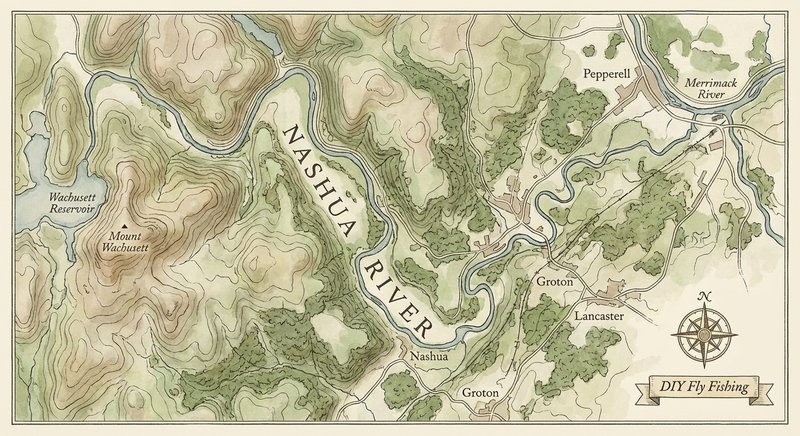
Nashua River
Fly fishing in Massachusetts · Beginner · Best seasons: Spring, Summer, Fall
Target Species
Smallmouth Bass, Northern Pike, Pickerel
About This Water
North-central Massachusetts river with bass and pike. Restoration success.
Fishing Recommendations
The Nashua River is one of the great comeback stories in American conservation. Once notoriously polluted, it has transformed into a premier warm-water fishery that winds through the pastoral landscapes of Central Massachusetts. For the fly angler, it offers a diverse "mixed bag" experience, ranging from technical sight-casting for Smallmouth to the adrenaline-fueled pursuit of Northern Pike.
🎣 Location Overview
The Nashua River is characterized by its dual personality. In some stretches, it mimics a classic New England meadow stream with slow-moving, tea-colored water and heavy lily pad cover—perfect for ambush predators. In other sections, particularly near the confluence of the North and South branches, you’ll find rocky riffles and deeper pools that scream Smallmouth Bass.
What makes it special is the Oxbow National Wildlife Refuge and the surrounding greenways, which provide miles of undeveloped shoreline. This is "low-pressure" fishing compared to the crowded trout streams of the West, offering a wilder feel just an hour from Boston.
🐟 Target Species & Behavior
Smallmouth Bass
The "Bronzebacks" of the Nashua are hard-fighting and abundant. They favor the moving water.
- Behavior: They hold near structure—downed timber, boulders, and bridge abutments. During the heat of summer, they move into the quicker riffles where oxygen levels are higher.
- Feeding: They focus on crayfish and baitfish like shiners and fallfish.
Northern Pike
The Nashua is one of the best Pike rivers in Massachusetts. These are the apex predators of the river.
- Behavior: They are ambush specialists. Look for them in the "slacker" water—weed edges, deep oxbows, and where smaller tributaries enter the main stem.
- Feeding: They are opportunistic, eating anything from large suckers and perch to frogs and even the occasional duckling.
Chain Pickerel
Often the most active species in the river, especially when the water is too cool for bass or too warm for pike.
- Behavior: They thrive in the weeds. If you find lily pads or "cabbage" (submerged weeds), you will find pickerel.
- Feeding: Extremely aggressive toward flashy, fast-moving flies.
📅 Best Times to Fish
- Spring (Late April – June): This is Pike Season. As the water warms, Pike become extremely active pre- and post-spawn. This is also when the largest Smallmouth are caught as they move toward spawning flats.
- Summer (July – August): Prime Smallmouth time. Focus on the early morning or late evening "golden hours" to avoid the midday heat. Topwater action is at its peak during these months.
- Fall (September – October): The "Second Season." As water temperatures drop, Pike and Bass go on a feeding binge to bulk up for winter. The colors on the river are spectacular, and the weed beds begin to die back, making it easier to fish large streamers.
🪰 Recommended Flies & Techniques
For Smallmouth Bass
- Topwater: Sneaky Petes or small Poppers (Size 4-6) in yellow or olive. Fish these with a "twitch-and-pause" retrieve near woody debris.
- Subsurface: Clouser Minnows (Chartreuse/White) and Woolly Buggers (Olive or Black).
- Crayfish Patterns: Near Nuff Craws or claws-up patterns bounced along the bottom of rocky runs.
For Northern Pike & Pickerel
- The "Nashua Special": Large Flashabou Streamers (6–9 inches) in Red/White or Chartreuse/Orange.
- Surface: Dahlberg Divers or large Gamechangers.
- Technique: Use a 8-9 weight rod for Pike to turn over heavy flies. Use a "strip-strip-pause" retrieve. The pause is often when the Pike will commit.
💡 Pro Tips & Local Knowledge
- The "Tailwater" Effect: The South Branch below the Clinton Dam (Wachusett Reservoir) offers cooler water. This area can be a sanctuary for fish during mid-summer heatwaves.
- Paddle vs. Wade: While there are wadeable spots near Groton and Pepperell, the Nashua is best explored by kayak or canoe. A quiet approach allows you to reach the "un-pressured" pockets in the Oxbow NWR that shore anglers can't touch.
- Find the Wood: In the Nashua, "Wood is Good." If you see a submerged log or a fallen tree stretching into the current, spend 10 minutes dissecting it. The biggest Smallmouth in the river are almost always tucked under timber.
- Color Palette: The water has a natural "tannin" (tea) stain. Use flies with gold flash or fluorescent orange/chartreuse accents to help the fish track the fly in lower visibility.
⚠️ Important Information
- Wire Trace is Mandatory: If you are targeting Pike (or even if you aren't, they will find you), you must use a 12–18 inch wire leader or 40-60lb fluorocarbon bite tippet. Their teeth will slice through standard trout leaders instantly.
- Access Points:
- Petapawag Boat Launch (Groton): Excellent for launching a boat or fishing the immediate area.
- Oxbow National Wildlife Refuge (Shirley/Ayer): Great hiking trails with bank access, though some areas are thick with brush.
- Main St. Bridge (Pepperell): Good wading access upstream and downstream.
- Regulations: A standard Massachusetts Freshwater Fishing License is required. Always check the MassWildlife abstracts for seasonal catch-and-release rules, especially regarding Bass during the spring spawn.
- Safety: The river bottom can be silty and soft in some areas. If wading, use a wading staff to test the depth of the mud before committing.
Bug Hatches & Matching Flies
| Hatch | Type | Peak months | Time of day | Hook sizes | Matching flies |
|---|---|---|---|---|---|
| Blue Winged Olive Baetis | mayfly | April, May, September, October | Afternoon | #18-22 | BWO Sparkle Dun #18-22, Pheasant Tail #18-20, RS2 #20-22 |
| Hendrickson Ephemerella subvaria | mayfly | April, May | Afternoon | #12-14 | Red Quill #12-14, Hendrickson Emerger #12-14, Gold Ribbed Hare's Ear #12-14 |
| Tan Caddis Hydropsyche | caddis | May, June, July | Evening | #14-18 | Elk Hair Caddis (Tan) #14-18, LaFontaine's Deep Sparkle Pupa #14-16, Soft Hackle Hare's Ear #14-16 |
| March Brown Maccaffertium vicarium | mayfly | May, June | Afternoon | #10-12 | March Brown American #10-12, Hare's Ear Nymph #10-12 |
| Light Cahill Stenacron / Stenonema | mayfly | June, July | Evening | #12-14 | Light Cahill Dry #12-14, Light Cahill Nymph #12-14 |
| Trico Tricorythodes | mayfly | July, August, September | Morning | #22-26 | Trico Spinner #22-24, Zebra Midge #22-24 |
| Zebra Midge / Chironomids Chironomidae | midge | March, April, October, November | All Day | #18-24 | Griffith's Gnat #18-22, Zebra Midge #18-22 |
| Terrestrials (Ants & Beetles) Formicidae / Coleoptera | terrestrial | July, August, September | Daytime | #14-18 | Black Foam Ant #16-18, Crowe Beetle #14-16 |