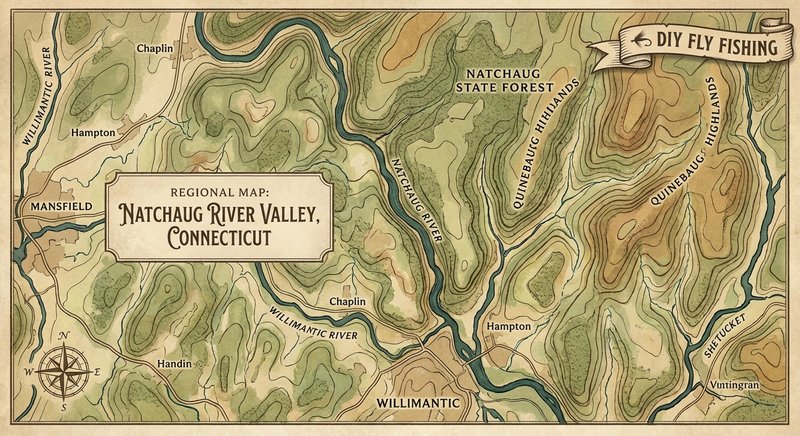
Natchaug River
Fly fishing in Connecticut · Beginner · Best seasons: Spring, Summer, Fall
Target Species
Brown Trout, Brook Trout
About This Water
Eastern Connecticut stream with wild trout. Flows through state forest.
Fishing Recommendations
The Natchaug River is one of Eastern Connecticut’s true gems. As a classic New England freestone stream, it offers a diverse landscape ranging from tumultuous "pocket water" and dramatic waterfalls to long, glassy pools. Flowing through the heart of the Natchaug State Forest, it provides an aesthetic experience that feels much more remote than it actually is.
Here is your comprehensive guide to fly fishing the Natchaug River.
🎣 Location Overview
The Natchaug is formed by the confluence of the Still River and Bigelow Brook in Eastford. It flows south through Chaplin and into Mansfield. What makes this river special is its freestone character—it is entirely dependent on rainfall and snowmelt, meaning its personality changes with the seasons.
Anglers love the Natchaug for its variety. You can fish high-gradient sections with plunging pools and heavy foam lines, or move downstream to find wider, slower water. The stretch within the Natchaug State Forest is particularly beloved for its pristine scenery and the famous "Diana’s Pool," a deep, rocky gorge that holds fish even when other parts of the river warm up.
🐟 Target Species & Behavior
The Natchaug is primarily a stocked fishery, but it has excellent "holdover" potential, and you may find wild brookies in the cooler tributaries.
- Brown Trout: These are the kings of the river. Large holdover browns (16–20 inches) are often found in the deeper, darker holes or tucked under the massive boulders that litter the riverbed. They are predatory and often move into the shallows at dusk to feed.
- Brook Trout: The state stocks high numbers of brookies. They tend to congregate in the faster, oxygenated "bubbly" water at the heads of pools. They are generally more aggressive than browns but can be spooked easily in the crystal-clear water.
- Behavior: During the day, fish hold in the "cushion" in front of or behind large rocks. Because the Natchaug has a rocky bottom, fish are used to looking up for dry flies but spend 90% of their time glued to the bottom eating nymphs.
📅 Best Times to Fish
- Spring (Mid-April – June): This is the "Golden Era" on the Natchaug. Water levels are usually high but manageable, and the primary hatches (Hendricksons and March Browns) occur now.
- Summer (July – August): This river is bottom-fed by small streams and can get warm. During a drought, the water can reach lethal temperatures (above 70°F). Only fish the early mornings, and always carry a thermometer. If the water is 68°F or higher, give the fish a break.
- Fall (September – November): As the water cools, the browns become aggressive before spawning. The foliage in the Natchaug State Forest is spectacular, and the crowds are significantly thinner than in the spring.
- Prime Window: Early morning just as the sun hits the water, or the "magic hour" before sunset when the caddis flies begin to dance.
🪰 Recommended Flies & Techniques
Dry Flies
- Spring: Hendrickson (Light & Dark) #12-14, Blue Winged Olive #16-18.
- Summer: Elk Hair Caddis (Tan) #14-16, Stimulators (Orange/Yellow) #12-14 (great for the rougher pocket water).
- Fall: Isonychia #10-12, Terrestrials (Ants and Beetles) #16.
Nymphs (The most consistent producers)
- Pheasant Tail Nymph #14-18: Mimics almost everything.
- Frenchie or Perdigon #14-16: Use these in the fast pocket water; they sink fast and reach the "strike zone" quickly.
- Prince Nymph #12-14: Excellent for the stocked brook trout.
Streamers
- Woolly Bugger (Black or Olive) #6-10: A staple. Swing these through the deep holes at Diana’s Pool.
- Muddler Minnow: Great for mimicking the sculpins found under the rocks.
Technique Tip: Tight-Line Nymphing
Because the Natchaug is so rocky, traditional indicator nymphing can be frustrating as your fly gets hung up constantly. Euro-nymphing or tight-line nymphing is highly effective here. It allows you to guide the fly through the narrow "slots" between boulders where the big browns sit.
💡 Pro Tips & Local Knowledge
- Focus on the TMA: The Trout Management Area (TMA) runs from the intermediate dam at the Natchaug State Forest boundary downstream to the bridge on Route 6. This area has special regulations designed to keep fish in the water longer.
- The "Pocket Water" Secret: Many anglers walk right past the shallow, rocky "riffles" to get to the big pools. Some of the biggest fish live in water only 12-18 inches deep, hidden behind a single basketball-sized rock.
- Stealth is Key: The Natchaug can run very clear. Avoid "lining" the fish (casting your fly line directly over their heads). Use a long leader (9ft to 12ft) and stay low to the bank.
- Wading Safety: The rocks here are notoriously slippery ("Greased Bowling Balls"). Use felt-soled boots or studs, and a wading staff is highly recommended, especially near Diana's Pool.
⚠️ Important Information
- Access: Route 198 runs parallel to much of the river. There are numerous pull-offs within the Natchaug State Forest. The "Iron Bridge" area is a popular and productive starting point.
- Regulations:
- TMA Section: Generally Catch and Release only from Oct 1 to mid-April.
- License: You must have a valid Connecticut Fishing License and a Trout & Salmon Stamp.
- Always check the CT DEEP Interactive Fishing Map for the most up-to-date stocking reports and boundary lines.
- Leave No Trace: This is a state forest. Please pack out all spent tippet and trash to keep this watershed pristine.
Guide’s Final Word: The Natchaug is a "moody" river. One day it fishes like a dream, and the next it requires every trick in your bag. Stick with it, focus on your drift, and the river will eventually reward you with a stunning New England trout.
Bug Hatches & Matching Flies
| Hatch | Type | Peak months | Time of day | Hook sizes | Matching flies |
|---|---|---|---|---|---|
| Hendrickson Ephemerella subvaria | mayfly | April, May | Afternoon | #12-14 | Red Quill #12-14, Hendrickson Emerger #12-14, Pheasant Tail #12-14 |
| Blue-Winged Olive Baetis / Pseudocloeon | mayfly | April, May, September, October | Late Morning/Afternoon | #18-24 | RS2 #20-22, Blue-Winged Olive Sparkle Dun #18-22, WD-40 #20-24 |
| Grannom Caddis Brachycentrus | caddis | April, May | Morning/Afternoon | #14-16 | Elk Hair Caddis (Olive) #14-16, Pupa (Green/Olive) #14-16, LaFontaine Sparkle Pupa #14-16 |
| Sulfur Ephemerella invaria / dorothea | mayfly | May, June | Evening | #14-18 | Sulfur Parachute #14-18, Sulfur Spinner #16-18, Hare's Ear (Yellow) #14-16 |
| Light Cahill Stenacron / Stenonema | mayfly | June, July | Late Afternoon/Evening | #12-14 | Light Cahill #12-14, Gold Ribbed Hare's Ear #12-14 |
| March Brown Maccaffertium vicarium | mayfly | May, June | Afternoon | #10-12 | March Brown American #10-12, March Brown Wet Fly #10-12, Gold Ribbed Hare's Ear #10-12 |
| Cinnamon Caddis Hydropsyche | caddis | June, July, August | Evening | #14-18 | Elk Hair Caddis (Tan) #14-18, Z-Lon Caddis #16-18 |
| Terrestrials (Ants and Beetles) Formicidae / Coleoptera | terrestrial | July, August, September | All Day | #12-20 | Black Foam Ant #16-20, Cinnamon Ant #14-18, Crowe Beetle #12-16 |
| Zebra Midge Chironomidae | midge | January, February, March, November, December | All Day | #18-24 | Zebra Midge (Black/Silver) #18-22, Griffith's Gnat #18-22 |