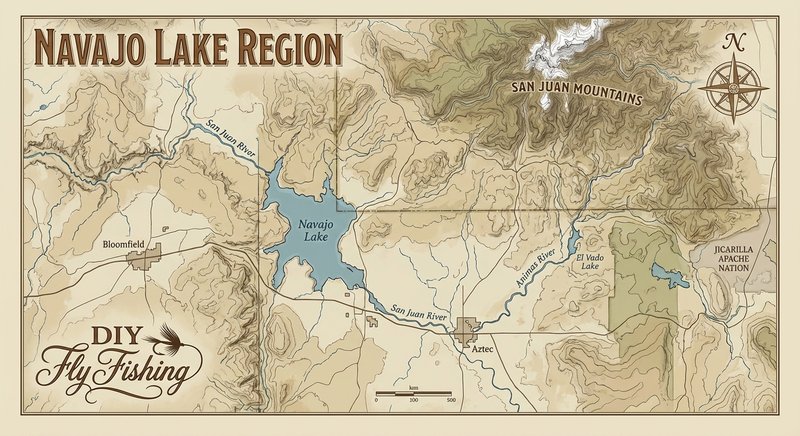
Navajo Lake
Fly fishing in New Mexico · Beginner · Best seasons: Spring, Summer, Fall
Target Species
Largemouth Bass, Smallmouth Bass, Northern Pike, Rainbow Trout
About This Water
Large reservoir above the San Juan tailwater. Excellent bass, pike, and trout fishing.
Fishing Recommendations
Navajo Lake is a premier "high desert" fishery located in the northwestern corner of New Mexico. While most fly anglers associate this area with the world-famous "Quality Waters" of the San Juan River below the dam, the reservoir itself is a sleeper hit for fly rod enthusiasts.
As your guide, I’m here to tell you that Navajo Lake offers a rare "grand slam" opportunity: the chance to catch cold-water trout and warm-water apex predators like Pike and Smallmouth in the same day, often off the same point.
🎣 Location Overview
Navajo Lake is a massive, deep-water impoundment characterized by sheer sandstone cliffs, deep canyons, and expansive rocky points. It is the second-largest lake in New Mexico. What makes it special is the thermal stratification. The deep, cold depths support a healthy population of Rainbow and Brown trout, while the sun-warmed coves and rocky shorelines create an ideal habitat for Smallmouth Bass and Northern Pike.
The water clarity is often exceptional (visibility up to 15–20 feet), making it a visual game. Anglers love it because it offers a "Western Lake Powell" vibe but with a much higher density of Northern Pike and a cooler climate.
🐟 Target Species & Behavior
- Smallmouth Bass: The "workhorse" of the lake. They hold on rocky ledges, submerged boulders, and steep drop-offs. They feed heavily on crawfish and various minnows (shad).
- Northern Pike: The "water wolves" of Navajo. They are found in the shallower, weedy backs of coves (like Miller Canyon or Francis Canyon). They are ambush predators, often holding near submerged brush or the edge of weed beds.
- Largemouth Bass: Less common than Smallmouth but larger. They prefer the "wood"—submerged cedar trees and brush piles in the backs of canyons.
- Rainbow Trout: These are often found near the dam or "cruising" the main lake points. In the spring and fall, they move into the upper layers of the water column to feed on midge hatches and terrestrial insects.
📅 Best Times to Fish
- Spring (April – June): Prime Time. As the water warms to 50–55°F, Pike move into the shallows to spawn, followed shortly by the Smallmouth. This is the best window for catching a trophy Pike on a fly.
- Summer (July – August): Focus on the early morning (first light) and late evening. Smallmouth will be active on the surface. During the heat of the day, fish move deep (20–40 feet), making fly fishing more difficult.
- Fall (September – November): The "Second Spring." As water temperatures drop, fish move back into the shallows to gorge before winter. The trout fishing near the surface improves significantly during this window.
🪰 Recommended Flies & Techniques
For Smallmouth & Largemouth Bass
- Technique: "Stair-stepping" flies down rocky ledges. Use a sink-tip line to get the fly to the 10–15 foot zone.
- Patterns:
- Clouser Minnow (Chartreuse/White or Olive/White) - Size 2-4.
- Near Nuff Crawfish - Size 4.
- Poppers/BoogleBugs - Early morning surface action in the backs of coves.
For Northern Pike
- Technique: High-speed strips with pauses. Use an 8-weight or 9-weight rod with a wire tippet (essential).
- Patterns:
- Barry’s Pike Fly (Red/White or Black/Orange).
- Game Changers (Large, 6–8 inches) in white or yellow.
- EP Toads in bright colors.
For Rainbow Trout
- Technique: Indicator nymphing from a boat near rocky points or "stripping" small streamers.
- Patterns:
- Balanced Leeches (Olive or Maroon) under an indicator.
- Wooly Buggers (Size 8-10) in White or Thin Mint.
💡 Pro Tips & Local Knowledge
- Follow the Wind: On Navajo, the wind often blows baitfish into specific coves. If you find a wind-swept point with "muds" (disturbed water), the Smallmouth and Pike will likely be there waiting for an easy meal.
- The "San Juan Arm" vs. "Pine Arm": The Pine Arm tends to stay clearer, while the San Juan Arm can get turbid after rains. If the water is murky, switch to high-vibration flies (rattles) or dark silhouettes (black/purple).
- The Drop-Off Rule: If you aren't getting hits, move deeper. Navajo is deep. Sometimes the fish are suspended at 25 feet over 80 feet of water. Use a Type 5 or Type 7 sinking line to reach them.
- Shadow Lines: In the heat of summer, Smallmouth will often tuck right against the shadows of the high sandstone cliffs. Cast your fly literally inches from the rock wall.
⚠️ Important Information
- Access: The main access points are Simms Marina (south side) and Navajo Dam Marina (north side). A boat (motorized or a very sturdy kayak) is highly recommended due to the lake's size and potential for high winds.
- Regulations: A New Mexico fishing license is required. If you cross into the northern section of the lake, you enter Colorado waters; a Colorado license is required to fish that portion. Check the boundary markers carefully!
- Safety: The wind can kick up 3-foot swells on this lake in minutes. Always check the weather forecast and have a life jacket accessible.
- Permits: There is a daily vehicle/entrance fee for the Navajo Lake State Park unless you have an annual pass.
Guide’s Final Thought: Don't just fish the San Juan River! Spend a day on the lake with an 8-weight rod and a big streamer. When a 35-inch Northern Pike explodes on your fly in crystal clear water, you'll understand why Navajo Lake is a hidden gem.
Bug Hatches & Matching Flies
| Hatch | Type | Peak months | Time of day | Hook sizes | Matching flies |
|---|---|---|---|---|---|
| Midges Chironomidae | midge | January, February, March, December | All Day | #20-26 | Griffith's Gnat #20-24, Morgan's Midge #22-26, Zebra Midge #20-24 |
| Blue Winged Olive (BWO) Baetis | mayfly | March, April, October, November | Late Morning/Afternoon | #18-24 | RS2 #20-24, Parachute Adams #18-22, Pheasant Tail #18-22 |
| Pale Morning Dun (PMD) Ephemerella | mayfly | June, July, August | Late Morning | #16-20 | PMD Sparkle Dun #16-20, Pale Morning Dun Emerger #18-20, Military Mayfly #18-20 |
| Spotted Sedge Hydropsyche | caddis | July, August, September | Evening | #14-18 | Elk Hair Caddis #14-18, LaFontaine's Deep Sparkle Pupa #16-18, Caddis Variant #16 |
| Cicada Magicicada/Tibicen | terrestrial | June, July | Afternoon | #6-10 | Black Foam Cicada #8-10, Project Cicada #6-8 |
| Trico Tricorythodes | mayfly | August, September | Early Morning | #22-26 | Trico Spinner #22-26, Sunken Trico #22-24 |
| Carpenter Ants Camponotus | terrestrial | July, August, September | Afternoon | #12-18 | Chernobyl Ant #12-16, Fur Ant #16-18 |
| Grasshoppers Acrididae | terrestrial | August, September | Midday/Afternoon | #8-12 | Hopper Juan #10-12, Dave's Hopper #8-12 |