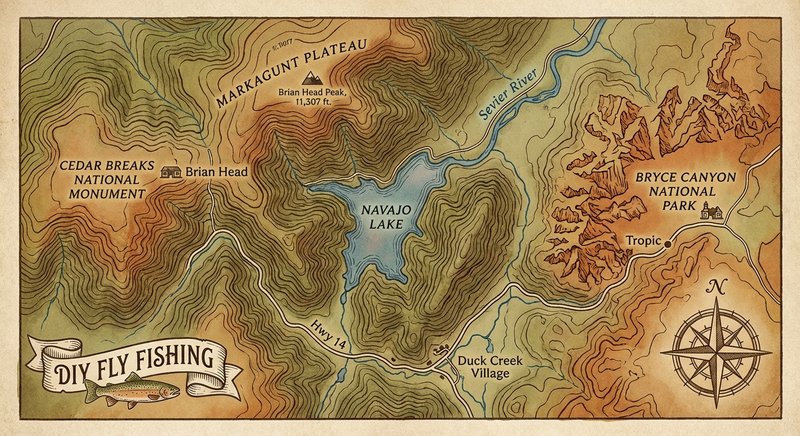
Navajo Lake
Fly fishing in Utah · Beginner · Best seasons: Summer, Fall
Target Species
Rainbow Trout, Splake, Brook Trout
About This Water
High mountain lake near Cedar Breaks. Rainbow and splake fishing.
Fishing Recommendations
Welcome to the high-country jewel of Southern Utah. As a guide who has spent years traversing the Brian Head and Duck Creek areas, I can tell you that Navajo Lake is one of the most unique stillwater fisheries in the West.
Sitting at over 9,000 feet in the Dixie National Forest, this lake is characterized by its volcanic geology and its "vanishing" nature—it has no surface outlet, instead draining through subterranean lava tubes (sinkholes) that eventually feed Cascade Falls.
Here is your comprehensive guide to fly fishing Navajo Lake.
🎣 Location Overview
Navajo Lake is a natural alpine lake formed by an ancient lava flow that dammed the valley. It is roughly 1.5 miles long and relatively shallow, which allows for prolific weed growth and massive insect hatches.
What makes it special is the clarity of the water and the dramatic backdrop of pink limestone cliffs and deep green conifers. For the fly angler, it offers a "big fish" feel in an intimate setting. Because it is shallow and nutrient-rich, the fish grow fast and fight hard. It is a premier destination for those looking to cross a "Splake" off their bucket list in a stunning high-altitude environment.
🐟 Target Species & Behavior
- Rainbow Trout: These are the most common residents. They cruise the shoreline in the early morning looking for midges and scuds. They are often found near the boat ramps and the dike on the east end.
- Splake (Lake Trout x Brook Trout hybrid): This is the "crown jewel" of Navajo. Splake behave like a mix of both parents; they love deep, cool water but will move into the shallows to hunt baitfish. They are aggressive predators and the primary reason to throw streamers here.
- Brook Trout: Found mostly near the cooler spring-fed inflows and the rocky northern shoreline. They are gorgeous, vibrant, and particularly active during the fall spawn.
Behavioral Note: Because the lake is shallow, fish are very sensitive to overhead movement and shadows. Stealth is your best friend here.
📅 Best Times to Fish
Seasons
- Summer (Late June – August): This is prime time for dry fly action and midging. The water is warm enough for high metabolic activity but cool enough for the fish to remain active throughout the day.
- Fall (September – October): My personal favorite. As the water cools, the Splake and Brookies move into the shallows to prepare for spawning. This is when you’ll catch the largest fish of the year on streamers. The quaking aspens turning gold add to the experience.
Time of Day
- First Light to 10:00 AM: The lake is usually glass-calm. Look for rising fish and cruise the banks.
- The "Magic Hour": The last 90 minutes before sunset. The wind usually dies down, and the midge hatches can be massive.
🪰 Recommended Flies & Techniques
The Stealth Nymph Rig (Mid-Column)
Since the lake is shallow and weedy, a standard "indicator" rig can sometimes spook fish. Try a "Nymph under Dry" or a very small, clear intermediate sink line.
- Flies: Zebra Midges (#18-22) in red or black, Chan’s Las Vegas Midges, and Scud patterns (#14-16) in olive or orange.
- Technique: Slow, rhythmic "figure-eight" retrieves with a midge or scud pattern just above the weed beds.
Streamer Stripping (For Splake)
- Flies: Olive or Black Woolly Buggers (#6-10), Pine Squirrel Leeches, and thin-profile baitfish patterns like the Balanced Leech.
- Technique: Use a sinking tip line. Cast toward the drop-offs or submerged lava rocks. Use an erratic "strip-strip-pause" retrieve. The pause is often when the Splake will hammer the fly.
Dry Fly Action
- Flies: Parachute Adams (#14-18), Elk Hair Caddis (#14-16), and Griffith’s Gnat (#18-20).
- Technique: Target "rings" on the water. Cast well ahead of a cruising fish's path rather than directly on top of it.
💡 Pro Tips & Local Knowledge
- Work the "Sinkholes": On the eastern end of the lake, there are visible depressions where water drains into the underground aquifer. These areas often create subtle currents that concentrate food. Fish these edges heavily.
- The Lava Rocks: The northern shore is lined with volcanic basalt. This rock holds heat and provides excellent structure for crayfish and leeches. If you want a trophy Splake, focus on the rocky drop-offs rather than the muddy flats.
- The "Navajo Twitch": When using midges under a buoy, don't just let them sit. Give your rod tip a tiny flick every 30 seconds. In the still water of Navajo, that slight vertical movement often triggers a strike from a curious Rainbow.
- Float Tubes/Kayaks: While you can fish from the bank, a float tube is a massive advantage here. It allows you to stay off the sensitive shoreline and fish the "outside" edge of the weed beds.
⚠️ Important Information
- Access: Located about 45 minutes from Cedar City via UT-14. There is a well-maintained loop road around the lake with several parking areas and campgrounds.
- Regulations: Navajo Lake falls under general Utah fishing regulations, but always check the current Utah Fishing Guidebook for seasonal changes or limit adjustments.
- Weather: At 9,000 feet, weather changes in minutes. Even in July, bring a rain shell and a warm layer. Afternoon thunderstorms are common and can produce dangerous lightning; if the clouds build up, get off the water immediately.
- Water Levels: Because of the sinkholes, Navajo Lake can drop significantly by late autumn in drought years. Check local reports (like the Duck Creek Village local shops) before heading up in October.
Guide’s Final Word: Navajo is a thinking angler's lake. Don't just chuck and chance it. Watch the water, identify the cruising lanes, and match the size of the midges. If you find the rhythm, the Splake here will give you a fight you won't soon forget.
Bug Hatches & Matching Flies
| Hatch | Type | Peak months | Time of day | Hook sizes | Matching flies |
|---|---|---|---|---|---|
| Chironomids (Midges) Chironomidae | midge | June, July, August | All Day | #14-22 | Zebra Midge #16-20, Ice Bud Midge #14-18, Griffith's Gnat #18-22 |
| Callibaetis (Speckled Duns) Callibaetis nigritus | mayfly | June, July, August | Morning/Afternoon | #12-16 | Parachute Adams #14-16, Callibaetis Nymph #12-16, Quigley Cripple #14-16 |
| Damselfly Enallagma | other | July, August | Afternoon | #10-14 | Marabou Damsel Nymph #10-12, Adult Damsel #12-14 |
| Cinnamon Caddis Hydropsyche | caddis | July, August | Evening | #14-18 | Elk Hair Caddis #14-16, LaFontaine's Deep Sparkle Pupa #14-18 |
| Terrestrials (Ants and Beetles) Formicidae/Coleoptera | terrestrial | August, September | Afternoon | #12-18 | Black Foam Ant #14-18, Chernobyl Ant #10-14, Peacock Beetle #14-16 |
| Water Boatmen Corixidae | other | September, October | All Day | #14-18 | Water Boatman #14-16, Prince Nymph (Small) #16-18 |
| Dragonfly Anisoptera | other | June, July, August | Afternoon | #4-10 | Dragonfly Nymph #6-10, Woolly Bugger (Olive) #6-10 |
| Scuds (Freshwater Shrimp) Gammarus | other | June, September | All Day | #12-18 | Ray Charles #14-18, Scud (Olive or Orange) #12-16 |