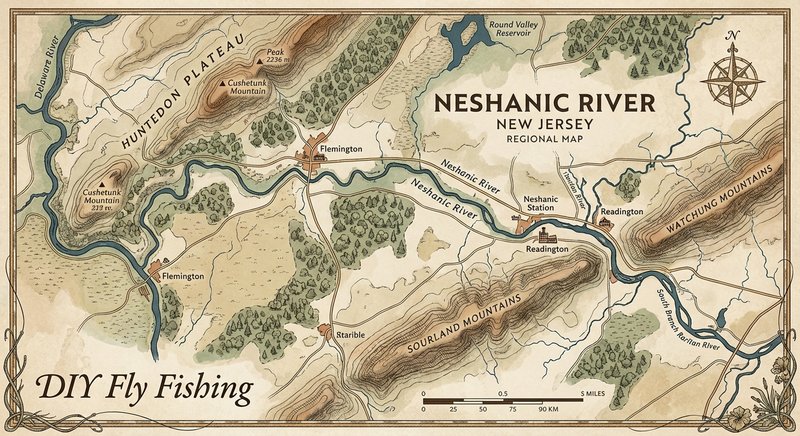
Neshanic River
Fly fishing in New Jersey · beginner · Best seasons: spring
Target Species
Rainbow Trout, Brown Trout
About This Water
Somerset County tributary with spring trout stocking. Accessible through county parks.
Fishing Recommendations
The Neshanic River in Hunterdon County, New Jersey, is a hidden gem for anglers who prefer a quieter, more intimate experience compared to the high-traffic waters of the nearby South Branch of the Raritan. While it is often overshadowed by its larger neighbors, the Neshanic offers productive spring trout fishing in a pastoral, low-gradient setting.
🎣 Location Overview
The Neshanic River is a meandering, low-gradient tributary of the South Branch of the Raritan River. Unlike the rocky, bouldery pocket water of the Musconetcong, the Neshanic flows through agricultural lands and suburban fringes, resulting in a substrate dominated by gravel, sand, and silt.
What makes this water special is its "sleeper" status. It is a designated trout-stocked water, but because it is smaller and slower, it attracts fewer crowds than the "big name" NJ rivers. Anglers love it for its undercut banks, deep woody pools, and the challenge of navigating its tighter corridors. It feels like true "small stream" fishing despite being in a well-developed part of the state.
🐟 Target Species & Behavior
The Neshanic is primarily a Rainbow and Brown Trout fishery during the spring.
- Rainbow Trout: These are the primary stockies. In the Neshanic’s slower current, they tend to pod up in the deeper holes and near bridge abutments. They are aggressive early in the season and will move into swifter water as the weather warms.
- Brown Trout: You will find both stocked browns and the occasional "holdover." Browns here are notorious for hugging the undercut banks and hiding under fallen logs. They are more selective and nocturnal than the rainbows.
- Feeding Habits: Early spring fish rely on midge larvae and aquatic worms. As the water hits the 50°F mark, they look for Mayflies (Hendricksons) and Caddis.
📅 Best Times to Fish
The Neshanic is a seasonal fishery. Because it is a low-elevation, slow-moving stream, it warms up significantly in the summer.
- Optimal Season: April through late May. This is the "Golden Window."
- Best Months:
- April: Peak stocking month; fish are plentiful but can be "pellet-focused."
- May: Best for matching the hatch; water temperatures are ideal (55–62°F).
- Time of Day:
- Early Spring: Midday is best as the sun warms the water and triggers insect activity.
- Late Spring: Early morning and the hour before dusk (the "magic hour") are most productive.
- Conditions: Fish 2–3 days after a rain once the water has cleared to a "tannin" or "green" tint. The Neshanic can get muddy quickly, but a little turbidity actually helps hide your approach.
🪰 Recommended Flies & Techniques
Top Fly Patterns
- Nymphs:
- Bead-head Pheasant Tail (#14-18): A classic that mimics many local mayflies.
- Zebra Midge (#18-22): Essential for picky fish in the slow pools.
- Sexy Walt’s Worm (#14-16): Highly effective in the Neshanic’s silty bottom.
- Dry Flies:
- Adams or Parachute Adams (#14-18): The best general attractor.
- Elk Hair Caddis (#14-16): Great for the evening "skitter" hatches in May.
- Streamers:
- Woolly Bugger (Olive or Black, #8-12): Dead-drifted or slowly pulsed through deep holes.
Techniques & Presentation
- High-Stick Nymphing: Since the river is narrow, you don't need long casts. A short-line nymphing approach with a small strike indicator is the most effective way to probe the deep pockets.
- The "Slow Swing": In the slower stretches, cast a streamer or wet fly toward the opposite bank and let it swing slowly across the current. This often triggers a strike from a territorial Brown Trout.
- Stealth Approach: Because the water is slow, trout are spookier here than in turbulent water. Stay low, wear drab clothing, and avoid splashing.
💡 Pro Tips & Local Knowledge
- Focus on the Woody Debris: In the Neshanic, "wood is good." Look for fallen trees or log jams. These create scour holes that hold the largest fish in the river.
- The Bridge Strategy: Access is often found near bridges. While most people fish right under the bridge, walk 200 yards upstream or downstream to find "fresh" fish that haven't seen a lure all day.
- Go Small on Tippet: The slow current gives fish a long time to look at your fly. Use 5X or 6X fluorocarbon tippet to increase your hook-up rate.
- Check the Golf Course: Areas near the Neshanic Valley Golf Course offer some of the most consistent water, but always ensure you are within the public fishing easements.
⚠️ Important Information
- Access: Much of the river runs through private property. Focus on the sections near Neshanic Station and the county park lands. Always look for "Fishing Permitted" signs or NJ Fish & Wildlife stocking markers.
- Regulations: The Neshanic is a Trout Stocked Water. You must have a valid NJ Fishing License and a Trout Stamp.
- Seasonal Closures: Be aware of the pre-season stocking closures (usually the three weeks leading up to the April opener) when fishing is prohibited. Check the NJ Division of Fish & Wildlife website for the exact "Opening Day" date.
- Wading Safety: The bottom can be very silty and "sticky." Watch your step to avoid getting a boot stuck in deep mud, and be cautious of steep, eroding banks.
Guide’s Final Word: The Neshanic is a "finesse" river. Bring your 3-weight or 4-weight rod, move slowly, and enjoy the pastoral beauty of Hunterdon County. It’s the perfect place for a quiet morning of technical small-stream fly fishing.
Bug Hatches & Matching Flies
| Hatch | Type | Peak months | Time of day | Hook sizes | Matching flies |
|---|---|---|---|---|---|
| Blue Winged Olive Baetis spp. | mayfly | March, April, October, November | Mid-day | #18-22 | RS2 #18-22, Parachute Adams #18-22, Pheasant Tail Nymph #18-20 |
| Hendrickson Ephemerella subvaria | mayfly | April, May | Afternoon | #12-14 | Red Quill #12-14, Hendrickson Emerger #12-14, Gold Ribbed Hare's Ear #12-14 |
| Grannom Caddis Brachycentrus spp. | caddis | April | Late Morning/Afternoon | #14-16 | Elk Hair Caddis (Dark) #14-16, Deep Sparkle Pupa #14-16, Peacock Caddis #16 |
| Sulphur Ephemerella invaria | mayfly | May, June | Evening | #14-18 | Sulphur Parachute #14-18, Sulphur Snowshoe Emerger #16-18, Sulphur Nymph #14-16 |
| Tan Caddis Hydropsyche spp. | caddis | May, June, July, August | Evening | #14-16 | Elk Hair Caddis (Tan) #14-16, LaFontaine's Emergent Sparkle Pupa #14-16, Pulsating Caddis Pupa #14-16 |
| Light Cahill Stenacron interpunctatum | mayfly | June, July | Evening | #12-14 | Light Cahill Dry #12-14, Cream Usual #14, Gold Ribbed Hare's Ear (Light) #12-14 |
| Midges Chironomidae | midge | January, February, March, December | Anytime | #20-24 | Zebra Midge #20-22, Griffith's Gnat #20-24, Palomino Midge #22 |
| Terrestrials (Ants/Beetles) Formicidae / Coleoptera | terrestrial | July, August, September | Daytime | #12-18 | Black Foam Ant #14-18, Cinnamon Ant #16-18, Foam Beetle #12-16 |