New River
Fly fishing in North Carolina · Beginner · Best seasons: Spring, Summer, Fall
Target Species
Smallmouth Bass, Musky, Rainbow Trout
About This Water
Ancient river with excellent smallmouth bass. Some trout in upper reaches.
Fishing Recommendations
The New River in North Carolina is a geological anomaly and a fly fisher’s paradise. Often cited as one of the oldest rivers in the world, it is unique because it flows north through the Blue Ridge Mountains. For the fly angler, it offers a rare "triple threat": technical trout fishing in the headwaters, world-class smallmouth bass in the middle stretches, and the chance at a prehistoric river monster—the Muskellunge—throughout.
🎣 Location Overview
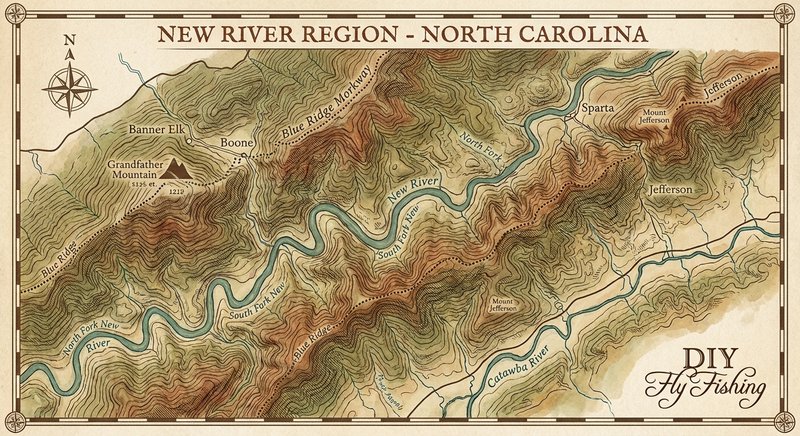
The New River is divided primarily into the North Fork, the South Fork, and the Main Stem.
- The South Fork: The most popular stretch, winding through Watauga and Ashe Counties. It’s characterized by long, glassy pools, dramatic rock ledges, and gentle riffles.
- The North Fork: Slimmer, more rugged, and slightly cooler.
- The Character: This is a "ledge" river. The geology creates underwater shelves that act as perfect ambush points. It is a prime river for float trips (drift boats or rafts) but offers excellent wade access through New River State Park and various bridge crossings.
🐟 Target Species & Behavior
Smallmouth Bass (The Star)
The "Bronzeback" is the primary draw. New River smallies are exceptionally hardy.
- Behavior: They hold behind rock ledges, in "push water" just above a drop-off, and in the "tail-outs" of pools during low light.
- Feeding: Their diet is heavy on crayfish and hellgrammites (dobsonfly larvae), but they will look up for a popper in a heartbeat.
Muskellunge (The Ghost)
The New River is one of the premier southern Musky fisheries.
- Behavior: Apex predators that hold in deep, slow-moving holes, often near sunken timber or large boulders.
- Feeding: They eat whatever they want—suckers, smallmouth, even ducklings. They are ambush predators that require heavy gear and extreme persistence.
Rainbow Trout
Found mostly in the upper South Fork and the various tributaries.
- Behavior: The NC Wildlife Resources Commission manages several sections as Delayed Harvest (DH). These fish hold in the faster oxygenated riffles and deeper runs.
- Feeding: They are susceptible to standard nymphing rigs and opportunistic dry fly rises during the spring hatches.
📅 Best Times to Fish
- Spring (March – May):
- Focus: Rainbow Trout and Musky.
- The Delayed Harvest trout sections are fishing at their peak. For Musky, the pre-spawn window in early spring is when some of the largest fish are moved.
- Summer (June – August):
- Focus: Smallmouth Bass.
- This is the "Golden Era" for topwater. Low-light mornings and evenings are best. During the heat of the day, fish deep with crayfish patterns.
- Fall (September – November):
- Focus: Large Smallmouth and Musky.
- As water temperatures drop, Smallmouth gorge before winter. October is arguably the best month for "numbers" and "size" combined. Musky activity spikes as they prepare for the cold months.
🪰 Recommended Flies & Techniques
For Smallmouth Bass
- Topwater: BoogleBugs (size 4), Stealth Bombers, and Sneaky Petes. Use a "pop-and-pause" retrieve.
- Sub-surface: Gamechangers (white/chartreuse), Clouser Minnows, and Near Nuff Crayfish.
- Technique: "Swing" your streamers through the current seams or dead-drift a hellgrammite pattern under an indicator if the bite is slow.
For Musky
- Flies: Massive 8–12 inch articulated streamers (Gamechangers, T-Bones) in black/orange, white, or "sucker" colors.
- Technique: Use 10-12wt rods with sinking lines. Crucial: Always perform a "Figure-8" at the end of every cast—Musky often follow the fly to the boat and strike at the last second.
For Rainbow Trout
- Nymphs: Prince Nymphs, Pheasant Tails, and Sexy Walt’s Worms (size 12-16).
- Dry Flies: Parachute Adams, Elk Hair Caddis, and Yellow Stimulators.
- Technique: High-stick nymphing through the pocket water or "indicator nymphing" in the deeper DH runs.
💡 Pro Tips & Local Knowledge
- Fish the Ledges: New River smallies love to sit under the lip of the rock ledges. Cast your fly upstream of the ledge and let it tumble over the edge—be ready for the strike the moment it drops.
- Wet Wading: In the summer, forget the waders. The New is perfect for wet wading with felt-soled boots (the rocks are incredibly slick).
- The "Slow" Retrieve: For Musky, sometimes a slower, erratic "dying fish" retrieve works better than a fast strip.
- South Fork Focus: If you are new to the river, focus on the stretch between Jefferson and the Virginia state line. This area has the most consistent water volume and fish density.
⚠️ Important Information
- Access: Use the New River State Park access points (Wagoner Access, US 221 Access). They offer easy boat ramps and designated wading areas.
- Regulations:
- Check the NCWRC website for current trout regulations.
- Delayed Harvest rules: Catch and Release only from Oct 1st to the first Saturday in June (no bait allowed).
- Safety: The New is generally a gentle river, but it can rise rapidly after heavy rains in the mountains. Check the USGS gauges (Jefferson or Galax) before heading out. A flow of 400–800 cfs at the Jefferson gauge is ideal for floating.
- Licensing: You need a standard NC Inland Fishing License. If fishing the DH sections in the spring, ensure you have the Trout privilege.
The New River is a place where you can catch a 50-fish day of smallmouth or grind for 10 hours for one legendary Musky. Respect the water, watch the weather, and enjoy one of the most ancient landscapes in America.
Bug Hatches & Matching Flies
| Hatch | Type | Peak months | Time of day | Hook sizes | Matching flies |
|---|---|---|---|---|---|
| Golden Stonefly Acroneria abbreviata | stonefly | May, June | Late Afternoon/Evening | #6-10 | Pat's Rubber Legs #6-8, Stimulator (Yellow) #8-10 |
| White Miller Nectopsyche | caddis | July, August | Evening/Dusk | #12-14 | White Miller Caddis #12-14, White Elk Hair Caddis #12-14 |
| Hellgrammite (Dobsonfly) Corydalus cornutus | terrestrial | June, July | Night/Low Light | #2-6 | Murray's Hellgrammite #4-6, Critter Mite #2-6 |
| Blue Winged Olive (BWO) Baetis | mayfly | March, April, October, November | Midday/Overcast | #18-22 | RS2 #20-22, Parachute Adams #18-22 |
| Trico Tricorythodes | mayfly | August, September | Early Morning | #20-24 | Trico Spinner #22-24, Sunken Trico #22-24 |
| Sulphur Ephemerella invaria | mayfly | May, June | Late Afternoon/Evening | #14-16 | Sulphur Parachute #14-16, Pheasant Tail Nymph #14-16 |
| Tan Caddis Hydropsyche | caddis | May, September | All Day/Evening | #14-18 | Elk Hair Caddis (Tan) #14-16, Holy Grail Caddis #14-18 |
| Terrestrials (Ants/Beetles) Formicidae/Coleoptera | terrestrial | July, August, September | Midday | #10-16 | Chernobyl Ant #8-12, Foam Beetle #12-16 |