Niantic River
Fly fishing in Connecticut · Beginner · Best seasons: Spring, Summer, Fall
Target Species
Striped Bass, Bluefish, Scup
About This Water
New London County estuary with striped bass. East Lyme area.
Fishing Recommendations
Welcome to the Niantic River, one of Connecticut’s most productive tidal estuaries. As your guide, I can tell you that while we call it a "river," it is technically a tidal embayment. This distinction is vital because the Niantic functions as a giant nursery and a buffet line for saltwater predators. It offers a unique mix of shallow-water sight fishing, high-current bridge fishing, and classic estuary salt-marsh tactics.
🎣 Location Overview
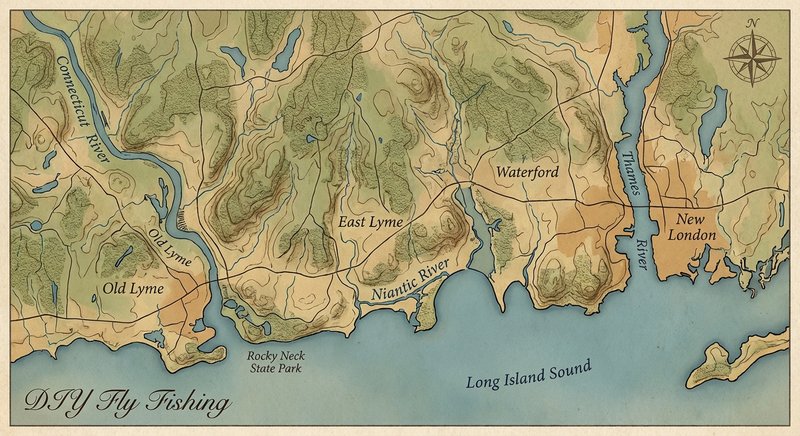
The Niantic River is a six-mile-long estuary separating the towns of East Lyme and Waterford. It is characterized by a narrow, high-velocity inlet at its mouth (under the Niantic-Waterford bridge) that opens into a wide, shallow basin filled with eelgrass beds, sand flats, and salt marshes.
What makes this water special is its diversity. You can be casting into 20 feet of churning water at the bridge for "cows" (large Striped Bass) in the morning, and by noon, you can be poling a skiff or wading a quiet flat in the upper "Golden Spur" section for cruising fish in two feet of water. It is one of the best places in New England to experience a "southern style" flats fishing vibe.
🐟 Target Species & Behavior
Striped Bass (Rockfish)
The star of the show. The Niantic holds "holdover" bass year-round in its deeper holes, but the migratory fish arrive in May.
- Behavior: They are ambush predators. In the lower river, they sit behind bridge pilings or rock groins waiting for the tide to sweep bait to them. On the upper flats, they cruise like bonefish, looking for crabs and shrimp.
- Feed: Silversides, mummichogs (killifish), sand eels, and the famous springtime cinder worms.
Bluefish (Yellow-eyed Devils)
Available from late spring through fall.
- Behavior: Aggressive and competitive. They often follow the "bunker" (Atlantic Menhaden) into the river. Look for "blitzes" where the water looks like it's boiling.
- Feed: Anything that moves. They focus heavily on peanut bunker (juvenile menhaden) in the late summer.
Scup (Porgy)
Often overlooked by fly anglers, but pound-for-pound a great fight on light tackle.
- Behavior: Schooling fish that hang around structure—bridge pilings, rocky bottoms, and docks.
- Feed: Small crustaceans and worms.
📅 Best Times to Fish
- Spring (May - June): This is the Prime Window. The water warms faster than the open Sound, drawing in the first migratory bass. This is also when the Cinder Worm Hatch occurs (usually around the new and full moons in late May/early June), leading to world-class surface feeding.
- Summer (July - August): Transition to low-light hours. Fishing is best at night or at the crack of dawn. Big bass move to the cooler, oxygenated water near the bridge or the deeper channels.
- Fall (September - October): The "Fall Run." As bait moves out of the marshes, the river mouth becomes a gauntlet. This is the best time for Bluefish and aggressive Stripers.
- Tides: The outgoing tide is generally the most productive, especially at the mouth, as it flushes bait out of the estuary into the waiting mouths of predators.
🪰 Recommended Flies & Techniques
Top Fly Patterns
- Cinder Worm: Red or orange marabou tail with a dark chenille or deer hair body (#6-#4). Essential for May.
- Clouser Minnow: Chartreuse/White or Olive/White with lead eyes. This is the "bread and butter" for bouncing the bottom.
- Hollow Fleye / Bob's Banger: For Bluefish and aggressive Bass. Go big (4-6 inches) to mimic adult bunker.
- Gurglers: Best for dawn/dusk surface action. The "pop and spit" drives fish crazy.
- Ray’s Fly: A local Connecticut staple—simple, sparse, and mimics silversides perfectly.
Techniques
- The Swing: At the Niantic Bridge, cast across the current with an intermediate or fast-sinking line, let the fly sink, and allow the current to swing it in an arc.
- Sight Fishing: On the upper flats (near the "Golden Spur"), use a floating line and a long leader (9-12ft). Look for "V" wakes or dark shadows over light sand.
- The "Twitch": For Scup, use a small #6 weighted shrimp pattern or Clouser. Drop it near dock pilings and use very short, sharp strips.
💡 Pro Tips & Local Knowledge
- The "Hole" at the Bridge: The area directly under the Amtrak railroad bridge and the Route 156 bridge has massive scour holes. Huge bass sit at the bottom of these holes. You need a heavy 350-450 grain sinking line to get down to them when the tide is ripping.
- The Sandbar: At low tide, a large sandbar is exposed near the mouth. Wading out onto this bar allows you to reach the main channel where fish transition between the Sound and the River.
- Stealth is Key: In the upper river, the water is often crystal clear. Long casts and quiet wading are mandatory. If you slam a hatch or splash too much, the school will vanish.
- Cinder Worm Etiquette: When the worms are hatching, fish can become extremely selective. Do not strip the fly fast; the worms swim with a slow, rhythmic wiggle. A "dead drift" with occasional twitches is most effective.
⚠️ Important Information
- Access:
- Mago Point (Waterford): Great for boat launching and public pier fishing.
- Niantic Bay Boardwalk (East Lyme): Excellent for shore-based anglers to access the mouth and the "Hole."
- Grand Street Boat Launch: Good for kayakers looking to access the mid-river flats.
- Regulations: A Connecticut Marine Waters Fishing License is required for everyone 16 and older. Check the current CT DEEP "Saltwater Limits" for size and creel limits (especially the "Slot Limit" for Striped Bass).
- Safety: The current at the mouth of the Niantic River is extremely dangerous. It can reach 4-5 knots. Do not attempt to wade into the main channel under the bridges; stay on the flats or the riprap. If you are in a kayak, be extremely mindful of the tide, or you may find yourself swept out into Long Island Sound.
Tight lines, and enjoy the salt!
Bug Hatches & Matching Flies
| Hatch | Type | Peak months | Time of day | Hook sizes | Matching flies |
|---|---|---|---|---|---|
| Cinder Worm Alitta succinea | midge | May, June | Evening | #10-14 | Red/Pink Cinder Worm #12, Gurgler #10 |
| Blue-Winged Olive Baetis | mayfly | April, May, September, October | Afternoon | #18-22 | BWO Sparkle Dun #20, Pheasant Tail #18 |
| Salt Marsh Midge Chironomidae | midge | May, June, July, August | Morning/Evening | #18-24 | Zebra Midge #20, Griffith's Gnat #22 |
| Tan Caddis Hydropsyche | caddis | May, June | Evening | #14-16 | Elk Hair Caddis #14-16, LaFontaine's Emerger #16 |
| Carpenter Ant Camponotus pennsylvanicus | terrestrial | June, July, August | Afternoon | #12-16 | Black Foam Ant #14, Chernobyl Ant #12 |
| Sulfur Mayfly Ephemerella invaria | mayfly | May, June | Evening | #14-16 | Sulfur Dun #16, Sulfur Emerger #16 |
| Brine Fly Ephydridae | midge | July, August | Morning | #18-20 | Brassie #18, Black Midge Larva #20 |
| Japanese Beetle Popillia japonica | terrestrial | July, August | Afternoon | #12-14 | Foam Beetle #12, Coffee's Sparkle Beetle #14 |