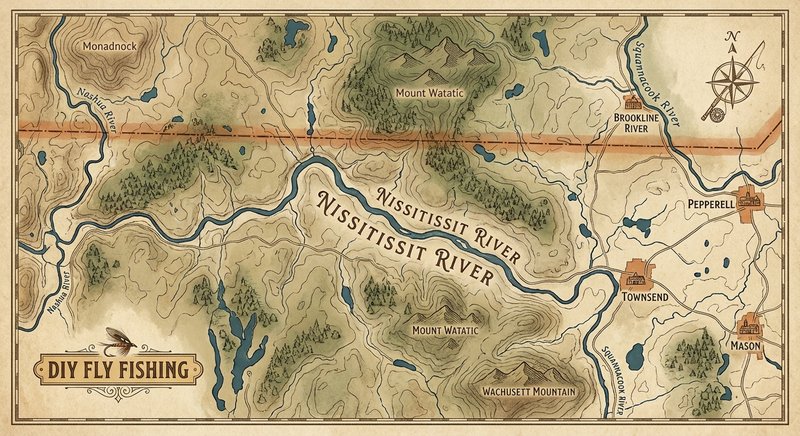
Nissitissit River
Fly fishing in Massachusetts · Advanced · Best seasons: Spring, Summer, Fall
Target Species
Brown Trout, Brook Trout
About This Water
North-central Massachusetts stream with wild trout. Technical small stream.
Fishing Recommendations
The Nissitissit River, stretching from southern New Hampshire into Pepperell, Massachusetts, is one of the most beloved trout streams in the Commonwealth. Often referred to simply as "The Nissi," it offers a classic New England freestone experience with technical pocket water, long runs, and a highly productive Catch-and-Release section.
🎣 Location Overview
The Nissitissit is a primary tributary of the Nashua River. What makes it special is its character: it feels much more like a remote mountain stream than its proximity to the Boston suburbs would suggest. It is characterized by boulder-strewn pocket water, hemlock-shaded pools, and gravel runs.
The crown jewel of the river is the Special Regulation Area, which runs from the New Hampshire border downstream to the Prescott Street bridge in Pepperell. This area is designated "Catch and Release, Artificial Lures Only," ensuring a higher density of fish and a higher quality of angling throughout the season.
🐟 Target Species & Behavior
- Brown Trout: These are the "smart" residents of the Nissi. While many are stocked, the Catch-and-Release regulations allow them to hold over and become quite wary. They prefer the deeper undercut banks and the dark water beneath overhanging trees.
- Brook Trout: MassWildlife stocks the river heavily with Brookies. You will find them in the faster oxygenated water at the heads of pools. While wild Brook Trout are rare in the main stem, they can be found in the smaller feeder tributaries.
- Behavior: During the day, fish hold tightly to structure (large boulders and fallen timber). As the sun dips or a hatch begins, they move into the shallower tail-outs and riffles to feed.
📅 Best Times to Fish
- Spring (Mid-April – June): This is the prime window. The river is stocked heavily, and the major hatches (Hendricksons and Caddis) bring fish to the surface.
- Summer (July – August): The Nissi can get low and warm. During these months, thermometers are mandatory. If the water exceeds 68°F, stop fishing to protect the trout. Focus on the early morning (sunrise to 10:00 AM) and deep, oxygenated riffles.
- Fall (September – November): The second peak season. Cooler nights drop water temperatures, and MassWildlife often performs a fall stocking. Brown trout become aggressive and territorial as they prepare for their spawning window.
🪰 Recommended Flies & Techniques
Top Fly Patterns
- Dry Flies:
- Hendrickson (Size 12-14): Essential for May.
- Elk Hair Caddis (Size 14-18): A staple all season; tan and olive work best.
- Blue Winged Olive (Size 18-22): Crucial for overcast spring and fall days.
- Terrestrials: Black Ants and Foam Beetles (Size 14-16) are deadly in mid-summer.
- Nymphs:
- Pheasant Tail (Size 14-18): Mimics almost everything.
- Prince Nymph (Size 12-16): Great for high-water "attractor" fishing.
- Zebra Midge (Size 18-22): Essential for picky fish in the C&R section.
- Streamers:
- Woolly Bugger (Olive or Black, Size 8-10): The gold standard for the Nissi.
- Mickey Finn: A classic New England pattern that works well for freshly stocked brookies.
Techniques
- Euro Nymphing: Because the Nissi has so many "pockets" created by boulders, a tight-line or Euro nymphing setup is incredibly effective at reaching fish holding in the deep slots.
- The "Nissi Swing": Swinging a small wet fly or soft hackle through the tail-outs of pools is a traditional and highly productive way to cover water during a caddis hatch.
- Stealthy Dries: In the slower pools of the C&R section, use long leaders (9-12 feet) and 6x tippet to avoid spooking holdover browns.
💡 Pro Tips & Local Knowledge
- Focus on the "Flats": Just above the Prescott Street bridge, there is a section of flatter water. While it looks boring compared to the boulders, it holds some of the largest holdover brown trout who cruise the banks looking for terrestrials.
- Wading Safety: The Nissi has many round, "greased" rocks. Felt soles (where legal) or studs are highly recommended, as the current can be deceptive.
- Shadow Management: The river is narrow. Be mindful of your shadow casting over the water, especially in the evening. Stay low and move slowly.
- The NH Side: Don't be afraid to cross the border into Brookline, NH. The river remains beautiful there, though you will need a New Hampshire fishing license to fish above the stone marker.
⚠️ Important Information
- Regulations: In the Special Regulation Area (NH Line to Prescott St.), it is strictly Catch and Release. No bait is allowed; artificial lures/flies only. Check the current Massachusetts Freshwater Fishing archives for any mid-season updates.
- Access Points:
- Prescott St. Bridge: Limited parking but direct access to the bottom of the C&R section.
- Wheeler Lane: Provides excellent access to the middle stretches.
- North Street: Good access for the upper MA sections near the border.
- Permits: A valid Massachusetts Freshwater Fishing License is required for all anglers 15 and older.
- Conservation: This is a high-pressure river. Please use barbless hooks and keep the fish in the water while unhooking to ensure their survival.
Bug Hatches & Matching Flies
| Hatch | Type | Peak months | Time of day | Hook sizes | Matching flies |
|---|---|---|---|---|---|
| Blue Winged Olive Baetis | mayfly | April, October, November | Mid-day | #18-22 | RS2 #20-22, Parachute BWO #18-20 |
| Hendrickson Ephemerella subvaria | mayfly | April, May | Afternoon | #12-14 | Red Quill #12-14, Pheasant Tail Nymph #12-14, Hendrickson Sparkle Dun #14 |
| Grannom Caddis Brachycentrus | caddis | April, May | Morning/Afternoon | #14-16 | Peacock Caddis #14-16, Deep Sparkle Pupa #14-16 |
| Sulphur Ephemerella invaria/dorothea | mayfly | May, June | Evening | #14-18 | Sulphur Parachute #16-18, CDC Sulphur Emerger #16-18 |
| Light Cahill Stenonema/Stenacron | mayfly | June, July | Evening | #12-14 | Light Cahill #12-14, Hare's Ear Nymph #12-14 |
| Tan Caddis Hydropsyche | caddis | June, July, August | Evening | #14-18 | Elk Hair Caddis #14-16, LaFontaine's Emergent Pupa #16 |
| Isonychia Isonychia bicolor | mayfly | August, September | Late Afternoon | #10-12 | Iso Parachute #10-12, Zug Bug #10-12 |
| Terrestrials Formicidae / Coleoptera | terrestrial | July, August, September | All Day | #12-18 | Cinnamon Ant #16-18, Black Foam Beetle #14-16 |
| Midges Chironomidae | midge | December, January, February, March | Mid-day | #20-24 | Zebra Midge #20-22, Griffith's Gnat #20-24 |