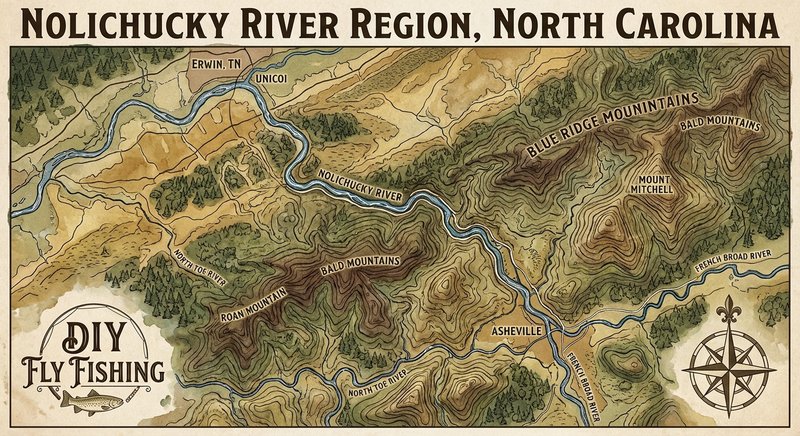
Nolichucky River
Fly fishing in North Carolina · Intermediate · Best seasons: Spring, Summer, Fall
Target Species
Smallmouth Bass, Rainbow Trout, Brown Trout
About This Water
Large river with excellent smallmouth bass and trout. Whitewater section famous for rafting.
Fishing Recommendations
The Nolichucky River in North Carolina is one of the most rugged and visually stunning rivers in the Southeast. Carving through the "Grand Canyon of the East" (the Nolichucky Gorge), this river offers a unique dual-identity fishery. While its lower reaches in Tennessee are famous for Smallmouth, the North Carolina headwaters and the wild Gorge section provide a world-class adventure for those seeking both wild trout and aggressive bass in a remote setting.
🎣 Location Overview
The Nolichucky is formed by the confluence of the North Toe and Cane Rivers near Huntdale, NC. What makes this water special is its wildness. Unlike many tailwaters in the region, the "Chucky" is a free-flowing river, meaning its character is dictated by rainfall and natural cycles.
The river transitions from high-elevation trout water into a brawling, boulder-filled canyon. The water is characterized by massive granite boulders, deep plunge pools, and long, ledge-filled runs. It is not a river for the faint of heart; the terrain is difficult, the wading is slick, and the scenery is spectacular. Anglers love it because you can realistically catch a 20-inch Brown Trout and a 4-pound Smallmouth Bass in the same mile of water.
🐟 Target Species & Behavior
Smallmouth Bass
The "Bronzebacks" here are lean and strong due to the heavy current.
- Behavior: They hold in the "soft" water behind large boulders, in the eddy lines, and along the deep rocky ledges.
- Feeding: They focus on crayfish and hellgrammites (the larvae of the Dobsonfly) along the bottom, as well as Shiners and Sculpins.
Rainbow and Brown Trout
The NC side of the Nolichucky is largely a "transition" fishery.
- Behavior: Trout are found primarily in the upper sections (Huntdale area) and the deeper, oxygenated pockets of the Gorge. Brown trout here are notorious for being nocturnal and predatory, often hiding under deep undercut ledges during the brightest parts of the day.
- Feeding: They rely on heavy hatches of Caddis and Mayflies in the spring, but shift to large terrestrial patterns and streamers as the water warms.
📅 Best Times to Fish
Optimal Seasons
- Spring (March – May): This is the prime window for Trout. The water temperatures are ideal, and the aquatic insect hatches (Quill Gordons, March Browns, and Hendricksons) are prolific.
- Summer (June – August): This is Smallmouth season. As the water warms, the bass become metabolic and aggressive. This is also the best time for "Popper" fishing on the surface.
- Fall (September – November): The "Goldilocks" zone. Water temperatures drop, making trout active again, while Smallmouth gorge themselves before winter. The Brown Trout also begin their spawning migration/aggression phase.
Best Times of Day
- Summer: First light until 10:00 AM, then again from 6:00 PM until dark. Mid-day is often too bright for the big fish.
- Spring/Fall: 10:00 AM to 4:00 PM as the sun warms the water slightly, activating the insect life.
🪰 Recommended Flies & Techniques
For Smallmouth Bass
- Topwater: Boogle Bugs (Chartreuse or White), Murdich Minnows, and Stealth Bombers.
- Sub-surface: Gamechangers, Wooly Buggers (Olive/Black), and Clouser Minnows.
- Nymphing/Dead Drift: Near-Nuff Crayfish and Hellgrammite imitations (Pat’s Rubber Legs in size 4-6).
For Trout
- Dry Flies: Parachute Adams, Elk Hair Caddis (Tan), and Yellow Stimulators.
- Nymphs: Frenchies, Pheasant Tails, and Girdle Bugs.
- Streamers: Sex Dungeon (White or Olive) and Black Ghost.
Techniques
- The "Nolichucky Swing": When fishing streamers for bass or trout, cast 45 degrees downstream toward the bank, give it two hard strips, and then let it swing through the current tongue.
- Heavy Nymphing: In the deep pools of the Gorge, use a heavy tungsten bead head to get the fly down quickly through the turbulent surface current.
💡 Pro Tips & Local Knowledge
- The Gorge Factor: The Nolichucky Gorge is essentially inaccessible by foot for several miles. The best way to fish the heart of the NC section is by raft. Do not attempt to take a hard-bottom drift boat through the Gorge; it is Class III-IV whitewater.
- Hellgrammite Heavy: If you aren't sure what to tie on for Smallmouth, use a Pat’s Rubber Legs in Coffee/Black. The Nolichucky has a massive population of Dobsonfly larvae, and everything in the river eats them.
- Watch the Gauge: Since it's free-flowing, the river can become dangerous quickly after rain. Check the USGS Poplar, NC gauge. Ideally, you want to see it below 1,000 cfs for wading and between 600–1,500 cfs for floating.
- The "Trout/Bass Line": Generally, the further upstream you go toward Spruce Pine and the Toe River, the better the trout fishing. As you move downstream toward the Tennessee line, the Smallmouth become the dominant predator.
⚠️ Important Information
Access Information
- Huntdale: A popular access point where the North Toe and Cane rivers meet.
- Poplar: The last major access point before the river enters the remote Gorge. There is a public boat ramp/access here.
- Erwin, TN: The take-out point for those floating the Gorge.
Regulations
- License: You need a North Carolina Fishing License if fishing above the state line. If your float carries you into Tennessee, you will need a TN license once you cross the border (be mindful, the line is in the middle of the wilderness).
- Public/Private: While the riverbed is public, much of the surrounding land in the upper reaches is private. Stick to the river corridor or established Forest Service land.
Special Considerations
- Safety: The rocks in the Nolichucky are famously "greased." Studded wading boots and a wading staff are highly recommended.
- Cell Service: Expect zero cell service once you leave the main roads and head into the Poplar or Gorge areas. Let someone know your float/hike plan.
Bug Hatches & Matching Flies
| Hatch | Type | Peak months | Time of day | Hook sizes | Matching flies |
|---|---|---|---|---|---|
| Blue Winged Olive Baetis | mayfly | March, April, October, November | Afternoon | #18-22 | RS2 #20-22, Parachute Adams #18-22, Pheasant Tail #18-20 |
| Quill Gordon Epeorus pleuralis | mayfly | March, April | Mid-day | #12-14 | Quill Gordon Dry #12-14, Gold Ribbed Hare's Ear #12-14 |
| March Brown Maccaffertium vicarium | mayfly | April, May | Afternoon | #10-14 | American March Brown #10-12, March Brown Emerger #12-14 |
| Yellow Sally Isoperla | stonefly | May, June, July | Late Afternoon/Evening | #14-16 | Yellow Sally Foam Dry #14-16, Iron Lotus #16 |
| Golden Stonefly Acroneuria | stonefly | June, July | Evening/Night | #6-10 | Pat's Rubber Leg #8-10, Golden Stimulator #8-12 |
| Light Cahill Stenonema/Stenacron | mayfly | May, June | Evening | #12-16 | Light Cahill #12-16, Cream Usual #14-16 |
| Cinnamon Caddis Hydropsyche | caddis | June, July, August, September | Evening | #14-18 | Elk Hair Caddis (Tan/Cinnamon) #14-16, Holy Grail #14-18 |
| Giant Black Stonefly Pteronarcys dorsata | stonefly | April, May | Morning/Evening | #4-8 | Girdle Bug #6-8, Kaufmann Stone #4-8 |