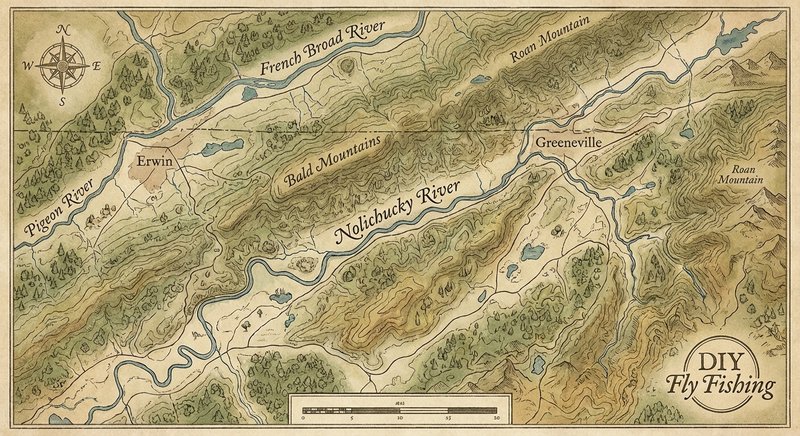
Nolichucky River
Fly fishing in Tennessee · Intermediate · Best seasons: Spring, Summer, Fall
Target Species
Smallmouth Bass, Rainbow Trout
About This Water
Mountain river with excellent smallmouth bass. Whitewater section offers unique fishing.
Fishing Recommendations
The "Noly" is one of the most underrated gems of the Southeast. Flowing from the high peaks of Western North Carolina into East Tennessee, it is a river of dual personalities: a rugged, mountain-fed trout stream in its upper reaches and a world-class, ledge-filled smallmouth factory as it widens.
Here is your guide to mastering the Nolichucky.
🎣 Location Overview
The Nolichucky River is defined by its dramatic scenery and its "wild" character. Unlike the tailwaters common in Tennessee (like the South Holston or Watauga), the Nolichucky is a freestone river. This means its flows are dictated by rainfall and snowmelt, not dam releases.
What makes it special is the Nolichucky Gorge. Carving a deep canyon through the Unaka Mountains, it offers some of the most remote fishing in the Eastern U.S. The river is characterized by massive rock gardens, deep plunge pools, and extensive limestone and shale ledges. Anglers love it because it feels prehistoric; once you enter the gorge, there are no roads, just the river and the railroad tracks.
🐟 Target Species & Behavior
Smallmouth Bass
The star of the show. Nolichucky smallmouth are "river-hardened"—lean, muscular, and aggressive.
- Behavior: They utilize the river's extensive ledge systems. They hang on the downstream side of rock shelves or in the "seams" where fast water meets slow water.
- Feeding: Their primary diet consists of crayfish and various shiners/minnows (like the Warpaint Shiner). In summer, they look up for terrestrial insects and damselflies.
Rainbow Trout
While the lower river is too warm for trout, the upper sections (near the NC/TN state line and through the Gorge) hold wild and stocked rainbows.
- Behavior: They hold in the oxygenated "white water" pockets and the heads of deep pools. During the heat of summer, they seek out cold-water tributaries.
- Feeding: They focus on aquatic insects (Mayflies, Caddis, Stoneflies) and small sculpins.
📅 Best Times to Fish
Optimal Seasons
- Spring (April – June): This is the prime window. As water temperatures hit the 55°F–60°F mark, Smallmouth become incredibly aggressive pre-spawn. Trout fishing is at its peak with heavy insect hatches.
- Summer (July – August): Focus on Smallmouth. This is "Topwater Time." The water is lower and clearer, making for excellent sight fishing.
- Fall (September – November): As the water cools, Smallmouth feed heavily to bulk up for winter. The fall colors in the Gorge are world-class.
Prime Windows
- Time of Day: In summer, the "Low Light" rule is king. Be on the water at dawn for topwater action. On overcast days, the bite can stay hot all day.
- Conditions: Look for "green" water. You want some clarity, but a little bit of stain (2–3 feet of visibility) is often better for Smallmouth than gin-clear water.
🪰 Recommended Flies & Techniques
For Smallmouth Bass
- Topwater: Boogle Bugs (Poppers) in Chartreuse or Black, and Murdich Minnows (fished on an intermediate line).
- Sub-surface: Gamechangers (white/pearl), Clouser Minnows (Chartreuse/White), and Crayfish patterns (Near Nuff Craw or Cheech Leech in olive/orange).
- Technique: "Swing and Strip." Cast across the current towards the banks or ledges, let the fly swing into the soft water, and use erratic strips to mimic a wounded baitfish.
For Rainbow Trout
- Dry Flies: Parachute Adams (14-16), Elk Hair Caddis (12-14), and Stimulators (8-12) for high-visibility attractor patterns.
- Nymphs: Pheasant Tails, Pat’s Rubber Legs (Stonefly mimic), and Bead-head Prince Nymphs.
- Technique: High-stick nymphing through the pocket water or "dry-dropper" rigs in the summer to cover two columns of water at once.
💡 Pro Tips & Local Knowledge
- Master the Ledges: The Nolichucky is full of underwater rock shelves. Don't just fish the banks. Often, the biggest Smallmouth are sitting in the middle of the river, tucked behind a submerged ledge that creates a break in the current.
- The "Gorge" Caution: The Nolichucky Gorge is Class III-IV whitewater. Do not attempt to float the Gorge in a drift boat. Use a self-bailing raft with a fishing frame and an experienced rower, or stick to the lower sections (Erwin to downstream) which are much more manageable (Class I-II).
- The "Hoot Owl" Strategy: In late August, if water temps hit 70°F+, give the trout a break. Switch entirely to Smallmouth, which thrive in those temperatures, to ensure fish survival.
⚠️ Important Information
- Access Points:
- USA Raft Adventure Resort: A great jumping-off point for the Gorge.
- Chestoa Recreation Area: Popular access for wading and launching smaller crafts.
- River Hill/Nolichucky Dam: Good areas for lower river smallmouth access.
- Regulations: A valid Tennessee Fishing License is required. If you cross the state line into North Carolina (Upper Gorge), you need a NC license. Check the TWRA website for specific size and creel limits, which can change.
- Safety: The Nolichucky rises very quickly after rain in the mountains. Always check the USGS gauge at Embreeville or Poplar before heading out. If the river is spiking, stay off the water—it becomes dangerous and muddy very fast.
Bug Hatches & Matching Flies
| Hatch | Type | Peak months | Time of day | Hook sizes | Matching flies |
|---|---|---|---|---|---|
| White Fly Ephoron leukon | mayfly | August, September | Late Evening/Dusk | #12-14 | White Wulff #12-14, Ephoron Emerger #12-14, White Poly Spinner #14 |
| Hellgrammite Corydalus cornutus | stonefly | May, June, July | All Day | #2-6 | Murray's Hellgrammite #4-8, Bitch Creek Nymph #6-10, Clouser Crayfish #4-8 |
| Tan Caddis Hydropsyche | caddis | April, May, June | Morning/Evening | #14-18 | Elk Hair Caddis (Tan) #14-16, Holy Grail #14-18, Pupa-Lezza #14-16 |
| Golden Stonefly Acroneuria | stonefly | May, June | Afternoon/Evening | #6-10 | Kaufmann's Stone #6-10, Girdle Bug #6-12, Stimulator (Yellow) #8-12 |
| Blue-Winged Olive Baetis | mayfly | March, April, October, November | Mid-day/Afternoon | #18-22 | RS2 (Gray) #20-22, Parachute Adams #18-22, Pheasant Tail Nymph #18-20 |
| Sulphurs Ephemerella invaria | mayfly | May, June | Late Afternoon/Evening | #14-16 | Sulphur Parachute #14-16, CDC Sulphur Emerger #14-16, Split Case Sulphur #14-16 |
| Slate Drake Isonychia | mayfly | June, September | Afternoon | #10-12 | Isonychia Nymph #10-12, Parachute ISO #10-12, Zug Bug #10-14 |
| Tricos Tricorythodes | mayfly | July, August, September | Early Morning | #22-26 | Trico Spinner #22-24, Griffith's Gnat #20-24, Sunken Trico Spinner #22 |