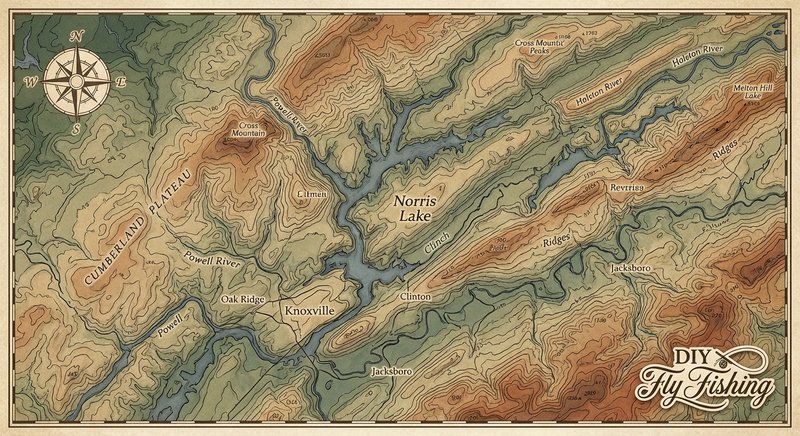
Norris Lake
Fly fishing in Tennessee · Beginner · Best seasons: Spring, Summer, Fall
Target Species
Striped Bass, Largemouth Bass, Walleye
About This Water
TVA reservoir with excellent striped bass and walleye. Clear water and scenic shoreline.
Fishing Recommendations
Welcome to Norris Lake, the crown jewel of the Tennessee Valley Authority (TVA) system. As a guide, I can tell you that Norris is a "highland reservoir," meaning it is deep, remarkably clear, and surrounded by the rugged beauty of the Cumberland Mountains. Unlike the muddy bottomland lakes of the South, Norris offers a technical but highly rewarding fly fishing experience that feels more like fishing a flooded mountain canyon.
🎣 Location Overview
Norris Lake is formed by the convergence of the Clinch and Powell Rivers. It covers over 34,000 acres and boasts 800 miles of shoreline. What makes it special is the water clarity. In the lower end near the dam, visibility can exceed 15–20 feet.
Anglers love Norris because it offers a "big water" experience with a "mountain lake" soul. Because it is deep and oxygen-rich, it supports massive populations of landlocked Striped Bass and some of the best Walleye fishing in the Southeast. For the fly angler, the challenge is the depth; for the reward, it’s the sheer power of a 20lb Striper on a 9-weight rod.
🐟 Target Species & Behavior
Striped Bass (Stripers)
These are the kings of Norris. They are nomadic, following massive schools of Gizzard and Threadfin Shad.
- Behavior: In spring, they push up the river arms (Clinch and Powell). In summer, they retreat to the deep, cool "thermocline" near the dam. In fall, they move back toward the flats and secondary points.
- Feed: Exclusively fish-eaters. They want big silhouettes.
Largemouth Bass
While Norris is famous for its Smallmouth, the Largemouth thrive in the backs of creeks and around submerged timber.
- Behavior: They are structure-oriented. Look for "laydowns" (fallen trees) and the rare patches of aquatic vegetation. Because the water is clear, they are spookier than your average pond bass.
- Feed: Shad, bluegill, and crawfish.
Walleye
Often considered "fly rod unicorns," Norris has one of the best populations in Tennessee.
- Behavior: They are light-sensitive. During the day, they hold in 20–40 feet of water against rocky walls. At night, they move onto shallow shoals and points to feed.
- Feed: Small shad and bottom-dwelling sculpins.
📅 Best Times to Fish
Spring (March – May) - The Prime Window
This is the best time for fly anglers.
- Stripers/Walleye: They make a "spawning run" up the Clinch and Powell River arms. The fish are concentrated in narrower moving water, making them much easier to target with a fly rod.
- Largemouth: They move to the banks for the pre-spawn and spawn.
Summer (June – August)
- Stripers: They head deep. You will need heavy sinking lines (350–500 grain).
- Best Time: The "Night Bite" or the first 60 minutes of daylight. Topwater Striper action can happen at dawn near the dam.
Fall (September – November)
- The "Bust": As water temperatures drop, shad move to the surface in massive schools. Stripers and Bass will "bust" these schools on the surface.
- Conditions: Overcast, drizzly days are best to keep the fish near the surface.
🪰 Recommended Flies & Techniques
For Striped Bass
- Flies: Gamechangers (5–7 inches) in white/chartreuse, Bob’s Banger (topwater popper), and Clouser Minnows with heavy lead eyes.
- Technique: Use a 9-weight or 10-weight rod. Use a "count down" method with a sinking line. Cast toward points, let it sink for 15–20 seconds, and use aggressive, long strips.
For Largemouth Bass
- Flies: Dahlberg Divers, Murdoch Minnows, and Crayfish patterns (in olive or orange).
- Technique: Tight-to-cover casting. Stealth is key because of the water clarity. Long leaders (9–12 feet) are often necessary to avoid lining the fish.
For Walleye
- Flies: Half-and-Halfs (Clouser/Deceiver hybrid) in purple/black or white/chartreuse.
- Technique: Dredging. Use a full-sink line and "bounce" the fly off rocky points at night. The retrieve should be much slower than for Stripers.
💡 Pro Tips & Local Knowledge
- Follow the Birds: In the late fall and spring, look for gulls and loons. If birds are diving, Stripers are pushing shad to the surface. Get there fast, but cut your motor 100 yards out and drift in.
- The "River Arms": If the main lake is too daunting, head north into the Powell River arm. It is narrower, more manageable for a fly caster, and has less boat traffic.
- The Shadow Line: On sunny days, bass will tuck into the shadows of the steep limestone cliffs. Cast your fly literally inches from the rock and let it sink vertically.
- Color Palette: In Norris, "White over Chartreuse" is the gold standard. However, if the water is extremely clear, switch to "Grey/White" or "Blue/White" to match the Threadfin Shad more naturally.
⚠️ Important Information
- Access: Norris is best fished from a boat. Public ramps are plentiful, with Hickory Star, Stardust, and Norris Dam State Park being popular launch points.
- Regulations: A Tennessee Fishing License is required. There are specific length and creel limits for Striped Bass (currently 2 per day, 15-inch minimum) and Walleye. Always check the TWRA website for current seasonal changes.
- Safety: Norris is a deep lake with heavy recreational boat traffic (pontoon boats and jet skis) in the summer. Always have a life jacket and be wary of "rogue wakes" hitting the limestone cliffs and bouncing back.
- Winter Drawdown: The TVA drops the lake level significantly in winter (up to 20+ feet). Be careful of newly exposed rock hazards if you fish the edges of the seasons.
Tight lines, and enjoy the views of the Smokies in the distance!
Bug Hatches & Matching Flies
| Hatch | Type | Peak months | Time of day | Hook sizes | Matching flies |
|---|---|---|---|---|---|
| Sulphur Mayfly Ephemerella invaria | mayfly | May, June, July | Late Afternoon/Evening | #16-20 | Sulphur Parachute #16-18, Pheasant Tail #16-20, Sulphur Emerger #18 |
| Chironomid Midge Chironomidae | midge | January, February, March, December | All Day | #18-24 | Zebra Midge #18-22, Griffith's Gnat #20-24, Top Secret Midge #20-22 |
| Blue Winged Olive Baetis | mayfly | March, April, October, November | Midday/Afternoon | #18-22 | BWO Sparkle Dun #18-20, RS2 #20-22, Barr's BWO Emerger #18-20 |
| Scuds and Sowbugs Gammarus & Asellus | crustacean | June, July, August, September | All Day | #14-18 | Ray Charles #16-18, Scud (Grey/Olive) #14-18, Sowbug #16-18 |
| Grannom Caddis Brachycentrus | caddis | April | Morning/Evening | #14-18 | Elk Hair Caddis (Black) #14-16, Deep Sparkle Pupa #16, Holy Grail Caddis #14-16 |
| Terrestrials (Beetles/Ants) Coleoptera & Formicidae | terrestrial | July, August, September | Midday | #12-16 | Black Foam Beetle #12-14, Cinnamon Ant #16-18, Chernobyl Ant #10-12 |
| Crane Fly Tipulidae | other | August, September, October | Morning/Evening | #10-14 | Crane Fly Adult #10-12, Crane Fly Larva #10-14, Daddy Long Legs #12 |
| Cinnamon Caddis Hydropsyche | caddis | June, July, August | Evening | #16-20 | Elk Hair Caddis (Tan) #16-18, Soft Hackle Hare's Ear #16-20, LaFontaine Sparkle Pupa #16-18 |