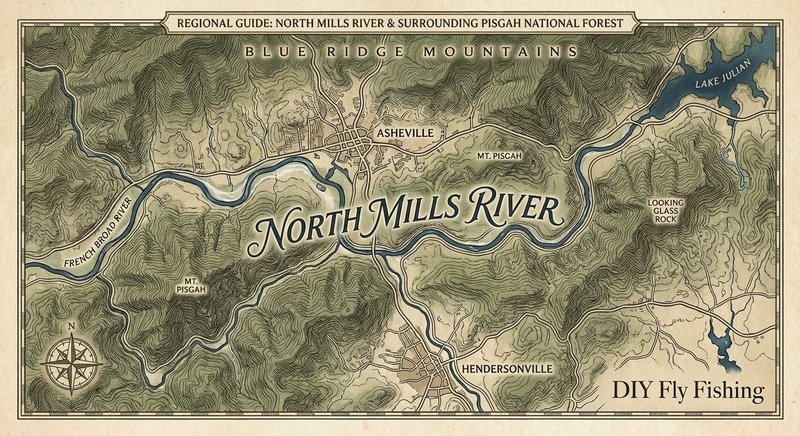
North Mills River
Fly fishing in North Carolina · Intermediate · Best seasons: Spring, Summer, Fall
Target Species
Brown Trout, Rainbow Trout
About This Water
Excellent freestone stream in Pisgah National Forest. Wild trout and good hatches.
Fishing Recommendations
As an expert guide familiar with the technical freestone waters of Western North Carolina, I am pleased to provide this comprehensive guide to the North Mills River.
Located within the Pisgah National Forest just south of Asheville, the North Mills is a quintessential Appalachian trout stream. It is a favorite among locals for its accessibility, yet it offers enough technical challenges to test the skills of seasoned anglers.
🎣 Location Overview
The North Mills River is a medium-to-small freestone stream characterized by its "pocket water," deep plunges, and classic pool-and-riffle sequences. It flows through a lush canopy of rhododendron and mountain laurel, which provides excellent shade for the fish but demands accurate casting from the angler.
What makes this river special is its Delayed Harvest (DH) section. This designation ensures a high density of fish during the prime fishing months while restricting the type of lures used, creating a "fly fisher’s playground." The water is generally clear and cool, though it can become "skinny" and technical during the summer months.
🐟 Target Species & Behavior
The North Mills is primarily a Rainbow and Brown Trout fishery.
- Rainbow Trout: These are the river's acrobats. They typically hold in the faster water—at the "heads" of pools where oxygen levels are high and food is delivered quickly. They are aggressive and often the first to strike a well-presented nymph.
- Brown Trout: The "kings of the undercut banks." Browns in the North Mills tend to be more cautious. Look for them in the slower "tailouts" of pools, under overhanging rhododendron branches, or tucked behind large boulders.
- Behavior: During the DH season (October–June), you will encounter many recently stocked fish that are less selective. However, as the season progresses, these fish become "educated" and require more natural presentations and lighter tippets.
📅 Best Times to Fish
Optimal Seasons
- Spring (March – May): Prime Time. This coincides with the best insect hatches (Quill Gordons, March Browns, and Yellow Sallies). The water temperatures are perfect (50–55°F).
- Fall (October – November): The river is replenished with fish for the Delayed Harvest season. The cooling water and falling leaves make for a beautiful, productive setting.
- Summer (June – August): Fishing becomes technical. Focus on the early morning or late evening. If the water temperature exceeds 68°F, give the fish a break to avoid mortality.
Prime Windows
- Morning: 8:00 AM to 11:00 AM (especially in Summer).
- Late Afternoon: The "Golden Hour" before sunset often triggers a caddis or midge hatch.
🪰 Recommended Flies & Techniques
Top Fly Patterns
- Nymphs:
- Sexy Walt’s Worm (Size 14-16) – A local staple for DH waters.
- Pheasant Tail (Flashback) (Size 16-18) – Mimics the abundant mayfly nymphs.
- Squirmy Wormies/Egg Patterns – Highly effective in the weeks immediately following a stocking.
- Dry Flies:
- Yellow Stimulator (Size 14) – Great for the Yellow Sally hatch and as an indicator fly.
- Elk Hair Caddis (Tan or Olive, Size 16).
- Parachute Adams (Size 16-20) – The best generalist dry fly for these waters.
- Streamers:
- Woolly Bugger (Black or Olive, Size 8-10) – Stripped through deep pools on overcast days.
Effective Techniques
- Tight-Line (Euro) Nymphing: Because the North Mills has many conflicting currents and pocket water, tight-lining allows you to maintain contact with your fly and avoid the "drag" caused by a traditional bobber.
- Dry-Dropper: A buoyant dry fly (like a Stimulator) with a small nymph tied 18–24 inches below it is the most effective way to cover the riffles and shallow runs.
- Stealth Approach: The water is often clear. Approach pools from downstream, stay low, and wear earthy colors to avoid spooking the fish.
💡 Pro Tips & Local Knowledge
- The "Walk-In" Rule: The most pressured water is right next to the North Mills River Recreation Area parking lot. If you walk 20 to 30 minutes upstream (past the gate on FS 5000), the fishing pressure drops significantly and the fish are less wary.
- Focus on the "Seams": In the North Mills, trout love the "seam"—the line where fast water meets slow water. If your fly isn't crossing that line, you're missing fish.
- Tippet Size: While you can get away with 4x tippet right after a stocking, by mid-spring, you should drop down to 5x or 6x fluorocarbon for your nymphs to fool the more educated trout.
⚠️ Important Information
Access & Parking
- The primary access point is the North Mills River Recreation Area. There is a modest fee for parking in the day-use area.
- For more "wild" feeling water, follow Forest Service Road 5000 (Wash Creek Rd). This road runs parallel to much of the river.
Regulations
- Delayed Harvest (DH): From October 1 until the first Saturday in June, the river is Catch and Release Only, and you must use single-hook, artificial lures only. No bait is allowed.
- Hatchery Supported: After the DH period ends in June, regulations change to allow harvesting and bait. Always check the NC Wildlife Resources Commission website for the most current dates.
- Permits: You must have a valid North Carolina Fishing License with a Trout Privilege (Trout Stamp).
Special Considerations
- Cell Service: Expect little to no cell service once you enter the Recreation Area. Download your maps beforehand.
- Wading: The rocks here are notoriously slippery ("Pisgah Grease"). I highly recommend felt-soled boots or rubber soles with studs.
Bug Hatches & Matching Flies
| Hatch | Type | Peak months | Time of day | Hook sizes | Matching flies |
|---|---|---|---|---|---|
| Quill Gordon Epeorus pleuralis | mayfly | March, April | Midday | #12-14 | Quill Gordon Dry #12-14, Quill Gordon Nymph #12-14 |
| Blue Winged Olive Baetis | mayfly | March, April, October, November | Late Morning/Afternoon | #18-22 | RS2 #20-22, Parachute Adams #18-22, Pheasant Tail Nymph #18-20 |
| Hendrickson Ephemerella subvariabilis | mayfly | April, May | Afternoon | #12-14 | Red Quill #12-14, Hendrickson Cripple #14 |
| Cinnamon Caddis Hydropsyche | caddis | May, June, September | Evening | #14-18 | Elk Hair Caddis (Tan) #14-16, Pupa-can-Caddis #16, Holy Grail #14-16 |
| Golden Stonefly Acroneuria | stonefly | May, June, July | Morning/Evening | #8-12 | Pat's Rubber Legs #8-12, Yellow Stimulator #10-12 |
| Light Cahill Stenacron interpunctatum | mayfly | June, July | Evening | #12-14 | Light Cahill Dry #12-14, Gold Ribbed Hare's Ear #14 |
| Black Beetle Coleoptera | terrestrial | July, August, September | All Day | #12-16 | Foam Beetle #14-16, Crowe Beetle #12-14 |
| Little Brown Stonefly Strophopteryx fasciata | stonefly | February, March | Midday | #14-16 | Little Brown Stone Nymph #14-16, Henryville Special #16 |