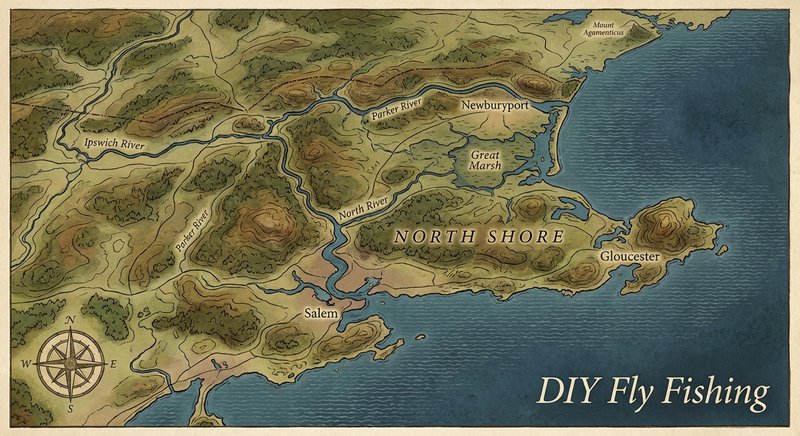
North Shore
Fly fishing in Massachusetts · Intermediate · Best seasons: Spring, Summer, Fall
Target Species
Striped Bass, Bluefish, Mackerel
About This Water
Essex County coastline with striped bass. Rocky shoreline and estuaries.
Fishing Recommendations
Welcome to the "Gold Coast" of New England fly fishing. The North Shore of Massachusetts—stretching from the marshes of Salisbury and Newburyport down through the rugged granite of Cape Ann and into the historic harbors of Salem and Marblehead—is a premier saltwater fly fishing destination.
As your guide, here is your comprehensive playbook for navigating these productive waters.
🎣 Location Overview
The North Shore is a study in contrasts. To the north, you have Plum Island and the Great Marsh, one of the largest continuous salt marshes in New England. This area is characterized by vast sand flats (like Joppa Flats), winding tidal creeks, and the massive outflow of the Merrimack River.
Moving south, the topography shifts dramatically to Cape Ann (Gloucester and Rockport). Here, the sandy beaches give way to rugged granite cliffs, deep kelp forests, and boulder-strewn shorelines.
What makes it special: The sheer volume of bait fueled by the Gulf of Maine’s cold, nutrient-rich waters. Anglers love it because it offers every type of saltwater experience: sight-casting to bass in two feet of water on a sandbar, or "clambering" over rocks to cast into 15-foot swells for trophy-sized "cows."
🐟 Target Species & Behavior
Striped Bass (The King)
The primary target. In early spring, "schoolies" (12–24 inches) arrive first, filling the estuaries. By June, larger migratory fish arrive.
- Behavior: They are ambush predators. They hold in "seams" where current moves past structure, in the "wash" of breaking waves on rocks, or patrolling the edges of salt marshes on a rising tide.
- Feeding: Sand eels, silversides, menhaden (pogies), river herring, and green crabs.
Bluefish (The Yellow-Eyed Devil)
Arriving typically in late June or July when the water warms.
- Behavior: Highly aggressive and fast-moving. You’ll often see them "blitzing" on the surface, turning the water into a washing machine of foam and scales.
- Feeding: Anything that moves. They will shred expensive flies, so wire tippet is often necessary.
Mackerel
Found in deeper harbor mouths or off rocky points.
- Behavior: Schooling fish that prefer cooler, deeper water.
- Feeding: Tiny crustaceans and small baitfish. Great fun on a 5-weight or 6-weight rod.
📅 Best Times to Fish
The Seasons
- Spring (May - June): The "Kickoff." Focus on the estuaries and salt marshes (Parker River, Essex River) where the water warms up faster. This is prime time for Joppa Flats.
- Summer (July - August): The "Dog Days." Large fish go deep or nocturnal. Best fishing is at night or 4:00 AM to 7:00 AM. Look for "whitewater" on the rocky coast where oxygen and bait are high.
- Fall (September - October): The "Fall Run." Fish are migrating south and feeding voraciously. Expect surface blitzes and fast action along the beaches (Crane Beach, Plum Island).
The Tides & Time of Day
- Moving water is mandatory. A "slack tide" usually means the bite stops.
- Low Light: Dawn and dusk are the golden hours. If you aren't fishing in the dark, you're missing the biggest fish.
🪰 Recommended Flies & Techniques
Top Fly Patterns
- Clouser Minnow: (Chartreuse/White or Olive/White). The most essential fly for the North Shore. It mimics sand eels and stays deep in the current.
- Bob’s Banger / Gurgler: For topwater action. Nothing beats the visual of a Striper exploding on a surface popper.
- Hollow Fleye: Large profiles (7–10 inches) for when the "Pogies" (Menhaden) are in the harbors.
- Ray’s Fly / Flatwing: Best for mimicking the slender profile of a silverside in calm water.
Techniques & Presentation
- The Strip Strike: Never "trout set" (lifting the rod). Keep the rod tip low, almost touching the water, and pull the line hard with your stripping hand to set the hook.
- The "Two-Handed" Strip: Tuck the rod under your arm and use both hands to retrieve the line rapidly. This is often the only way to trigger a Bluefish.
- Swing the Current: In river mouths (like the Essex or Merrimack), cast across the current and let the fly "swing" like a wet fly for trout. Bass often sit right in the seam.
💡 Pro Tips & Local Knowledge
- The "Joppa" Method: If fishing Joppa Flats, use a floating line and a long leader with a lightly weighted fly. Sight-casting to "tailing" bass in the shallow grass is the closest thing to bonefishing in the North.
- Korkers are Mandatory: If you are fishing the "Back Shore" of Gloucester or the rocks of Rockport, you must wear studded wading boots (Korkers). The rocks are covered in "black snot" (algae) that is incredibly slippery.
- Look for Birds: Tern and Gull activity is your GPS. If birds are diving, bait is being pushed to the surface by predators.
- The "Wash" is your Friend: On rocky shores, cast your fly directly into the white foam where waves hit the rocks. Stripers sit right in that turbulence to disorient baitfish.
⚠️ Important Information
Regulations & Permits
- MA Saltwater Fishing Derby/Registry: You must have a Massachusetts Saltwater Fishing Permit. It’s cheap and can be bought online via the MassFishHunt website.
- Striped Bass Limits: Regulations change yearly (currently a very narrow "slot limit"). Check the current MA DMF (Division of Marine Fisheries) website for the exact inches allowed for harvest. Most fly anglers practice 100% Catch & Release.
Access Spots
- Plum Island (Parker River National Wildlife Refuge): Miles of beach access. Note: Plover nesting can close certain beach sections in summer.
- Gloucester (Back Shore): Public access along Atlantic Ave. Great for night fishing.
- Newburyport (Cashman Park): Great launch point for kayaks or boats heading to the flats.
Safety
- The Tide: The North Shore has a 9-to-12-foot tidal range. If you wade out onto a sandbar, be extremely mindful of the tide coming in behind you. It can cut off your path to shore quickly.
- Water Temp: Even in summer, the water is cold. If you're "wet wading," watch for signs of hypothermia during long night sessions.
Bug Hatches & Matching Flies
| Hatch | Type | Peak months | Time of day | Hook sizes | Matching flies |
|---|---|---|---|---|---|
| Early Black Midge Chironomidae | midge | March, April | Late Morning/Afternoon | #20-24 | Zebra Midge #20-22, Griffith's Gnat #20-24 |
| Hendrickson Ephemerella subvaria | mayfly | April, May | Afternoon | #12-14 | Hendrickson Dark #12-14, Pheasant Tail Nymph #12-14, Red Quill #14 |
| Blue-Winged Olive Baetis | mayfly | April, May, September, October | Overcast Afternoons | #18-22 | RS2 #20-22, BWO Sparkle Dun #18-20, Baetis Nymph #18-22 |
| Grannom Caddis Brachycentrus | caddis | April, May | Morning/Afternoon | #14-16 | Elk Hair Caddis (Olive) #14-16, Pupa-Peeping Caddis #14-16, LaFontaine Sparkle Pupa #16 |
| March Brown Maccaffertium vicarium | mayfly | May, June | Afternoon | #10-12 | March Brown Dry #10-12, Gold Ribbed Hare's Ear #10-12 |
| Light Cahill Stenocron / Stenonema | mayfly | June, July | Evening | #12-14 | Light Cahill #12-14, Cream Usual #14 |
| Spotted Sedge Hydropsyche | caddis | June, July, August | Evening | #14-18 | Tan Elk Hair Caddis #14-18, Holy Grail Caddis #16 |
| Trico Tricorythodes | mayfly | July, August, September | Early Morning | #22-26 | Trico Spinner #22-26, Sunken Trico Spinner #24 |
| Common Terrestrials Formicidae / Coleoptera | terrestrial | July, August, September | All Day | #12-18 | Black Foam Ant #16-18, Cricket/Hopper #12-14, Cinnamon Ant #16-18 |
| White Miller Caddis Nectopsyche | caddis | July, August | Evening/Night | #14-16 | White Elk Hair Caddis #14-16, White Wulff #14 |