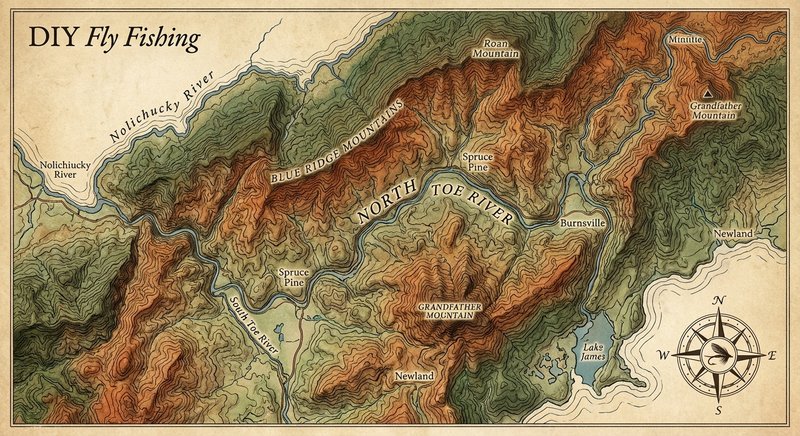
North Toe River
Fly fishing in North Carolina · Intermediate · Best seasons: Spring, Summer, Fall
Target Species
Brown Trout, Rainbow Trout
About This Water
Wild trout stream with good public access. Beautiful Black Mountain scenery.
Fishing Recommendations
Tight lines! As your guide for the day, let’s dive into the North Toe River in Western North Carolina. This is one of the most versatile and scenic river systems in the Blue Ridge Mountains, offering everything from technical wild trout water to rod-bending "Delayed Harvest" action.
🎣 Location Overview
The North Toe River originates high on the slopes of Grandfather Mountain and flows through Avery and Mitchell Counties before joining the South Toe to form the Toe River (and eventually the Nolichucky).
What makes the North Toe special is its diversity. The upper reaches near Newland and Linville are high-gradient, cold-water environments. As it flows through Spruce Pine, it widens into a classic mountain river with large boulders, deep plunge pools, and expansive runs. It offers a mix of "Wild Trout" water, "Hatchery Supported" sections, and a highly popular "Delayed Harvest" (DH) stretch. The scenery is quintessential Appalachia—towering hardwoods, rhododendron-lined banks, and the occasional passing of the historic Clinchfield Railroad.
🐟 Target Species & Behavior
The North Toe is a powerhouse for two primary species:
- Rainbow Trout: These are the acrobats of the river. In the DH sections, they are plentiful and aggressive. They tend to hold in the faster "bubble lines" and at the heads of riffles.
- Brown Trout: The North Toe is legendary for producing "toads"—large, wild, or holdover Browns. Unlike the Rainbows, these fish are wary. They hold in the "guts" of deep pools, under overhanging rhododendrons, or tight against the many undercut banks and large boulders.
Feeding Behavior: In the spring, they are opportunistic, keyed into heavy aquatic insect hatches. In the summer, they transition to terrestrials and nocturnal feeding. In the fall, Browns become aggressive and territorial as they prepare for the spawn.
📅 Best Times to Fish
Optimal Seasons
- Spring (March – May): This is the "Goldilocks" zone. Water temperatures rise into the 50s, sparking massive insect hatches. The Delayed Harvest section is heavily stocked, but the wild fish are also looking up.
- Summer (June – August): Focus on the upper, higher-elevation reaches or the early morning/late evening hours. Look for "thermal refuges" where cold tributaries enter the main stem.
- Fall (October – November): This is prime time for big Browns. As the leaves change, the water cools, and the fish become very active before the winter metabolic slowdown.
Prime Windows
- The "Evening Rise": During summer, the last two hours of daylight can be magical as caddis and mayflies swarm the surface.
- Overcast Days: Light rain or heavy clouds bring the big, predatory Browns out of their hiding spots.
🪰 Recommended Flies & Techniques
Top Fly Patterns
- Nymphs:
- Frenchies & Pheasant Tails (Size 14-18) – The bread and butter.
- Pat’s Rubber Legs (Coffee/Black, Size 8-12) – Vital for mimicking the large Golden Stoneflies common in this river.
- Sexy Walt’s Worm – A deadly DH attractor.
- Dry Flies:
- Yellow Stimulator (Size 12-16) – Great for mimicking stones or as a high-vis hopper.
- Parachute Adams (Size 14-20) – The ultimate searcher pattern.
- Elk Hair Caddis (Tan or Olive) – Essential for summer evenings.
- Streamers:
- Black or Olive Wooly Buggers (Size 6-10).
- Galloup’s Dungeon (in white or yellow) – If you are hunting a trophy Brown.
Effective Techniques
- Tight-Line (Euro) Nymphing: Because the North Toe has a lot of "pocket water" created by boulders, a tight-line rig allows you to get deep in the holes without your line getting caught in conflicting currents.
- Dry-Dropper: A large Stimulator with a 24-inch dropper to a bead-head nymph is the most effective way to cover the river during the late spring and summer.
- Streamer Stripping: On the lower sections near Spruce Pine, swinging a streamer through deep runs or stripping it erratically past boulders can trigger violent strikes.
💡 Pro Tips & Local Knowledge
- The Spruce Pine "Delayed Harvest" Stretch: This is the most famous section. Focus on the area around Riverside Park. It is heavily stocked and perfect for beginners or those looking for high numbers of fish.
- The "Shadow" Factor: Because the river is flanked by steep mountains, certain sections stay in the shade longer. Fish the "shade lines"—trout feel much more secure moving into shallow water when the sun isn't directly overhead.
- Stealth is Key: Despite the stocking, the North Toe can run very clear. Long leaders (9ft–12ft) and 5X or 6X fluorocarbon tippet are often necessary to fool the larger holdover fish.
- Watch the Mica: The area is famous for mica mining. You’ll notice the riverbed often glitters. This silt can be slippery—studded wading boots or aluminum bars are highly recommended.
⚠️ Important Information
Access Information
- Public Access: Significant access is available along Hwy 19E and through the town of Spruce Pine.
- Upper Reaches: Access near Newland is more limited and often requires fishing from bridge pull-offs. Always respect "Posted" signs.
Regulations & Permits
- NC License: You must have a North Carolina Inland Fishing License and a Trout Sign-off.
- Delayed Harvest (DH): From October 1 until the first Saturday in June, DH sections are Catch and Release Only and restricted to single-hook artificial lures. No bait is allowed.
- Wild Trout Waters: Some tributaries have a 7-inch minimum size limit and a 4-fish creel limit (though we always recommend C&R for wild fish!).
Safety
- Water Levels: The North Toe can rise rapidly after a heavy rain in the mountains. Check the USGS gauges (Toe River at Spruce Pine) before heading out. If it’s over 400-500 cfs, wading can become dangerous.
Guide’s Final Thought: The North Toe is a river of secrets. Spend your morning in the crowded DH section to get your numbers up, but spend your afternoon hiking into the quieter stretches—that’s where the 20-inch Browns live. Tight lines!
Bug Hatches & Matching Flies
| Hatch | Type | Peak months | Time of day | Hook sizes | Matching flies |
|---|---|---|---|---|---|
| Quill Gordon Epeorus pleuralis | mayfly | March, April | Mid-day | #12-14 | Quill Gordon Dry #12-14, Quill Gordon Wet #12-14 |
| Blue Winged Olive (BWO) Baetis | mayfly | March, April, October, November | Afternoon | #18-22 | RS2 #20-22, Parachute Adams #18-22, Pheasant Tail #18-20 |
| Hendrickson Ephemerella subvaria | mayfly | April, May | Afternoon | #12-14 | Red Quill #12-14, Hendrickson Emerger #14 |
| Yellow Sally Isoperla | stonefly | May, June, July | Late Afternoon/Evening | #14-16 | Yellow Sally Foam Dry #14-16, Little Yellow Stone Nymph #14-16 |
| Golden Stonefly Acronuria | stonefly | June, July | Evening/Night | #8-12 | Pat's Rubber Legs #8-12, Golden Stimulator #10-12 |
| Cinnamon Caddis Hydropsyche | caddis | May, June, September | Evening | #14-18 | Elk Hair Caddis (Cinnamon/Tan) #14-18, Holy Grail #16 |
| Light Cahill Stenonema | mayfly | June, July | Evening | #14-16 | Light Cahill Dry #14-16 |
| Giant Black Stonefly Pteronarcys | stonefly | April, May | Afternoon | #4-8 | Kaufmann's Stone #6-8, Giant Rogue Stone #6-8 |
| Midges Chironomidae | midge | January, February, March, December | Morning | #18-24 | Zebra Midge #18-22, Griffith's Gnat #20-24 |
| Terrestrials Formicidae/Coleoptera | terrestrial | July, August, September | All Day | #12-18 | Chernobyl Ant #12-14, Black Foam Beetle #14-18 |