Norwalk River
Fly fishing in Connecticut · Beginner · Best seasons: Spring, Fall
Target Species
Brown Trout, Sea-Run Brown Trout
About This Water
Fairfield County stream with trout. Urban restoration success story.
Fishing Recommendations
The Norwalk River is one of Fairfield County’s most resilient and intriguing fisheries. While it flows through some of the most developed areas of Connecticut, it offers a surprisingly intimate and productive fly fishing experience. It is a river of contrasts—passing through manicured parks, dense woodlands, and urban corridors—providing a unique challenge for the technical angler.
🎣 Location Overview
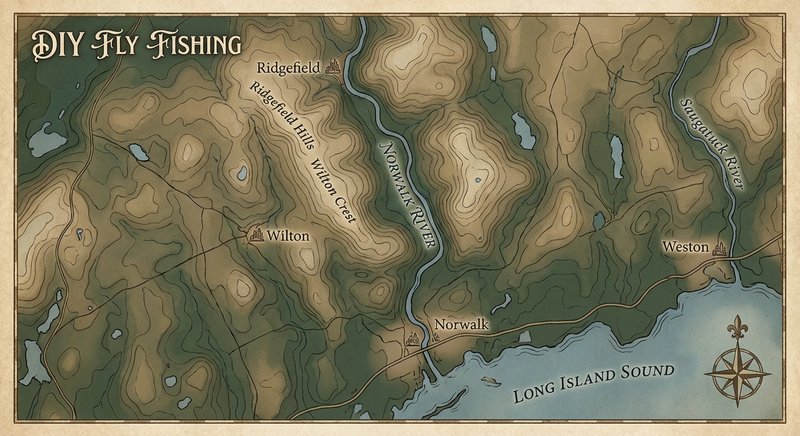
The Norwalk River is a small-to-medium-sized coastal stream that originates in Ridgefield and flows south through Wilton and Norwalk before emptying into Long Island Sound.
What makes it special is its designation as a Class 1 Wild Trout Management Area in certain stretches, meaning there is successful natural reproduction of brown trout. The river is characterized by classic pool-riffle-run sequences, punctuated by old mill dams and bridge abutments. It is primarily a freestone stream, sensitive to rainfall, but it holds cool temperatures well in the upper reaches due to canopy cover and groundwater springs.
🐟 Target Species & Behavior
- Brown Trout (Wild & Stocked): The "bread and butter" of the river. Wild browns here are notoriously spooky and favor heavy overhead cover. They hold in undercut banks, beneath downed timber, and in the deep "buckets" at the tail-outs of riffles.
- Sea-Run Brown Trout: The "unicorns" of the Norwalk. These are brown trout that have migrated to the brackish waters of the harbor or the Sound to forage, returning to the river to spawn. They are silver, powerful, and highly aggressive when they first enter the system.
- Behavior: During the day, fish are tight to structure. During low-light periods or high-water events, they move into the center of the current to feed on drifting nymphs and small baitfish.
📅 Best Times to Fish
- Spring (April – June): This is the prime window. Water levels are usually stable, and the primary insect hatches occur. May is the "Golden Month" for dry fly activity.
- Fall (Late September – November): As water temperatures drop, brown trout become aggressive ahead of the spawn. This is also the best time to encounter a sea-run brown moving up from the estuary.
- Time of Day: In the spring, midday is excellent. In the summer and early fall, the "first light" and "last light" windows are mandatory for success, especially for larger wild fish.
- Prime Conditions: A receding hydrograph after a rain event. "Tea-colored" water provides the stealth needed to fool the larger, more cautious residents.
🪰 Recommended Flies & Techniques
Nymphing (The most consistent producer)
The Norwalk is relatively shallow, making Euro Nymphing or "Tight-line" nymphing incredibly effective.
- Patterns: Pheasant Tail (size 14-18), Zebra Midge (size 18-22), Walt’s Worm, and Prince Nymphs.
- Pro Tip: Use a heavy tungsten bead to get down quickly in the small, deep pockets.
Dry Flies
When the hatches happen, they are localized but intense.
- Patterns: Blue-Winged Olives (BWO) (size 18-20), Tan/Olive Caddis (size 14-16), and Light Cahills in late May.
- Presentation: Use a long leader (9-12ft) and 6X tippet. These fish see a lot of pressure and will refuse a fly on a heavy line.
Streamers (For Sea-Runs and Trophy Browns)
- Patterns: Black or Olive Woolly Buggers, Sculpin patterns, and for the tidal sections, Ray’s Fly or small Flatwings.
- Technique: "Swing and strip." Cast toward the opposite bank, let it swing into the current, and use erratic strips to mimic a fleeing baitfish.
💡 Pro Tips & Local Knowledge
- The "Shadow" Game: Because the river is narrow, your shadow will spook fish 20 feet ahead of you. Always wade upstream and try to stay low. If possible, cast from the bank rather than standing in the water.
- Focus on Wilton: The stretches through Wilton Center and Merwin Meadows are highly productive. The "Loop" near the high school offers great access and a mix of water types.
- Tidal Influence: If you are hunting sea-run browns, focus on the section below the first major dam (near the Wall Street area in Norwalk). Fish the incoming tide; the salt-wedge pushes baitfish and predators upstream.
- The "Bow and Arrow" Cast: Much of the river is overgrown with mountain laurel and overhanging trees. Master the bow-and-arrow cast to get your fly into tight spots where others can't reach.
⚠️ Important Information
Access Information
- Merwin Meadows Park (Wilton): Excellent parking and easy access to some of the best-stocked and wild water.
- Norwalk River Valley Trail (NRVT): This trail runs alongside much of the river, providing miles of walking access to spots that don't see as much vehicle-side pressure.
- Schenck’s Island: A beautiful park in Wilton with great meadow-style water.
Regulations & Permits
- License: A valid Connecticut Fishing License and a Trout & Salmon Stamp are required.
- Class 1 WTMA: Note that specific stretches are Class 1 Wild Trout Management Areas. In these zones, it is often Catch and Release Only, Year-Round, and limited to single-point hooks. Always check the current CT DEEP Fishing Guide before heading out.
- Ethics: If you encounter fish on "redds" (bright gravel spawning beds) in late October or November, please leave them be to ensure the next generation of wild trout.
Special Considerations
- Water Quality: The Norwalk is an urban river. While much cleaner than it was decades ago, it is always wise to wash your hands after fishing and avoid fishing immediately after heavy sewage bypass warnings (though rare, they can occur after extreme floods).
Bug Hatches & Matching Flies
| Hatch | Type | Peak months | Time of day | Hook sizes | Matching flies |
|---|---|---|---|---|---|
| Blue Winged Olive Baetis spp. | mayfly | April, May, September, October | Mid-day/Afternoon | #18-22 | RS2 #20-22, Blue Winged Olive #18-22, Pheasant Tail #18-20 |
| Hendrickson Ephemerella subvaria | mayfly | April, May | Afternoon | #12-14 | Hendrickson #12-14, Red Quill #14, Hendrickson Nymph #12-14 |
| Tan Caddis Hydropsyche | caddis | May, June | Evening | #14-16 | Elk Hair Caddis #14-16, LaFontaine's Deep Sparkle Pupa #14-16, Holy Grail #16 |
| Sulfur Ephemerella invaria/dorothea | mayfly | May, June | Evening | #14-18 | Sulfur Parachute #16-18, Sulfur Emerger #16-18, Sulfur Spinner #16-18 |
| Light Cahill Stenonema/Stenacron | mayfly | June, July | Late Evening | #12-14 | Light Cahill #12-14, Cahill Wet Fly #12-14 |
| Trico Tricorythodes | mayfly | July, August, September | Morning | #22-26 | Trico Spinner #22-26, Trico Parachute #24 |
| Zebra Midge Chironomidae | midge | January, February, March | All Day | #18-24 | Zebra Midge #18-22, Griffith's Gnat #20-22, Black Midge Pupa #20 |
| Cinnamon Ant Formicidae | terrestrial | July, August, September | Afternoon | #14-18 | Cinnamon Ant #16-18, Black Foam Ant #14-16 |