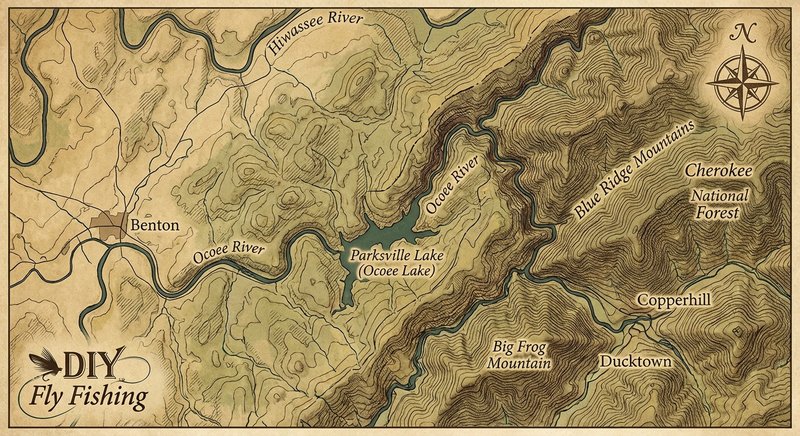
Ocoee River
Fly fishing in Tennessee · Intermediate · Best seasons: Spring, Summer, Fall
Target Species
Rainbow Trout, Brown Trout
About This Water
Famous whitewater river with trout in upper sections. Olympic venue for kayaking.
Fishing Recommendations
Welcome to one of the most unique and adrenaline-pumping fly fishing destinations in the Southeast. As your guide, I’ll tell you right now: the Ocoee River is a tale of two worlds. While it is world-famous for its Class III-V whitewater and the 1996 Olympics, it is a sleeper hit for trout anglers who understand the "rhythm of the river."
The Ocoee is the same river as the Toccoa in Georgia (the name changes at the state line). In Tennessee, it flows through the rugged Cherokee National Forest. This is technical, high-energy water that rewards the observant angler.
🎣 Location Overview
The Ocoee is divided into three distinct sections (Ocoee No. 1, No. 2, and No. 3). For the fly fisher, the Upper Ocoee (Section 3) and the stretches near the Georgia border are the primary focus.
The river is a "tailwater" managed by the Tennessee Valley Authority (TVA), but because it flows through a steep gorge, it feels like a wild mountain freestone. You’ll find massive boulders, deep plunges, and oxygen-rich pocket water. What makes it special is the seclusion—most people are here to raft the "Middle" section, leaving the upper reaches relatively quiet for those willing to hike and timing the dam releases correctly.
🐟 Target Species & Behavior
- Rainbow Trout: These are the "workhorses" of the Ocoee. You’ll find aggressive, acrobatic fish that love the fast water. They typically hold in the "pillows" in front of boulders or in the soft seams on the edges of heavy rapids.
- Brown Trout: The Ocoee holds some surprisingly large, buttery Browns. They are more predatory and secretive, hiding under undercut banks or at the very tail-outs of deep pools. During the fall, they become more aggressive as they prepare for the spawn.
Feeding Behavior: Because of the high gradient, these fish are opportunistic. They don't have long to inspect a fly in the fast current. If it looks like food and is at their depth, they will strike.
📅 Best Times to Fish
The Ocoee is entirely dependent on the TVA Release Schedule. If the water is "on" (generating/releasing for rafting), it is generally too dangerous and fast to fish.
- Spring (March – May): The prime window. Water temperatures are rising, and the bug life is waking up. The Quill Gordon and Blue Winged Olive (BWO) hatches can be spectacular.
- Summer (June – August): Best for "Early Bird" or "Late Evening" sessions. During the day, the river is often taken over by rafters. Focus on the weekdays when releases are less frequent.
- Fall (September – November): My personal favorite. The crowds vanish, the foliage is stunning, and the Orange Sedge (Caddis) hatch is legendary. Browns become very active.
- Time of Day: On non-release days, mid-morning to late afternoon is best. On release days, you must fish the "low water" windows before the wall of water arrives or after it recedes.
🪰 Recommended Flies & Techniques
Top Fly Patterns
- Nymphs:
- Sexy Walt’s Worm (Size 14-16) - Mimics general larvae.
- Pheasant Tail (Size 16-20) - A staple for BWO hatches.
- Girdle Bug/Pat’s Rubber Legs (Size 8-12) - The "Ocoee Special" for high water or mimicking stoneflies.
- Dry Flies:
- Elk Hair Caddis (Size 14-16) - Tan or Orange.
- Parachute Adams (Size 16-18) - The ultimate searcher pattern.
- Stimulator (Size 10-14) - Great for skating across riffles.
- Streamers:
- Wooly Bugger (Black or Olive) - Always works.
- Galloup’s Dungeon (White or Natural) - For targeting trophy Browns in the deep holes.
Techniques
- High-Stick Nymphing / Euro Nymphing: This is the most effective way to fish the Ocoee. The complex currents make getting a long, drag-free drift with a float nearly impossible. Use heavy tungsten beads to get down into the pockets between rocks.
- Dry-Dropper: In the summer, a big foam terrestrial (like a Chernobyl Ant) with a small nymph 18 inches below is deadly in the shallower riffles.
- The "Swing": Swinging soft hackles or small streamers through the tail-outs of pools can trigger explosive strikes from active fish.
💡 Pro Tips & Local Knowledge
- The "Secret" Window: Check the TVA Lake Info app religiously. Look for the "Ocoee No. 3" and "Ocoee No. 2" schedules. You want the "un-scheduled" hours.
- The State Line Stretch: The water near the "Twin Bridges" area (where TN and GA meet) offers excellent access and holds a high density of fish because it benefits from the colder water of the Toccoa tailwater upstream.
- Watch the Bubbles: In the heavy whitewater sections, fish the "bubble lines." If there are bubbles on the surface, there is a current seam below that carries food directly to the trout's "conveyor belt."
- Studded Boots are Mandatory: The rocks in the Ocoee are notoriously slick and often unstable. Do not attempt to wade this river in rubber-soled boots without aluminum or carbide studs.
⚠️ Important Information
- Access: Much of the river runs along Hwy 64. There are numerous pull-offs provided by the Forest Service. The Ocoee Whitewater Center is a great starting point for the Upper section.
- Regulations:
- A Tennessee Fishing License with a Trout Permit is required.
- If you cross the state line into Georgia, you must have a Georgia license. The state line is clearly marked at the "Twin Bridges."
- Check current TN Wildlife Resources Agency (TWRA) maps for "Special Regulation" zones, as some nearby tributaries have different size/creel limits.
- Safety Warning: The Ocoee is a powerful river. When the dams open, the water rises several feet in minutes. If you hear a siren or notice the water becoming muddy/rising—get out immediately. Always have an exit path planned.
Guide’s Final Word: The Ocoee isn't a river that gives up its secrets easily, but if you master the timing of the dams and learn to fish the pocket water, it offers some of the most exciting trout fishing in the Appalachian range. Tight lines!
Bug Hatches & Matching Flies
| Hatch | Type | Peak months | Time of day | Hook sizes | Matching flies |
|---|---|---|---|---|---|
| Blue Winged Olive Baetis | mayfly | March, April, October, November | Afternoon | #18-22 | RS2 #20-22, Parachute BWO #18-22, WD-40 #20-22 |
| Grannom Caddis Brachycentrus | caddis | April | All Day | #14-16 | Holy Grail #14-16, Elk Hair Caddis (Black) #14-16, Zebra Midge #16-18 |
| Sulfur Mayfly Ephemerella invaria | mayfly | May, June | Evening | #14-18 | Pheasant Tail Nymph #14-16, Sulfur Parachute #14-18, Sulfur Cripple #16 |
| Yellow Sally Isoperla | stonefly | May, June, July | Late Afternoon | #14-16 | Yellow Sally Dry #14-16, Iron Lotus #16, Stimulator (Yellow) #14-16 |
| Tan Caddis Hydropsyche | caddis | June, July, August, September | Evening | #14-18 | Caddis Pupa #14-16, Elk Hair Caddis (Tan) #14-18, X-Caddis #16-18 |
| Zebra Midge Chironomidae | midge | January, February, December | Morning | #20-24 | Zebra Midge (Red/Black) #20-24, Griffith's Gnat #20-22, Top Secret Midge #22-24 |
| Golden Stonefly Acroneuria | stonefly | June, July | All Day | #6-10 | Pat's Rubber Leg #6-10, Golden Stimulator #8-12, Prince Nymph #10-14 |
| Light Cahill Stenocron | mayfly | June, July | Evening | #12-14 | Light Cahill Dry #12-14, Hare's Ear Nymph #12-14, Cream Usual #14 |
| Terrestrials Formicidae / Coleoptera | terrestrial | July, August, September | All Day | #12-18 | Black Foam Ant #16-18, Dave's Hopper #10-12, Beetle (Foam) #14-16 |