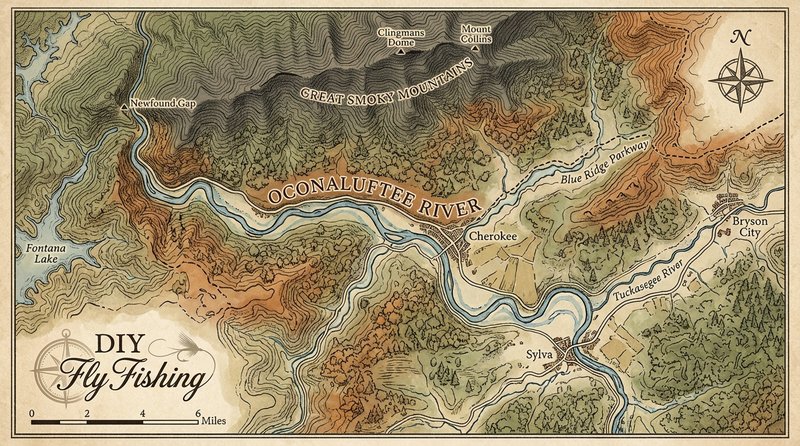
Oconaluftee River
Fly fishing in North Carolina · Beginner · Best seasons: Spring, Summer, Fall
Target Species
Rainbow Trout, Brown Trout
About This Water
Major stream in Great Smoky Mountains near Cherokee. Good access and wild trout.
Fishing Recommendations
The Oconaluftee River—affectionately known by locals as "The Luftee"—is one of the crown jewels of Southern Appalachian fly fishing. Located in Western North Carolina, it flows through both the Great Smoky Mountains National Park (GSMNP) and the Qualla Boundary (the Cherokee Indian Reservation). It offers a unique "dual personality": wild, technical fishing for native-born fish in the park, and world-class trophy trout opportunities in the managed Cherokee waters.
🎣 Location Overview
The Oconaluftee is a classic high-gradient freestone river. It is characterized by exceptionally clear water, large boulders, deep plunge pools, and long, glassy runs.
What makes it special is the sheer diversity of the experience. You can spend the morning targeting wild, "vibrant-as-jewels" Brook and Rainbow trout in the high-elevation headwaters, and spend the afternoon casting large streamers for 20-plus-inch "heavyweight" Browns in the lower stretches. The scenery is unmatched, often featuring sightings of the valley’s famous elk herd.
🐟 Target Species & Behavior
- Rainbow Trout: In the National Park sections, these are wild, acrobatic fish that hold in the "heavy water" or at the heads of pools. In the Cherokee Trophy section, they are stocked frequently and can reach massive proportions (5–8 lbs).
- Brown Trout: The Luftee is famous for its wild Brown Trout. They are nocturnal and predatory. They tend to hold in deep undercut banks, under overhanging rhododendrons, or in the dark shadows of large boulders.
- Southern Appalachian Brook Trout: Found primarily in the high-altitude tributaries (like Beech Flats Prong) above 3,000 feet. They are opportunistic feeders but very spooky.
📅 Best Times to Fish
Spring (March – May)
The "Prime Time." This is when the most prolific hatches occur.
- Conditions: Water temperatures rise into the 50s, triggering insect activity.
- Window: Mid-morning to late afternoon. Look for the Quill Gordon and March Brown hatches in March and April.
Summer (June – August)
Great for high-country exploration.
- Conditions: The lower sections can get warm; focus on the shaded park sections or the "Trophy Water" which stays cooler due to depth.
- Window: Early morning and "the witching hour" (dusk). This is peak Terrestrial season (ants, beetles, and hoppers).
Fall (September – November)
The most scenic time and the best chance for a "Wall Hanger" Brown.
- Conditions: Cooling water and the Brown Trout spawn.
- Window: All day. Brown Trout become aggressive and territorial. October Caddis are a highlight hatch.
🪰 Recommended Flies & Techniques
Top Fly Patterns
- Dry Flies: Parachute Adams (size 12-18), Elk Hair Caddis (tan/yellow), Stimulators (orange/yellow), and the local favorite, the Never Sink Caddis.
- Nymphs: Pheasant Tail (flashback), Prince Nymph, Frenchie, and Pat’s Rubber Legs (stonefly imitation) for high water.
- Streamers: Black or Olive Wooly Buggers, Sex Dungeons (for the Trophy section), and Sparkle Minnows.
Effective Techniques
- Tight-Line/Euro Nymphing: Because the Luftee has complex currents and "pockets," a high-sticking or Euro technique is incredibly effective to avoid drag.
- Dry-Dropper: This is the "bread and butter" for the Luftee. Use a buoyant Stimulator or Hopper on top and a weighted nymph (6–18 inches below) to cover two columns of water.
- Streamer Stripping: In the Cherokee Trophy section, use a sink-tip line and "strip-pause" large streamers near structure to entice big Browns.
💡 Pro Tips & Local Knowledge
- The Stealth Factor: Because the water is "gin-clear," your approach is more important than your fly. Wade slowly, wear earthy tones (no white hats!), and use long leaders (9–12 feet) with 5x or 6x fluorocarbon tippet.
- Target the "Seams": On the Luftee, trout love the "seam" where fast water meets slow water. If you see a bubble line, there is likely a trout underneath it.
- The Cherokee "Trophy Water": If you want a fish for the record books, fish the 2.2-mile stretch of "Catch and Release" water in the Qualla Boundary. These fish are educated—use smaller midges if the big stuff isn't working.
- Watch the Elk: If you see elk in the water, the fishing in that immediate spot will be blown for 20 minutes. Move upstream and enjoy the view.
⚠️ Important Information
Access Information
- In the Park: US-441 runs parallel to the river for miles, offering dozens of pull-offs. The closer you get to the Smokemont Campground, the better the wading access.
- In Cherokee: Access is easy through the town of Cherokee with many designated parking areas along the river banks.
Regulations & Permits
This is the most critical part for the Oconaluftee:
- GSMNP Waters: You need either a valid NC or TN state fishing license. No special park permit is required. No corn, bread, or live bait—artificial lures with a single hook only.
- Cherokee (EBCI) Waters: You MUST have a specific Tribal Fishing Permit (purchased locally or online at fishcherokee.com). A standard NC state license is not valid here.
- Trophy Section: Requires an additional "Trophy Trout" permit on top of the daily tribal permit.
Special Considerations
- Wading Safety: The rocks are notoriously "greasy." Felt-soled boots or studs are highly recommended.
- Wildlife: This is bear country. Keep your food secured and be aware of your surroundings, especially when cleaning fish (where legal).
Bug Hatches & Matching Flies
| Hatch | Type | Peak months | Time of day | Hook sizes | Matching flies |
|---|---|---|---|---|---|
| Quill Gordon Epeorus pleuralis | mayfly | March, April | Mid-day to Afternoon | #12-14 | Quill Gordon Dry #12-14, Quill Gordon Wet #12-14 |
| Blue Quill Paraleptophlebia adoptiva | mayfly | March, April | Late Morning to Afternoon | #16-18 | Blue Quill Dry #16-18, Pheasant Tail Nymph #16-18 |
| Yellow Sally Isoperla spp. | stonefly | May, June, July | Late Afternoon to Evening | #14-16 | Yellow Sally Stone #14-16, Iron Lotus (Yellow) #14-16 |
| Light Cahill Stenacron interpunctatum | mayfly | May, June, July | Evening | #12-16 | Light Cahill #12-16, Gold Ribbed Hare's Ear #14-16 |
| Slate Drake (Isonychia) Isonychia bicolor | mayfly | May, June, September, October | Evening | #10-12 | Isola Nymph #10-12, Parachute Adams #10-12 |
| Blue Winged Olive (BWO) Baetis spp. | mayfly | February, March, October, November | Mid-day | #18-22 | BWO Sparkle Dun #18-22, RS2 #20-22 |
| Green Sedge Rhyacophila spp. | caddis | April, May, June | Morning and Evening | #12-16 | Green Weenie #12-16, Elk Hair Caddis (Olive) #14-16 |
| October Caddis Pycnopsyche spp. | caddis | September, October, November | Late Afternoon to Evening | #8-12 | Stimulator (Orange) #8-10, Orange Soft Hackle #12 |
| Terrestrials Formicidae / Coleoptera | terrestrial | July, August, September | All Day | #12-18 | Parachute Ant #16-18, Foam Beetle #14-16 |