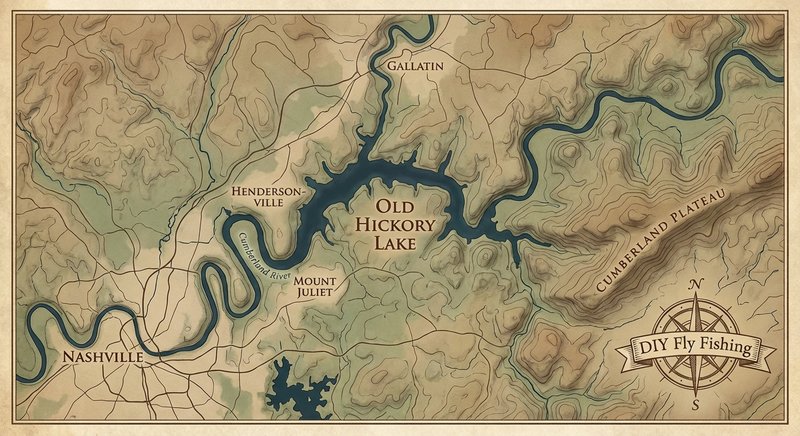
Old Hickory Lake
Fly fishing in Tennessee · Beginner · Best seasons: Spring, Summer, Fall
Target Species
Largemouth Bass, Striped Bass, Crappie
About This Water
Nashville area reservoir with excellent bass fishing. Good striper runs.
Fishing Recommendations
Old Hickory Lake is a legendary piece of water on the Cumberland River system, just a stone's throw from Nashville. As a guide, I view Old Hickory as a "blue-collar" powerhouse—it’s not a crystal-clear mountain lake, but it is incredibly fertile and produces massive fish for those who understand its riverine nature.
🎣 Location Overview
Old Hickory is a "run-of-the-river" reservoir, meaning it behaves more like a massive, slow-moving river than a static lake. Stretching 57 miles from Carthage to the dam in Hendersonville, it covers over 22,000 acres.
What makes it special for the fly angler is the abundance of aquatic vegetation (milfoil and hydrilla) and the current. Unlike many Tennessee highland reservoirs that are deep and rocky, Old Hickory is relatively shallow with expansive flats, thousands of boat docks, and lush grass beds. This creates a perfect environment for warm-water fly fishing, offering "bass pond" styles of fishing on a massive scale.
🐟 Target Species & Behavior
Largemouth Bass
Old Hickory is a premier bass destination. These fish are "structure-oriented." In the spring, they move to the back of the creeks to spawn. In the summer and fall, they live in the main-lake grass beds and under the shadows of the countless boat docks. They primarily feed on Gizzard and Threadfin Shad, but they are also opportunistic crawfish and bluegill eaters.
Striped Bass (Rockfish)
These are the kings of the river. They thrive in the cooler, moving water of the main channel. They are nomadic, following massive schools of shad. During high-generation periods at the dams, they become aggressive predators, often "busting" bait on the surface in the early mornings.
Crappie
While often targeted by gear anglers with minnows, Old Hickory crappie are suckers for a well-presented fly. They hold tight to submerged brush piles, bridge pilings, and "fish attractors" placed by the TWRA. They are ambush predators that look for small minnows and insect larvae.
📅 Best Times to Fish
- Spring (March – May): The "Big Fish" window. As water hits 55-60°F, Largemouth move shallow. This is the best time for sight-fishing in the back of the creeks.
- Summer (June – August): The "Topwater" window. Low light is your friend. Fish the crack of dawn (5:00 AM – 8:00 AM) or the "witching hour" before sunset. Look for Stripers crashing bait in the main channel when the turbines are running at the dam.
- Fall (September – November): The "Shad Migration." As temperatures drop, shad move into the creeks, and the bass follow them in a feeding frenzy. This is arguably the most fun time for a fly fisher, as the fish are aggressive and shallow.
Prime Window: Always check the TVA Lake Info app. When the dams are "generating" (releasing water), the current kicks the food chain into gear. Moving water = Biting fish.
🪰 Recommended Flies & Techniques
For Largemouth Bass
- Patterns: BoogleBugs (Poppers), Gamechangers (White/Chartreuse), and Dahlberg Divers. For subsurface, use a Clouser Minnow or a Rubber-Legged Dragon.
- Technique: "Chugging" poppers over the edges of grass mats or skipping streamers under boat docks.
- Presentation: If fishing grass, use a weedguard. Strip-pause-strip. The pause is usually when the strike occurs.
For Striped Bass
- Patterns: 4–6 inch Hollow Fleyes, Leftys Deceivers, and heavy EP Fiber Minnows.
- Technique: You need an 8-weight or 9-weight rod with a sinking tip line (250–350 grains). Cast into the current seams near the main channel and strip fast.
- Presentation: Strip as fast as you can. You cannot outswim a Striper.
For Crappie
- Patterns: Size 8-10 Wooly Buggers (White, Pink, or Chartreuse), Mop Flies, and small Micro-Clousers.
- Technique: Use a 3-weight or 4-weight rod with a slow-sinking leader or a strike indicator.
- Presentation: Vertical jigging the fly over brush piles or a very slow "count-down" retrieve near bridge pilings.
💡 Pro Tips & Local Knowledge
- The "Grass" is King: If you find submerged hydrilla in 4–6 feet of water with a nearby drop-off to 10 feet, you’ve found a goldmine. Use a floating line and a long leader to work the "pockets" in the grass.
- The Tailwaters: The area below Old Hickory Dam (the headwaters of Cheatham Lake) is world-class for Striped Bass. If you have a boat that can handle swifter water, the "Boils" just below the dam are where the giants live.
- The Shade Factor: Old Hickory bass are sun-sensitive. On bright days, if a dock has a pontoon boat or a roof, the bass will be in the darkest shadow possible. You must be able to "side-arm" cast or skip your fly under the structure.
- Color Palette: Old Hickory water is rarely crystal clear. Use Chartreuse, White, and Black/Blue. If the water is "TN Mud," go with solid Black to provide a silhouette.
⚠️ Important Information
- Access: There are dozens of public boat ramps (Laguardo, Sanders Ferry, Shutes Branch). For fly anglers without a boat, Bledsoe Creek State Park offers some decent bank access and wading opportunities in the creek arms.
- Regulations: A valid Tennessee Fishing License is required. Check the TWRA (Tennessee Wildlife Resources Agency) handbook for specific length and creel limits, especially for Striped Bass, which have strict seasonal size requirements.
- Safety: This is a commercial waterway. Watch out for barges in the main channel—they cannot stop or turn quickly. Also, keep an eye on the weather; the lake is north-south oriented, and a strong wind can whip up "whitecaps" very quickly.
Guide’s Final Word: Old Hickory isn't about delicate presentations to rising trout. It’s about heavy rods, big flies, and being on the water when the current is moving. Hook into a 20lb Striper or a 6lb Largemouth in the grass, and you'll see why we love this muddy river.
Bug Hatches & Matching Flies
| Hatch | Type | Peak months | Time of day | Hook sizes | Matching flies |
|---|---|---|---|---|---|
| Giant Mayfly (Hex) Hexagenia limbata | mayfly | June, July | Dusk/Night | #6-10 | Hexagenia Dry #6-8, Burrowing Mayfly Nymph #8-10, Hex Emerger #8 |
| White Fly Ephoron leukon | mayfly | August, September | Evening/Dusk | #12-14 | White Wulff #12-14, Ephoron Spinner #14, White Sparkle Dun #12-14 |
| Midges Chironomidae | midge | March, April, October, November | All Day | #18-24 | Zebra Midge #18-22, Griffith's Gnat #20-24, RS2 #20-22 |
| Cinnamon Caddis Hydropsyche | caddis | May, June, September | Evening | #14-18 | Elk Hair Caddis (Cinnamon) #14-16, Hydropsyche Larva #14-16, Pupa Sparkle Caddis #16 |
| Tricos Tricorythodes | mayfly | July, August, September | Early Morning | #20-24 | Trico Spinner #22-24, Trico Dun #20-22 |
| Angler's Curse Caenis | mayfly | June, July, August | Early Morning | #22-26 | Caenis Spinner #24-26, Micro-midge Larva #24 |
| Black Ants Formicidae | terrestrial | June, July, August | Afternoon | #14-20 | Chernobyl Ant #12-14, Black Foam Ant #16-18 |
| Annual Cicada Neotibicen canicularis | terrestrial | July, August | All Day | #4-8 | Cicada Foam Fly #6-8, Project Cicada #6 |