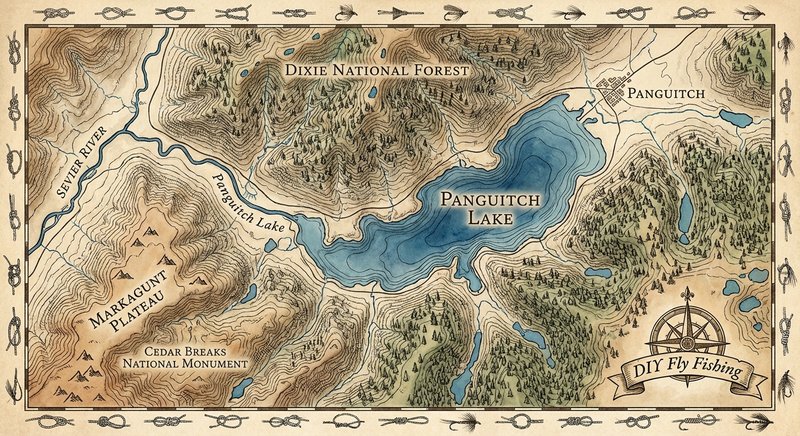
Panguitch Lake
Fly fishing in Utah · Beginner · Best seasons: Summer, Fall
Target Species
Rainbow Trout, Cutthroat Trout
About This Water
Southern Utah lake with excellent rainbow trout. Near Bryce Canyon.
Fishing Recommendations
Welcome to Panguitch Lake, one of the crown jewels of high-altitude stillwater fishing in the Western United States. The name "Panguitch" translates to "Big Fish" in the Southern Paiute language—and this lake lives up to that reputation every single season.
Sitting at 8,200 feet in the Dixie National Forest of Southern Utah, Panguitch is a highly productive, alkaline lake that functions like a massive food factory for trout. If you are looking for thick-bodied fish that fight hard, this is your destination.
🎣 Location Overview
Panguitch Lake is a high-mountain desert oasis. What makes it special is its productivity. Because the water is slightly alkaline and relatively shallow (maximum depth around 66 feet, but mostly much shallower), it produces staggering amounts of aquatic insects, scuds (freshwater shrimp), and snails.
The water is generally clear but can develop "algae blooms" in late summer. For the fly angler, the lake offers a mix of volcanic rock shorelines and vast weed beds. It is a premier stillwater destination where a float tube or a small boat is a massive advantage, though wade fishing is very productive during certain hatches.
🐟 Target Species & Behavior
The lake is managed for trophy potential, meaning the fish grow fast and get large.
- Rainbow Trout: These are the "workhorses" of the lake. They are aggressive, frequent the shallow flats to feed, and are often found cruising the edges of weed beds.
- Bear Lake Cutthroat Trout: These fish are leaner and meaner. They tend to stay slightly deeper than rainbows but move into the shallows during the early morning and late evening. They are known for their spectacular colors and willingness to chase streamers.
- The "Bonus" Species (Tiger Trout): While you asked for Rainbows and Cutthroats, you cannot fish Panguitch without encountering Tiger Trout. These hybrids are piscivorous (fish-eaters) and are often the largest fish in the lake, reaching upwards of 25 inches.
Behavior: During the summer, fish stay near the thermocline or deep in the weed beds to stay cool. In the fall, they go on a feeding binge to prepare for winter, moving into very shallow water (3–6 feet).
📅 Best Times to Fish
Summer (Late June – August)
- Window: Early morning (dawn until 10:00 AM) and "The Magic Hour" (sunset).
- Conditions: Mid-day can be tough due to the high-altitude sun heating the surface. Look for wind-chopped water (the "Panguitch Chop"), which provides cover for the fish to feed in the shallows.
Fall (September – Early November)
- Window: This is arguably the best time for "Big Fish." As water temperatures drop, trout move toward the shorelines.
- Conditions: Overcast, slightly breezy days are prime. The fish lose their wariness and become much more aggressive toward streamers.
🪰 Recommended Flies & Techniques
Top Fly Patterns
- Chironomids (Midges): Ice Cream Cone (red, black, or zebra) in sizes 12–16.
- Scuds: This is the primary protein source. Use flashback scuds in olive, orange, or "dead" gray (sizes 14–18).
- Leeches/Streamers: The Balanced Leech (black, olive, or bruiser) is deadly under an indicator. For stripping, use Wooly Buggers or Pine Squirrel Leeches.
- Dries: During summer evenings, Callibaetis spinners or Parachute Adams (size 14–16) work well when the wind dies down.
Effective Techniques
- The "Static" Indicator Rig: Suspend two flies (a leech and a midge or scud) under a slip-indicator. Set your depth so the bottom fly is about 12–18 inches off the lake floor or just above the weed beds.
- The Slow Strip: Use an intermediate sinking line (1.5–2.0 ips). Cast over the weed edges, let it sink for 5–10 seconds, and use a slow, "hand-over-hand" retrieve.
- Drying: If you see "head-and-tail" rises in the evening, the fish are taking Callibaetis. Use a long leader (12ft+) to avoid spooking them.
💡 Pro Tips & Local Knowledge
- The "North Shore" Rocks: The north side of the lake has rocky drop-offs. This is a prime spot for Cutthroat trout. If the wind is blowing into the shore, the fishing is usually better as it pushes bait and insects toward the rocks.
- Watch the Weeds: If you aren't catching fish, you are likely too deep or too shallow relative to the weed line. Most fish at Panguitch hold right on the "crown" of the submerged weeds.
- The "Panguitch Twitch": When fishing under an indicator, don't just let it sit. Every 30 seconds, give your line a sharp 6-inch twitch. This often triggers a strike from a trout that was just "inspecting" your fly.
- The Spring Creeks: In the early summer, focus near the inlets of Blue Springs Creek and Clear Creek. Fish congregate here for oxygen and cooler water.
⚠️ Important Information
Regulations (Crucial!)
Panguitch has specific Slot Limits to protect the fishery.
- Current Rule: You must immediately release any trout between 15 and 22 inches.
- You may keep trout under 15 inches or over 22 inches (limit of 4, with only 1 over 22").
- Note: Always check the current Utah Fishing Guidebook as rules can change annually.
Access
- Public Access: There are several Forest Service access points with parking. The "North Shore" and "South Shore" boat ramps are the most common entry points.
- Safety: The wind can kick up extremely fast at this altitude. If you are in a float tube and see whitecaps forming, get to shore immediately.
Gear Recommendations
- Rod: 5-weight or 6-weight (9 or 10 feet long). The extra length helps with long-leader indicator rigs.
- Line: A Weight Forward Floating line is a must; an Intermediate Sinking line is highly recommended for fall streamer fishing.
- Leader: 3X or 4X fluorocarbon. These fish are strong and the weeds are thick—don't go too light or you'll lose the big ones.
Tight lines, and enjoy the "Big Fish" of the high country!
Bug Hatches & Matching Flies
| Hatch | Type | Peak months | Time of day | Hook sizes | Matching flies |
|---|---|---|---|---|---|
| Chironomids (Midges) Chironomidae | midge | May, June, September | All Day | #12-20 | Ice Cream Cone #12-18, Zebra Midge #16-20, Griffith's Gnat #18-22 |
| Callibaetis (Speckled Duns) Callibaetis | mayfly | June, July, August | Morning/Afternoon | #12-16 | Callibaetis Spinner #14-16, Hare's Ear Nymph #12-16, Parachute Adams #14-16 |
| Damselflies Enallagma | terrestrial | June, July | Morning/Afternoon | #10-14 | Marabou Damsel #10-12, Adult Damsel #12-14, Burk's Damsel #12-14 |
| Scuds (Freshwater Shrimp) Gammarus lacustris | crustacean | April, May, October, November | All Day | #12-16 | Ray Charles #14-16, Orange Scud #12-16, Olive Flashback Scud #12-16 |
| Caddis (Traveling Sedges) Trichoptera | caddis | July, August | Evening | #12-16 | Elk Hair Caddis #12-16, LaFontaine's Deep Sparkle Pupa #14-16, Godzilla Caddis #10-12 |
| Leeches Hirudinea | annelid | May, June, September | Low Light/Overcast | #8-12 | Balanced Leech #8-12, Woolly Bugger (Olive/Black) #6-12, Mohair Leech #10-12 |
| Water Boatmen & Backswimmers Corixidae / Notonectidae | terrestrial | September, October | Afternoon | #12-16 | Water Boatman #14-16, Prince Nymph #12-16 |
| Terrestrials (Beetles/Ants) Coleoptera / Formicidae | terrestrial | July, August | Afternoon | #10-16 | Black Foam Beetle #12-16, Cinnamon Ant #14-16, Chernobyl Ant #8-12 |