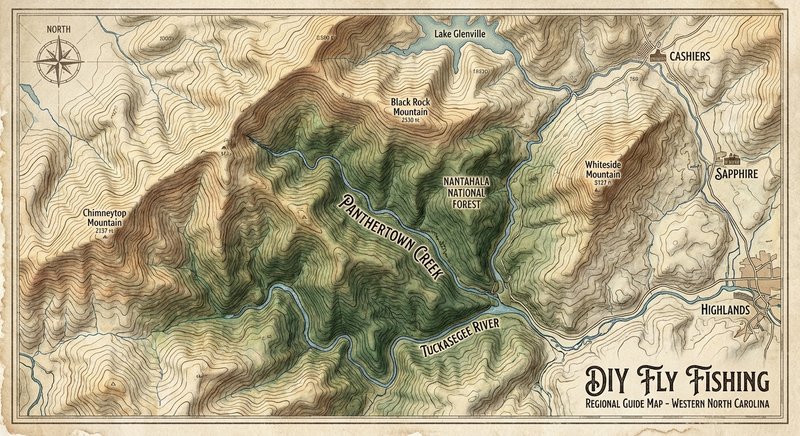
Panthertown Creek
Fly fishing in North Carolina · Intermediate · Best seasons: Spring, Summer, Fall
Target Species
Brook Trout, Rainbow Trout, Brown Trout
About This Water
Wilderness stream in Panthertown Valley. Native brook trout in headwaters.
Fishing Recommendations
Welcome to "The Yosemite of the East." As your guide, I can tell you that Panthertown Creek, located within the Panthertown Valley near Cashiers, North Carolina, is one of the most visually stunning and unique fly fishing destinations in the Southern Appalachians.
This isn't your typical high-gradient mountain stream crashing over boulders. Instead, it offers a rare "spring creek" feel set within a high-altitude sandy basin.
🎣 Location Overview
Panthertown Creek is the centerpiece of a 6,300-acre wilderness area. What makes it special is its geomorphology. While most WNC streams are steep and rocky, Panthertown Creek meanders through a flat, high-elevation valley floor.
The water is characterized by deep, dark tea-colored pools (tannic water), undercut banks, and fine white sand bottoms. It is slow-moving compared to the nearby Tuckasegee or Cullasaja, requiring a stealthy approach. The surrounding scenery—massive granite domes and rare bog ecosystems—makes it feel more like the Rocky Mountains than the Blue Ridge.
🐟 Target Species & Behavior
The valley is a sanctuary for both native and wild trout:
- Southern Appalachian Brook Trout: These are the stars of the show. They are native to these headwaters and are found primarily in the upper reaches and the smaller feeder tributaries. They are opportunistic but wary.
- Wild Brown Trout: The "kings" of the deeper, dark tea-colored holes. They use the undercut banks and submerged timber for cover. They are notoriously spooky and often require "one-shot" accuracy.
- Wild Rainbow Trout: Usually found in the faster-moving water at the heads of pools or where the creek begins to pick up gradient as it exits the valley.
Behavior: Because the water is clear and relatively slow, these fish have a wide field of vision. They are highly sensitive to "shadow flash" and heavy footsteps on the sandy banks.
📅 Best Times to Fish
- Spring (Late March – June): This is the prime window. As the valley warms, the insect life explodes. The water levels are usually perfect, and the fish are hungry after the winter lean.
- Summer (July – August): While many WNC streams get too hot, Panthertown’s high elevation (3,600+ ft) keeps the water cooler. However, focus on early mornings and late evenings. This is "Terrestrial Heaven."
- Fall (September – November): The most beautiful time to be in the valley. Brown trout become aggressive as they prepare to spawn, and the Brookies take on brilliant orange spawning colors.
Prime Window: 10:00 AM to 4:00 PM in the Spring; Dawn and Dusk in the Summer.
🪰 Recommended Flies & Techniques
Top Fly Patterns
- Dry Flies: Yellow Stimulators (size 14-16), Royal Wulff, Elk Hair Caddis, and the Parachute Adams (size 16-20).
- Terrestrials (Summer Must-Haves): Foam Beetles, Dave’s Hopper, and small Cinnamon Ants (size 18).
- Nymphs: Pheasant Tail Nymphs, Hare’s Ear, and small black Zebra Midges.
- Streamers: Small Woolly Buggers (Black or Olive) to mimic leeches or crawfish in the deep holes.
Techniques & Presentation
- Stealth Nymphing: Use a "Dry-Dropper" rig. A buoyant dry fly (like a Stimulator) with a small unweighted nymph 18 inches below it is deadly here.
- The "Crawl": Because the banks are often flat and open, you should literally crawl into position to avoid being silhouetted against the sky.
- Downstream Drifts: Sometimes, a traditional upstream cast is impossible due to overhanging rhododendrons. A "downstream drift" where you feed line out can be highly effective for reaching spooky Browns under banks.
💡 Pro Tips & Local Knowledge
- The Sand Factor: The sand bottom is beautiful but unstable. Don't expect firm footing in the middle of the creek. Furthermore, trout don't hold over open sand as often as they do near "structure"—look for submerged logs, root balls, and where the sand meets the darker mud or rock.
- Mind the Tannins: The water looks darker than it is. While it provides some cover for the fish, they can see you much better than you can see them.
- Feeder Streams: Don't just stick to the main stem. Explore the small tributaries like Greenland Creek. These often hold the purest strains of native Brookies.
- Long Leaders: Use a 9-foot or even 12-foot leader tapered to 6X. The slow water gives the fish plenty of time to inspect your tippet.
⚠️ Important Information
- Access: The most common access is via the Cold Mountain Entrance (near Lake Toxaway) or the Salt Rock Entrance (near Cashiers). Be prepared for a hike; you will be walking at least 1–3 miles to reach the best water.
- Regulations: Panthertown Creek is designated as Catch and Release, Artificial Lures Only (Wild Trout Waters). Always check the NC Wildlife Resources Commission (NCWRC) map for the most current boundaries.
- Safety: This is a wilderness area. Cell service is non-existent. Bring a map (the "Panthertown Valley" map by Burt Kornegay is the gold standard).
- Bear Country: This is an active Black Bear corridor. Keep food sealed and be "Bear Aware."
Guide’s Final Word: Panthertown is not a numbers game; it's an experience. Come for the solitude and the chance to catch a native Brookie in one of the most prehistoric-looking landscapes in the South. Tight lines!
Bug Hatches & Matching Flies
| Hatch | Type | Peak months | Time of day | Hook sizes | Matching flies |
|---|---|---|---|---|---|
| Quill Gordon Epeorus pleuralis | mayfly | March, April | Midday | #12-14 | Quill Gordon Dry #12-14, Quill Gordon Wet Fly #12-14, Pheasant Tail Nymph #12-16 |
| Blue Winged Olive Baetis | mayfly | March, April, October, November | Midday/Afternoon | #18-22 | Parachute Adams #18-22, RS2 #20-22, BWO Nymph #18-20 |
| Yellow Sally Isoperla | stonefly | May, June, July | Late Afternoon/Evening | #14-16 | Yellow Stimulator #14-16, Little Yellow Sloan #14-16, Iron Lotus #16 |
| March Brown Maccaffertium vicarium | mayfly | April, May | Midday/Afternoon | #12-14 | March Brown American #12-14, Gold Ribbed Hare's Ear #12-14, March Brown Wet #12-14 |
| Light Cahill Stenacron / Stenonema | mayfly | June, July | Evening | #14-16 | Light Cahill Dry #14-16, Cream Usual #14-18 |
| Cinnamon Caddis Hydropsyche | caddis | May, June, July, August | Morning/Evening | #14-18 | Elk Hair Caddis (Tan/Ginger) #14-18, Holy Grail #16, Peeping Caddis #14-16 |
| Terrestrials (Ants and Beetles) Formicidae / Coleoptera | terrestrial | July, August, September | All Day | #12-18 | Foam Beetle #14-16, Cinnamon Ant #16-18, Amy's Ant #12-14 |
| Giant Black Stonefly Pteronarcys dorsata | stonefly | April, May | Morning/Afternoon | #6-10 | Girdle Bug (Pat's Rubber Legs) #6-10, Kaufmann's Stone #8-10 |