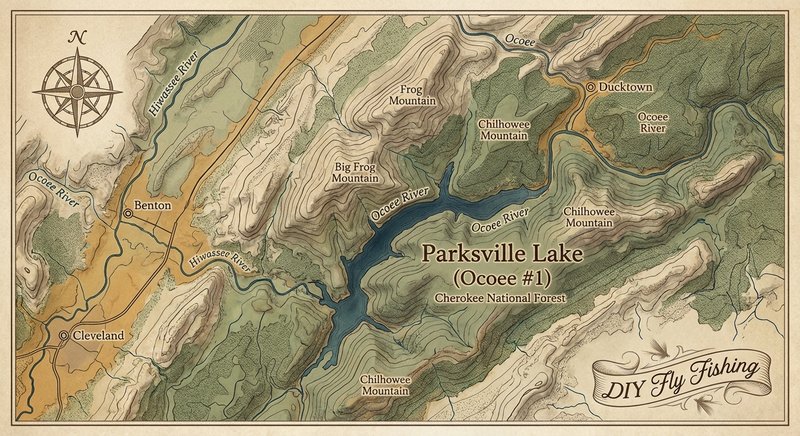
Parksville Lake (Ocoee #1)
Fly fishing in Tennessee · Beginner · Best seasons: Spring, Summer, Fall
Target Species
Rainbow Trout, Largemouth Bass, Walleye
About This Water
Mountain reservoir with trout and bass. Scenic fishing in Cherokee National Forest.
Fishing Recommendations
Tight lines! As your guide for the day, I’m excited to break down Parksville Lake, also known as Ocoee #1. Located in the heart of the Cherokee National Forest in Polk County, Tennessee, this is the oldest reservoir in the TVA system.
Parksville is a unique beast for a fly angler. It is an "oligotrophic" lake—meaning it is deep, cold, and low in nutrients. While it doesn't have the high fish density of some lowland reservoirs, it offers incredible water clarity and some of the most stunning mountain scenery in the Southeast.
🎣 Location Overview
Parksville Lake is a 1,900-acre emerald gem nestled in the shadows of the Blue Ridge Mountains. What makes it special is its transitionary nature; it is where the high-gradient, whitewater-famous Ocoee River slows down and settles.
Anglers love Parksville for its clarity. In a state where many lakes can turn "muddy," Parksville usually stays clear, allowing for sight-fishing opportunities on the banks. Because much of the shoreline is federally protected, you won't see the heavy dock development found on other lakes, giving it a "wilderness" feel even though it’s easily accessible via Highway 64.
🐟 Target Species & Behavior
Rainbow Trout
These aren't your typical lake trout. The TWRA stocks rainbows here, but they behave more like river fish near the upper end of the lake.
- Behavior: They hold in the "transition zone" where the Ocoee River enters the lake. They thrive in the oxygenated, colder water coming off the Ocoee #2 flume.
- Feeding: They focus on midge larvae, small terrestrial insects, and tiny shad.
Largemouth & Spotted Bass
Parksville has a healthy population of both. The Spotted Bass here are particularly aggressive.
- Behavior: During the day, they hold deep against the steep rock bluffs. In the low light of morning and evening, they move to the "shelves" and downed timber to hunt.
- Feeding: Their primary forage is threadfin shad and crawfish.
Walleye
The "ghosts" of Parksville.
- Behavior: They are light-sensitive. During the day, they are 20–40 feet deep. In the spring, they make a legendary run up the Ocoee River channel to spawn.
- Feeding: They are strictly piscivorous (fish-eaters) in this lake, targeting shad and small perch.
📅 Best Times to Fish
- Spring (March – May): Prime Time. This is when the Walleye run up the river channel and Bass move into the shallows (5–10 feet) to spawn. The Trout are most active in the upper third of the lake.
- Summer (June – August): Best for Night Fishing or "Dawn Patrol." The water is clear, so fish go deep during the day to avoid the sun. Target the thermocline (usually 15–20 feet down).
- Fall (September – November): The "Second Spring." As the water cools, Bass chase shad into the backs of the creeks (like Greasy Creek). This is the best time for topwater fly fishing.
- Optimal Windows: The first two hours of daylight and the last hour before dark are critical due to the high water clarity.
🪰 Recommended Flies & Techniques
For Rainbow Trout
- Technique: Indicator nymphing near the river mouth or stripping small streamers.
- Flies:
- Zebra Midges (Size 18-22) in red or silver.
- Woolly Buggers (Size 8-12) in white or olive to mimic small shad.
- Soft Hackle Pheasant Tails during a morning hatch.
For Bass
- Technique: "Banging the banks." Cast toward downed timber or rock walls.
- Flies:
- Gamechangers (White/Chartreuse): These mimic the erratic motion of a wounded shad.
- Clouser Minnows: Essential for getting down to the Spotted Bass. Use lead eyes to reach the 10-foot mark.
- Poppers: In the evening, use hard-body poppers in black or frog patterns near the shadows of the bluffs.
For Walleye
- Technique: Heavy sinking lines (Type 5 or 7) are a must. You have to "dredge" the bottom of the river channel.
- Flies:
- Large Clouser Minnows (Size 2/0) in Chartreuse/White or Orange/Gold.
- Bunny Leeches: The movement of rabbit fur is irresistible to a slow-moving Walleye.
💡 Pro Tips & Local Knowledge
- The "River Mouth" Secret: The area where the Ocoee River enters the lake (near the Ocoee Whitewater Center and the flume discharge) is the highest-percentage spot for Trout. The moving water keeps the temperature lower and the oxygen higher.
- Mind the Clarity: Because the water is so clear, drop your tippet size. If you usually use 12lb fluoro for bass, drop to 8lb. For trout, use 5x or 6x fluorocarbon.
- The "Shadow Line": On Parksville, the mountains create massive shadows on the water long before the sun actually sets. Fish the "shadow line" as it moves across the lake; predators use this edge to ambush prey.
- TVA App: Always check the TVA Lake Info app. Look at the release schedule for Ocoee #2 and #3. High releases from the upstream dams can create "current" in the upper lake, which turns the bite on.
⚠️ Important Information
- Access:
- King’s Slough and Greasy Creek are the best boat ramps for fly anglers.
- For shore-based fly fishing, the area around the Parksville Beach and the Ocoee No. 1 Boat Launch offers some wading/bank room.
- Regulations:
- A Tennessee Fishing License is required.
- If you are targeting Trout, you must have a Trout Supplement.
- Check the current TWRA Fishing Guide for specific length and creel limits, as they can change annually.
- Safety: The Ocoee is a managed power river. Be aware of rising water levels if you are fishing the upper river section. Also, the lake can get busy with recreational boaters on summer weekends—weekdays are highly recommended for the best experience.
Guide’s Final Word: Parksville isn't a "numbers" lake, but it is a "quality" lake. Bring your 6-weight for the bass and a 4-weight for the trout, and enjoy the most beautiful lake in Tennessee.
Bug Hatches & Matching Flies
| Hatch | Type | Peak months | Time of day | Hook sizes | Matching flies |
|---|---|---|---|---|---|
| Chironomids Chironomidae | midge | February, March, April, October | All Day | #18-24 | Zebra Midge #18-22, Griffith's Gnat #20-24, Ice Cream Cone #16-18 |
| Giant Mayfly Hexagenia limbata | mayfly | June, July | Late Evening/Night | #6-10 | Hexagenia Spinner #6-8, Hearteled Hex #8-10, Paradrake #8-10 |
| Cinnamon Caddis Hydropsyche | caddis | May, June, September | Evening | #14-18 | Elk Hair Caddis #14-16, Pupa Sparkle Emerger #16, Holy Grail Caddis #14-18 |
| Blue Winged Olive Baetis | mayfly | March, April, October, November | Mid-day/Overcast | #18-22 | RS2 #20-22, BWO Parachute #18-20, Pheasant Tail #18-20 |
| Damselfly Enallagma | terrestrial | June, July, August | Afternoon | #10-14 | Adult Damselfly #12-14, Marabou Damsel Nymph #10-12 |
| Trico Tricorythodes | mayfly | August, September | Early Morning | #20-24 | Trico Spinner #22-24, Trico Drowned Spinner #22 |
| Black Ants Formicidae | terrestrial | July, August, September | All Day | #14-20 | Chernobyl Ant #10-14, Black Foam Ant #16-18 |
| Dragonfly Anisoptera | terrestrial | June, July, August | Afternoon | #4-8 | Dragonfly Nymph #6-10, Deer Hair Dragonfly #4-8 |