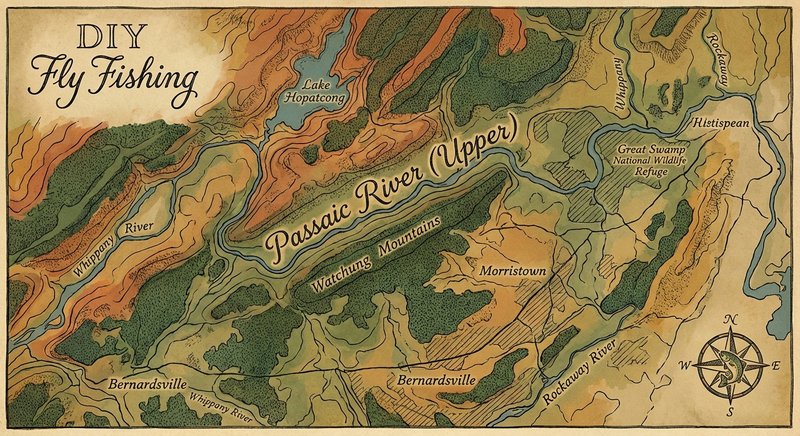
Passaic River (Upper)
Fly fishing in New Jersey · intermediate · Best seasons: spring, fall
Target Species
Brown Trout
About This Water
Upper Passaic in Great Swamp area. Surprising trout fishing in protected watershed.
Fishing Recommendations
The Upper Passaic River in New Jersey is one of the state’s best-kept secrets for the dedicated trout angler. While the lower Passaic is known for its industrial history, the headwaters—specifically the stretch from Mendham down through Lord Stirling Park and into Millington—offer a surprisingly pastoral, classic limestone-influenced stream experience.
Here is your comprehensive guide to fly fishing the Upper Passaic for Brown Trout.
🎣 Location Overview
The Upper Passaic is a unique fishery that transitions from a tiny, cold-water brook in the hills of Morris County into a meandering, silt-bottomed river. What makes this water special is its limestone influence. The water chemistry is rich, supporting a robust biomass of aquatic insects and crustaceans.
Unlike the rocky, freestone rivers of the Catskills, the Upper Passaic is characterized by undercut banks, fallen timber, and deep, slow-moving pools. It feels intimate and "toothy." Anglers love it because it requires stealth and technical precision rather than long, hero casts. It is a "hunter’s" river where you stalk individual fish.
🐟 Target Species & Behavior
Primary Species: Brown Trout (Stocked and "Holdovers")
- Behavior: The Brown Trout here are notorious for being "structure-oriented." You will rarely find them sitting in the middle of a shallow riffle. Instead, they tuck tightly against the mud banks, beneath overhanging root balls, or deep inside log jams.
- Feeding: Because of the muddy/silty substrate, the river is a factory for Scuds (freshwater shrimp) and Sowbugs. These are the bread and butter for Passaic trout. During hatches, they become opportunistic surface feeders, but they are generally wary and easily spooked by heavy wading.
📅 Best Times to Fish
Optimal Seasons
- Spring (April – Early June): This is the prime window. Water levels are usually stable, and the major hatches (Hendricksons and Sulphurs) occur.
- Fall (Late September – November): As water temperatures drop, the Brown Trout become aggressive ahead of the spawn. This is the best time to hunt for larger holdover fish using streamers.
Best Times of Day
- Spring: Mid-day (11:00 AM – 3:00 PM) is best for insect activity.
- Early Summer/Fall: Low light is your friend. The first hour of light and the "magic hour" at dusk are when the larger Browns leave their woody cover to hunt.
Prime Conditions
- Water Clarity: Look for "tannin" or slightly stained water. If the river is crystal clear, the fish are incredibly spooky. A little bit of color in the water allows you to get closer to the holding wood.
🪰 Recommended Flies & Techniques
Top Fly Patterns
- Nymphs/Wet:
- Ray Charles or Scud Patterns (Pink or Grey, #14-18): Essential for this river.
- Pheasant Tail Nymph (#16-20): Imitates the prolific Mayfly nymphs.
- Zebra Midge (#18-22): Effective year-round in the deeper pools.
- Dry Flies:
- Sulphurs (#16-18): The most reliable late spring hatch.
- Parachute Adams (#14-20): The perfect "prospecting" fly.
- Elk Hair Caddis (#14-16): Great for the pocket water sections near Mendham.
- Streamers:
- Wooly Bugger (Black or Olive, #8-10): Jigged near wood or undercut banks.
Effective Techniques
- Tight-Line Nymphing: Given the amount of submerged wood, a traditional indicator often gets snagged or creates too much drag. Using a Euro-style or tight-line rig allows you to "feel" your way through the branches.
- Stealth Dry Fly: Long leaders (12ft+) are necessary. You must stay out of the water whenever possible; the silt bottom carries vibrations, and the fish will feel you coming before they see you.
💡 Pro Tips & Local Knowledge
- The "Wood is Good" Rule: If you aren't losing a few flies to submerged logs, you aren't fishing where the trout are. In the Upper Passaic, the fish live inside the structure.
- Millington Gorge: Focus on the area around the Millington Gorge. The gradient increases here, creating more oxygenated water and rocky runs that hold fish even during warmer spells.
- Lord Stirling Park: This area offers miles of access but requires a lot of walking. The further you get from the parking lots, the less pressured the fish are.
- The "Silt Step": Be careful when wading. The bottom can transition from firm gravel to waist-deep silt instantly. Move slowly and use a wading staff.
⚠️ Important Information
Access Points
- Jockey Hollow/Mendham: Small water, perfect for 2-weight or 3-weight rods.
- Dead River Confluence: A known "hot spot" for holdover trout where the water deepens.
- Millington Station: Easy access point to fish the stretches above and below the bridge.
Regulations & Permits
- License: A valid New Jersey Fishing License and a Trout Stamp are required for all anglers aged 16–69.
- Regulations: Most of the Upper Passaic follows standard statewide regulations (daily creel limits), but always check the current NJ Fish & Wildlife Digest for any "Year-Round Trout Conservation" updates.
Special Considerations
- Water Temps: This is not a "tailwater." By mid-July, water temperatures can often exceed 70°F, which is lethal for trout. Please carry a thermometer and stop fishing for trout if the water hits 67°F to ensure their survival. Switch to targeting the river's excellent Fallfish or Pike populations during the heat of summer!
Bug Hatches & Matching Flies
| Hatch | Type | Peak months | Time of day | Hook sizes | Matching flies |
|---|---|---|---|---|---|
| Blue-Winged Olive Baetis | mayfly | April, May, September, October | Mid-day/Afternoon | #18-22 | BWO Sparkle Dun #18-22, Pheasant Tail Nymph #18-20, RS2 #20-22 |
| Grannom Caddis Brachycentrus | caddis | April, May | Morning/Evening | #14-16 | Elk Hair Caddis (Olive) #14-16, Deep Sparkle Pupa #14-16, Peacock Caddis #16 |
| Light Cahill Stenacron interpunctatum | mayfly | June, July | Evening | #12-14 | Light Cahill Dry #12-14, Gold Ribbed Hare's Ear #12-14 |
| Trico Tricorythodes | mayfly | July, August, September | Early Morning | #20-24 | Trico Spinner #22-24, Griffith's Gnat #20-22 |
| Tan Caddis Hydropsyche | caddis | May, June, July, August | Late Afternoon/Evening | #14-18 | Tan Elk Hair Caddis #14-18, Hydropsyche Larva #14-16, Pulsating Caddis Pupa #16 |
| White Miller Ephoron leukon | mayfly | August | Late Evening/Night | #12-14 | White Wulff #12, Ephoron Emerger #14 |
| Common Midge Chironomidae | midge | January, February, March, December | Anytime/Mid-day in Winter | #20-26 | Zebra Midge #20-22, Morgan's Midge #22-24 |
| Terrestrials (Ants/Beetles) Formicidae / Coleoptera | terrestrial | July, August, September | All Day | #12-18 | Black Foam Ant #16-18, Japanese Beetle #12-14, Chernobyl Ant #10-14 |