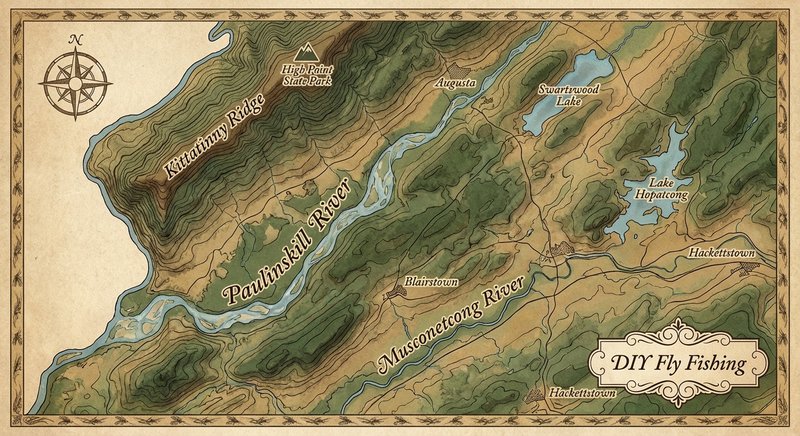
Paulinskill River
Fly fishing in New Jersey · beginner · Best seasons: spring, fall
Target Species
Brown Trout, Rainbow Trout
About This Water
Scenic Sussex County stream with good trout populations. Rail trail provides excellent access along much of its length.
Fishing Recommendations
The Paulinskill River in northwestern New Jersey is one of the state's most storied trout streams. Flowing through Sussex and Warren counties before emptying into the Delaware River, it offers a diverse fishing experience that blends the characteristics of a meadow limestone stream with those of a classic freestone river.
As your guide, here is the comprehensive breakdown for fishing the "Kill."
🎣 Location Overview
The Paulinskill is New Jersey’s third-largest tributary to the Delaware River. It is characterized by its dual personality: the upper reaches (near Newton and Lafayette) are often slow-moving and silt-bottomed, reminiscent of a meadow stream, while the middle and lower sections (around Blairstown and Columbia) feature classic riffle-pool-run configurations.
What makes it special is the Paulinskill Valley Trail, a rail-trail that runs parallel to much of the river. This provides anglers with unparalleled access to miles of water that are far removed from road crossings. The river benefits from limestone springs in its headwaters, which help maintain cooler temperatures and provide a rich alkaline environment for aquatic insects.
🐟 Target Species & Behavior
- Brown Trout: The Paulinskill holds a mix of heavily stocked fish and a surprising number of "holdover" or wild browns in the cooler tributaries and spring-fed sections. Browns here are cover-oriented; look for them under overhanging branches, tucked against undercut banks, or behind the many fallen log jams.
- Rainbow Trout: These are primarily stocked by the NJ Division of Fish and Wildlife. Rainbows tend to hold in the faster, highly oxygenated water—heads of pools and bubbly riffles. They are generally more opportunistic than the browns and will move further to chase a fly.
📅 Best Times to Fish
- Spring (April – June): This is the "Golden Era" on the Paulinskill. Stocking levels are at their peak, and the major hatches (Hendricksons, March Browns, and Sulphurs) occur.
- Fall (September – November): As water temperatures drop, the trout become active again. This is the best time to target large, aggressive Brown Trout moving into pre-spawn mode. The fall foliage makes this one of the most scenic times to be on the water.
- Optimal Windows:
- Spring: 10:00 AM – 4:00 PM (until May, then evening rises become dominant).
- Fall: Mid-day when the sun warms the water slightly, triggering insect activity.
- Conditions: The Paulinskill can get muddy after a heavy rain due to agricultural runoff. Look for "green-tinted" receding water for the best streamer fishing.
🪰 Recommended Flies & Techniques
Dry Flies
The Paulinskill has excellent hatches. You must "match the hatch" during emergence:
- Blue-Winged Olive (BWO): Sizes 18-22 (Overcast spring/fall days).
- Hendrickson: Sizes 12-14 (Late April).
- Sulphurs: Sizes 14-18 (May into June) — The most consistent evening hatch.
- Tan/Green Caddis: Sizes 14-16 (Throughout spring).
- Terrestrials: Foam Ants and Beetles (August – September) are deadly near the grassy banks.
Nymphs
Nymphing accounts for 80% of the fish caught here.
- Pheasant Tail: Sizes 14-18 (Classic mayfly imitation).
- Hare’s Ear: Sizes 12-16.
- Zebra Midge: Sizes 18-22 (Red or Black) – essential for picky fish in slower water.
- Pat’s Rubber Legs: Sizes 8-12 (Great for high water).
Streamers
- Woolly Bugger: Black or Olive, sizes 6-10.
- Muddler Minnow: Excellent for imitating the sculpins and dace native to the river.
Techniques
- Tight-Line Nymphing: Because the river has many "pockets" created by rocks and wood, a European-style nymphing rig is highly effective.
- The "Skate": During caddis hatches, don't be afraid to let your dry fly skitter across the surface at the end of a drift.
💡 Pro Tips & Local Knowledge
- Walk the Trail: Most anglers crowd the bridge pools at Blairstown or Marksboro. If you walk 15–20 minutes down the Paulinskill Valley Trail, you will find pristine water that sees very little pressure.
- Target the Wood: The Paulinskill has a lot of "woody debris" (fallen trees). While you may lose a few flies, the biggest trout are almost always tucked deep into the timber. Accurate casting is rewarded here.
- The "Middle" River: Focus on the stretch between Marksboro and Blairstown. This area has the best gradient (drop in elevation), creating the most oxygenated water and the best habitat for wilder fish.
- Check the USGS Gauge: Look for the "Paulinskill at Blairstown" gauge. Ideal flows for wading are between 150 and 300 cfs. Over 400 cfs can be dangerous to wade; under 100 cfs requires very stealthy approaches and light tippets (6X).
⚠️ Important Information
- Regulations: New Jersey requires a valid Fishing License and a Trout Stamp.
- Access: Much of the river passes through private land. Stick to the areas marked as "Public Access" or utilize the Paulinskill Valley Trail. Always respect "Posted" signs.
- Wading Safety: The Paulinskill has some "slippery" limestone rocks and occasional deep holes. Felt soles or studded boots are highly recommended.
- Catch & Release: While some sections allow harvesting, practicing catch and release (especially for holdover fish) helps maintain the quality of this fishery. Use barbless hooks to ensure a quick and safe release.
Guide’s Final Word: The Paulinskill is a "moody" river. One day it fishes like a dream, and the next it requires every trick in your box. Stay mobile, watch for the subtle sips of rising fish near the banks, and enjoy the solitude of the Sussex County woods. Tight lines!
Bug Hatches & Matching Flies
| Hatch | Type | Peak months | Time of day | Hook sizes | Matching flies |
|---|---|---|---|---|---|
| Blue-Winged Olive Baetis | mayfly | March, April, September, October | Midday | #18-22 | RS2 #18-22, Parachute BWO #18-22, Pheasant Tail #18-20 |
| Hendrickson Ephemerella subvaria | mayfly | April, May | Afternoon | #12-14 | Red Quill #12-14, Hendrickson Emerger #14, Gold Ribbed Hare's Ear #12-14 |
| Grannom Caddis Brachycentrus | caddis | April, May | Late Morning/Afternoon | #14-16 | Elk Hair Caddis (Dark) #14-16, LaFontaine's Deep Sparkle Pupa #14-16, Peacock Caddis #16 |
| Sulphur Ephemerella invaria/dorothea | mayfly | May, June | Evening | #14-18 | Sulphur Parachute #14-18, CDC Sulphur Emerger #16-18, Sulphur Spinner #14-18 |
| March Brown Maccaffertium vicarium | mayfly | May | Midday/Afternoon | #10-12 | March Brown American #10-12, Hare's Ear Nymph #10-12, March Brown Wet #12 |
| Slate Drake Isonychia | mayfly | June, September | Afternoon/Evening | #10-12 | Iso Parachute #10-12, Zug Bug #10-12, Prince Nymph #10-14 |
| Light Cahill Stenacron/Stenonema | mayfly | June, July | Evening | #14-16 | Light Cahill #14-16, Cream Usual #14-16 |
| Trico Tricorythodes | mayfly | July, August, September | Early Morning | #22-26 | Trico Spinner #22-26, Trico Drowned Spinner #24 |
| Tan Caddis Hydropsyche | caddis | May, June, July, August | Evening/Night | #14-18 | Elk Hair Caddis (Tan) #14-18, Hydropsyche Larva #14-16, Soft Hackle Hare's Ear #16 |