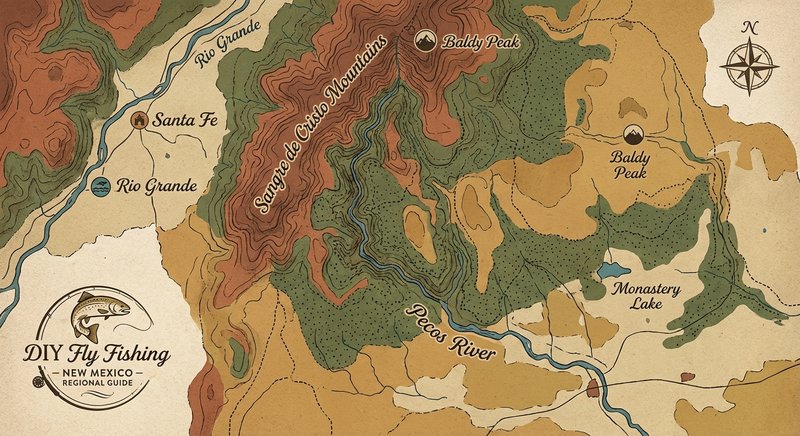
Pecos River
Fly fishing in New Mexico · Intermediate · Best seasons: Summer, Fall
Target Species
Brown Trout, Rainbow Trout, Cutthroat Trout
About This Water
High mountain stream in the Sangre de Cristo Mountains. Wild brown and rainbow trout in scenic wilderness.
Fishing Recommendations
The Pecos River in New Mexico is a crown jewel of the Sangre de Cristo Mountains. Just a short drive from Santa Fe, it offers a diverse range of fishing experiences, from high-gradient pocket water and tight canyons to meadow-style streams. It is a quintessential mountain river that provides both accessibility for beginners and technical challenges for seasoned veterans.
🎣 Location Overview
The Pecos is special because of its transition. In its upper reaches within the Pecos Wilderness, it is a pristine, high-alpine stream. As it flows south through the Pecos Valley, it becomes a classic freestone river characterized by large granite boulders, deep plunge pools, and glassy runs.
Anglers love the Pecos because it feels remote despite being accessible. The water is crystal clear, cold, and highly oxygenated, making it a perfect habitat for wild trout. Whether you are fishing the "Box" canyons or the public stretches near the town of Terrero, the scenery—cliffs of red rock and towering ponderosa pines—is as much a draw as the fishing itself.
🐟 Target Species & Behavior
The Pecos is a "Grand Slam" water where you can find:
- Brown Trout: The kings of the Pecos. They are wild, spooky, and highly territorial. They hold in the undercut banks, behind large boulders, and in the deep, dark slots of the canyons.
- Rainbow Trout: A mix of wild and stocked fish. The "stockers" are found near bridge access points and campgrounds, while the wild bows inhabit the faster riffles and pocket water.
- Rio Grande Cutthroat Trout: The state fish of New Mexico. These are primarily found in the high-altitude headwaters above the falls and in tributaries like Mora Creek or Jack’s Creek. They are opportunistic feeders but require stealthy approaches.
Behavior Note: Pecos trout are wary. Because the water is often gin-clear, they have excellent vision. Shadow management and a delicate presentation are more important here than on many other Western rivers.
📅 Best Times to Fish
While the Pecos can be fished year-round, you specifically asked for the prime seasons:
Summer (Late June – August)
- Conditions: This is the time for dry fly action. Post-runoff (usually mid-June) is the "magic window."
- Time of Day: Early morning (6 AM – 10 AM) for nymphing; late afternoon and evening for caddis hatches.
- Note: Watch for the "Monsoons." Afternoon thunderstorms are common in July/August. They can blow out the river quickly, but the fishing just before and after a rain can be incredible.
Fall (September – November)
- Conditions: Arguably the best time. The crowds thin out, the Aspens turn gold, and the Brown Trout become aggressive as they prepare to spawn.
- Time of Day: 10 AM – 4 PM. As the water cools, the fish wait for the sun to hit the water to become active.
- Note: This is "Streamer Season." Large Browns will strike out of aggression.
🪰 Recommended Flies & Techniques
Top Fly Patterns
- Dry Flies:
- Chubby Chernobyl (Size 10-14) in Orange or Royal - excellent as a hopper or a dry-dropper lead.
- Elk Hair Caddis (Size 14-18) in Tan or Olive.
- Parachute Adams (Size 16-22) for technical sips in slow water.
- Stimulators (Size 12-16) for the pocket water.
- Nymphs:
- Perdigons (Size 16-20) in flashy colors (Blue/Purple) to get deep fast.
- Pats Rubber Legs (Size 10-12) in Coffee/Black.
- RS2 or Pheasant Tail (Size 18-22) for picky fish.
- Streamers:
- Woolly Buggers (Size 8-12) in Olive or Black.
- Near Nuff Sculpin to mimic the natural forage.
Techniques
- Dry-Dropper: This is the bread and butter of the Pecos. Use a buoyant dry fly (like a Stimulator) and hang a small beaded nymph 18–24 inches below it.
- High-Sticking / Tight-Line: In the canyon stretches, there are many "micro-eddies." Using a long rod to keep your fly line off the conflicting currents is vital for a drag-free drift.
- The "Stealth" Approach: Stay low. If you can see the fish, they have likely already seen you.
💡 Pro Tips & Local Knowledge
- The "Box" Canyon: If you are physically fit, hike into the canyons away from the road. The fishing pressure drops significantly once you are a 15-minute walk from a pull-out.
- Mora Creek Confluence: This area is a hotspot. The mixing of different water temperatures and nutrients makes it a magnet for larger fish.
- Size Down: If fish are rising but refusing your fly, don't change the pattern—change the size. Drop from a 16 to a 20.
- 6x Tippet: While 5x is standard, carry 6x fluorocarbon for the Fall. The water gets incredibly clear, and the fish become leader-shy.
⚠️ Important Information
Access
- Public vs. Private: The Pecos has significant stretches of private land (notably around the Monastery and certain ranches). Respect "No Trespassing" signs. The Santa Fe National Forest provides ample public access—look for the marked campgrounds and fishing pull-outs.
- The Pecos Wilderness: To reach the purest Cutthroat water, you must hike in from the Iron Gate or Panchuela trailheads. No motorized or wheeled vehicles (including bicycles) are allowed in the Wilderness.
Regulations & Permits
- License: A valid New Mexico Fishing License and a "Habitat Management & Access Validation" are required.
- Bag Limits: Check the current NM Department of Game & Fish (NMDGF) proclamation, as certain stretches may have "Catch and Release" or "Special Trout Water" designations requiring barbless hooks and artificial lures only.
Special Considerations
- Altitude: You will be fishing between 7,000 and 10,000 feet. Hydrate aggressively and wear sunblock.
- Wildlife: This is Black Bear and Mountain Lion country. Carry bear spray if you are hiking deep into the Wilderness.
- Flash Floods: During Summer monsoons, the river can rise several feet in minutes. If the water turns muddy or you hear a roar upstream, exit the river immediately.
Bug Hatches & Matching Flies
| Hatch | Type | Peak months | Time of day | Hook sizes | Matching flies |
|---|---|---|---|---|---|
| Blue Winged Olive (BWO) Baetis spp. | mayfly | March, April, October, November | Late Morning/Afternoon | #18-22 | RS2 #20-22, Parachute Adams #18-22, Barr's BWO Emerger #20-22 |
| Western March Brown Rhithrogena morrisoni | mayfly | April, May | Midday | #12-14 | March Brown Parachute #12-14, Gold Ribbed Hare's Ear #12-14, Pheasant Tail Nymph #14 |
| Mother's Day Caddis Brachycentrus occidentalis | caddis | May | Late Afternoon/Evening | #14-16 | Elk Hair Caddis (Dark) #14-16, LaFontaine's Deep Sparkle Pupa #14-16, Peacock Caddis #16 |
| Pale Morning Dun (PMD) Ephemerella excrucians | mayfly | June, July | Late Morning/Early Afternoon | #16-18 | PMD Parachute #16-18, CDC Pheasant Tail #16-18, Split Case PMD #16-18 |
| Golden Stonefly Hesperoperla pacifica | stonefly | June, July | All Day/Evening | #8-12 | Pats Rubber Legs #8-12, Chubby Chernobyl (Gold) #10-12, Stimulator (Yellow) #10-14 |
| Yellow Sally Isoperla spp. | stonefly | June, July, August | Afternoon/Evening | #14-16 | Yellow Sally Stimulator #14-16, Iron Lotus #16, Micro Mayfly (Yellow) #16 |
| Midges Chironomidae | midge | December, January, February, March | Late Morning | #20-24 | Zebra Midge #20-24, Griffith's Gnat #20-22, Top Secret Midge #22-24 |
| Grasshoppers Orthoptera | terrestrial | August, September | Midday/Afternoon | #8-12 | Dave's Hopper #10-12, Amy's Ant #10-12, Parachute Hopper #10-14 |
| Trico Tricorythodes | mayfly | August, September | Early Morning | #22-24 | Trico Spinner #22-24, Drowned Trico Spinner #22-24, Trico Dun #22 |