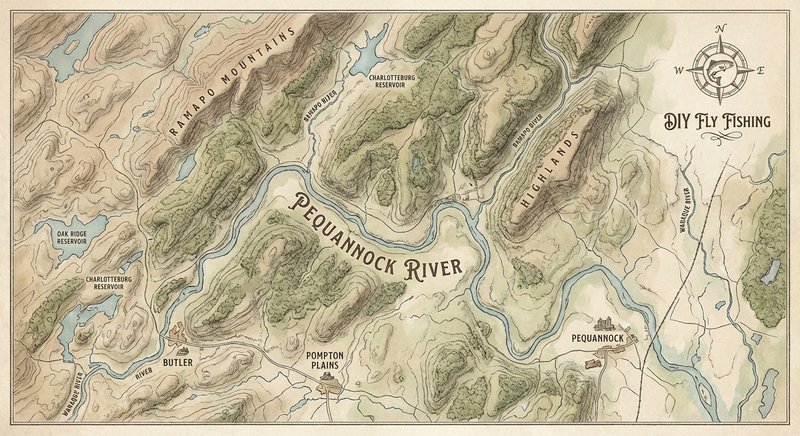
Pequannock River
Fly fishing in New Jersey · intermediate · Best seasons: spring, fall
Target Species
Brown Trout, Brook Trout
About This Water
Newark watershed stream with excellent wild trout. Limited access but high-quality fishing in protected watershed.
Fishing Recommendations
The Pequannock River is one of New Jersey's true gems—a rugged, high-gradient river that feels more like a mountain stream in the Blue Ridge or the Adirondacks than a waterway in the most densely populated state in the U.S. As a tailwater fed by the deep, cold bottom-releases of the Newark Reservoir system, it offers a sanctuary for wild trout even when other Garden State streams are warming up.
Here is your guide to mastering the Pequannock.
🎣 Location Overview
The Pequannock River flows through the heart of the Highlands, carving a steep valley along the border of Morris and Passaic counties. What makes it special is its "wild" character. Unlike the flatter, meadow-style streams of the south, the Pequannock is a boulder-strewn, "pocket water" river.
Anglers love it because it offers a rare opportunity in New Jersey to target wild, stream-born Brown Trout in a setting that feels remarkably remote. The river is heavily forested, providing excellent canopy cover that keeps water temperatures stable and creates a scenic, intimate fishing experience.
🐟 Target Species & Behavior
- Wild Brown Trout: The primary draw. These fish are hardy, buttery-yellow, and incredibly wary. They are not "dumb" hatchery fish; they require stealth and precise presentations.
- Brook Trout: You will find native Brookies in the upper reaches and near the mouths of the many cold-water tributaries that feed the main stem.
- Behavior: Because the river is rocky and fast, fish hold in classic "pocket water"—small eddies behind boulders, the "pillows" in front of rocks, and the deep seams where fast and slow water meet. They are opportunistic feeders but will spook at the sight of a shadow or a heavy splash.
📅 Best Times to Fish
- Spring (April – June): This is the prime window. The Hendrickson hatch in late April/early May is the highlight of the year. May brings March Browns and Sulphurs.
- Fall (Late September – November): As the water cools and the Brown Trout prepare to spawn, they become more aggressive. The fall foliage in the Pequannock Valley is spectacular, and the fish take on deep, vibrant spawning colors.
- Time of Day: In the spring, the "afternoon warming" often triggers hatches (12:00 PM – 4:00 PM). In the summer and early fall, "low light" is your friend—be on the water at dawn or dusk.
- The "Flow" Factor: Always check the USGS gauges. The river is best fished between 100 and 225 CFS. Anything over 300 CFS becomes difficult and dangerous to wade.
🪰 Recommended Flies & Techniques
Top Fly Patterns
- Dry Flies:
- Hendrickson (Red Quill): Sizes 12-14 (Spring)
- Tan or Olive Caddis: Sizes 14-18 (Year-round)
- Blue Winged Olive (BWO): Sizes 18-22 (Cloudy days, Spring/Fall)
- Stimulators: Sizes 10-14 (Great for high-visibility "skittering" in fast water)
- Nymphs:
- Pheasant Tail & Hare’s Ear: Sizes 14-18
- The Frenchie or Perdigons: Sizes 14-16 (Weight is key to getting down in the pockets)
- Zebra Midge: Sizes 18-20
- Streamers:
- Woolly Buggers: Black or Olive, Size 8-10 (Fish these deep in the plunges)
Techniques
- Tight-Line/Euro Nymphing: This is arguably the most effective way to fish the Pequannock. Because the current is complex with many micro-drag issues, keeping your fly line off the water and using a heavy nymph to "tick" the bottom of pockets is deadly.
- Dry-Dropper: A high-floating foam fly (like a Chubby Chernobyl) with a small Pheasant Tail dropped 18 inches below it is perfect for searching the pocket water in late spring.
- The "Short Cast": Do not try to bomb 50-foot casts. Most fish are caught within 15–20 feet. Stealth and positioning are more important than distance.
💡 Pro Tips & Local Knowledge
- The "Newark Permit": This is the most important "pro tip." Large sections of the river are owned by the Newark Watershed Conservation and Development Corporation (NWCDC). You MUST purchase a specific permit from them to hike and fish these lands. Without it, you risk a heavy fine. It can be purchased at their office in Echo Lake.
- Studded Boots are Mandatory: The rocks in the Pequannock are notoriously "greasy" and unstable. Wear felt or rubber soles with aluminum cleats/studs and use a wading staff.
- Target the "Bubbles": In the fast-moving water, trout love the oxygen-rich "bubble lines." If you see a line of foam, your fly should be under it or on it.
- Stealth Mode: Because the river is often clear, wear drab colors (olive, tan, or camo). Approach pools from downstream and stay low to avoid "lining" the fish.
⚠️ Important Information
- Access: Route 23 parallels much of the river. There are several pull-offs between the Charlotteburg Reservoir and Bloomingdale. Note that some areas are strictly "No Parking," so watch the signs carefully.
- Regulations: The Pequannock has several different designations, including "Wild Trout Stream" sections. These have specific gear restrictions (usually artificial lures/flies only) and strict size/creel limits. Always consult the current NJ Freshwater Fishing Digest before heading out.
- Wading Safety: The river can rise rapidly if the reservoir gates are opened. If you notice the water getting murky or rising suddenly, exit the river immediately.
- Bear Country: This area has one of the highest black bear populations in the country. They generally avoid people, but it’s wise to stay alert and keep your food secured.
The Pequannock is a "thinking man's" river. It won't give up its prizes easily, but for the angler who appreciates wild fish and technical pocket water, there is no better place in New Jersey. Tight lines!
Bug Hatches & Matching Flies
| Hatch | Type | Peak months | Time of day | Hook sizes | Matching flies |
|---|---|---|---|---|---|
| Blue Winged Olive Baetis / Pseudocloeon | mayfly | April, May, September, October | Late Morning/Afternoon | #18-22 | RS2 #18-22, BWO Parachute #18-22, Pheasant Tail #18-20 |
| Hendrickson Ephemerella subvaria | mayfly | April, May | Afternoon | #12-14 | Hendrickson Dark #12-14, Red Quill #14, Hare's Ear #12-14 |
| Sulphur Ephemerella invaria/dorothea | mayfly | May, June | Late Afternoon/Evening | #14-18 | Sulphur Parachute #14-18, CDC Sulphur Emerger #16-18, Sulphur Spinner #14-18 |
| Tan Caddis Hydropsyche | caddis | May, June, July | Morning/Evening | #14-18 | Elk Hair Caddis (Tan) #14-18, LaFontaine's Deep Sparkle Pupa #14-16, X-Caddis #14-18 |
| March Brown Maccaffertium vicarium | mayfly | May, June | Morning/Afternoon | #10-12 | March Brown American #10-12, Gold Ribbed Hare's Ear #10-12 |
| Slate Drake Isonychia bicolor | mayfly | June, September | Afternoon/Evening | #10-14 | Isonychia Parachute #12-14, Zug Bug #10-14, Iso Nymph #10-12 |
| Light Cahill Stenacron interpunctatum | mayfly | June, July | Evening | #14-16 | Light Cahill #14-16, Cream Usual #14-16 |
| Trico Tricorythodes | mayfly | July, August, September | Early Morning | #22-26 | Trico Spinner #22-26, Griffith's Gnat #20-24 |
| Terrestrials Formicidae / Coleoptera | terrestrial | July, August, September | All Day | #12-20 | Black Foam Ant #16-20, Chernobyl Ant #12-14, Crowe Beetle #14-18 |