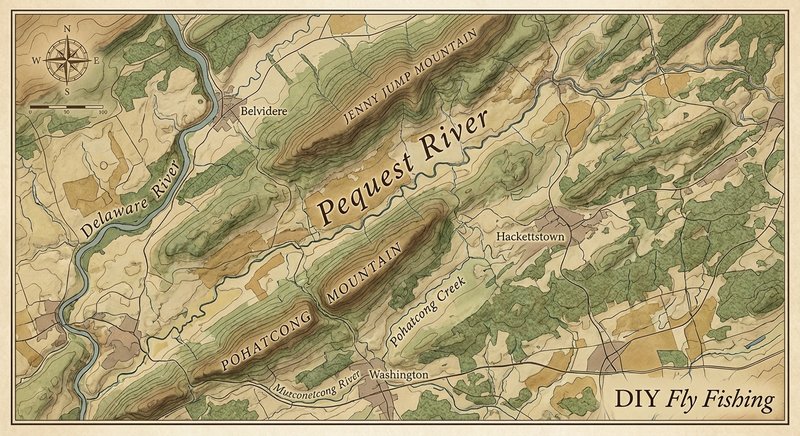
Pequest River
Fly fishing in New Jersey · beginner · Best seasons: spring, summer
Target Species
Brown Trout, Rainbow Trout, Brook Trout
About This Water
Warren County limestone stream with excellent insect hatches. Home to the Pequest Trout Hatchery with nearby fishing access.
Fishing Recommendations
Welcome to one of New Jersey’s premier trout destinations. As your guide, I’m excited to walk you through the Pequest River. Located in Warren County, this limestone-influenced stream is the "crown jewel" of the Garden State’s trout program, largely because it hosts the state’s main trout hatchery.
The Pequest offers a rare combination for the Mid-Atlantic: high fish density, consistent cold-water influence, and classic pool-and-run geography.
🎣 Location Overview
The Pequest River is a spring-fed limestone stream that flows through the rolling hills of Northwest New Jersey. What makes it special is its thermal stability. Because it is fed by limestone springs and receives the cool-water discharge from the Pequest Trout Hatchery, it stays cooler in the summer and warmer in the winter compared to other freestone streams in the region.
The river features a diverse mix of water: pocket water, long glassy glides, and deep, oxygenated "hatchery holes." It is a fertile environment with high insect biomass, meaning the trout are well-fed and can grow to impressive sizes.
🐟 Target Species & Behavior
- Rainbow Trout: These are the primary residents. Due to the proximity of the hatchery, the river is heavily stocked with vibrant, hard-fighting rainbows. They tend to hold in the faster riffles and at the heads of pools where oxygen is highest.
- Brown Trout: You will find both stocked browns and "holdover" fish that have survived multiple seasons. The holdovers become wary and nocturnal, usually tucked under the undercut banks or beneath fallen timber in the deeper runs.
- Brook Trout: While less common than rainbows, they are stocked regularly. You’ll find them in the slower, colder pockets and near the confluences of small, spring-fed tributaries.
Behavior Note: Because of heavy fishing pressure, these trout—especially in the Seasonal Catch and Release areas—become "PhD trout" very quickly. They will scrutinize your drift and your tippet size.
📅 Best Times to Fish
Spring (Peak Season)
- Months: Late March through June.
- Conditions: This is the prime window. The "Pre-Stocking" period (early March) offers great nymphing. Once the hatches begin in mid-April, the dry fly fishing is world-class for NJ.
- Window: Mid-day (11:00 AM – 3:00 PM) in early spring; shifting to late evening as June approaches.
Summer (Early & Late)
- Months: July and August.
- Conditions: While other NJ rivers warm up and become dangerous for trout, the Pequest (specifically the stretch near the Hatchery) often stays below 68°F.
- Window: First light is mandatory. Once the sun hits the water, the fish go deep and dormant. Terrestrial fishing (ants/beetles) becomes the name of the game.
🪰 Recommended Flies & Techniques
The Nymphing Game (80% of your success)
The Pequest is a nymphing river.
- Patterns: Pheasant Tail (14-18), Gold-Ribbed Hare’s Ear (14-16), Zebra Midges (18-22), and San Juan Worms (especially after rain).
- Technique: Use a "Trout Spey" or a standard 9ft 5wt with an indicator. If the water is clear, ditch the indicator and use a "Euro" or tight-line rig to detect subtle takes.
The Dry Fly Action
- Spring Hatches: Blue Winged Olives (BWOs) in late March; Hendricksons in April; and the famous Sulphurs in May/June.
- Patterns: Parachute Adams (16-20), CDC Sulphur (16), Elk Hair Caddis (tan or olive, 14-16).
- Technique: Long leaders (12ft+) are essential here. A 6x or 7x tippet is often required to fool the pressured fish in the flat water.
Streamers
- Patterns: Woolly Buggers (Black or Olive), Sculpin patterns.
- Technique: Swing them through the deep holes near the Hatchery bridge or "strip and pause" through the undercut banks to draw out the larger holdover Browns.
💡 Pro Tips & Local Knowledge
- The "TCA" Stretch: Focus your energy on the Trophy Trout Area (TCA). This is a 1.4-mile stretch from the downstream boundary of the Pequest Trout Hatchery to the US-46 bridge. It is heavily regulated and holds the highest concentration of educated, large fish.
- Stealth is Key: The Pequest is often clear. If you can see the fish, they have likely already seen you. Wear earthy tones, stay low, and move slowly.
- The Hatchery Discharge: The area directly around the hatchery outflow provides the most consistent water temperatures. If the rest of the river is running warm in late June, head here.
- Watch the Gauge: Check the USGS gauge at Pequest, NJ. If it’s blowing out after a heavy rain, the river can get muddy, but a "stained" Pequest is actually the best time to throw large streamers for trophy Browns.
⚠️ Important Information
- Access: Ample parking is available at the Pequest Trout Hatchery and Natural Resource Education Center off Route 46. There are several well-marked angler parking lots along Pequest Rd.
- Regulations:
- Trophy Trout Area: Catch and Release only for most of the year (check the current NJ Fish & Wildlife Digest for specific dates).
- Gear: In the TCA, you are restricted to artificial lures and flies only. No bait.
- Permits: A valid New Jersey Fishing License AND a Trout Stamp are required for all anglers 16 and older.
- Wading: The river is generally easy to wade with a gravel bottom, but watch out for occasional deep "blow-out" holes in the bends. Felt soles or studs are recommended for the larger, slicker rocks.
Guide’s Final Word: The Pequest is a gem of the Northeast. Treat the fish with respect, use a rubber net, and keep them in the water. Tight lines!
Bug Hatches & Matching Flies
| Hatch | Type | Peak months | Time of day | Hook sizes | Matching flies |
|---|---|---|---|---|---|
| Blue Winged Olive Baetis / Pseudocloeon | mayfly | April, October | Late Morning/Afternoon | #18-22 | BWO Sparkle Dun #18-22, Pheasant Tail #18-20, RS2 #20-22 |
| Hendrickson Ephemerella subvaria | mayfly | April | Afternoon | #12-14 | Hendrickson Pink Lady #12-14, Red Quill #14, Hendrickson Wet Fly #12-14 |
| Tan Caddis Hydropsyche | caddis | May, June | Evening | #14-16 | Elk Hair Caddis #14-16, LaFontaine's Deep Sparkle Pupa #14-16, Hydropsyche Larva #14 |
| Sulphur Ephemerella invaria/dorothea | mayfly | May, June | Evening | #14-18 | Sulphur Parachute #14-18, Sulphur Cripple #16-18, Hare's Ear #16 |
| Light Cahill Stenacron interpunctatum | mayfly | June, July | Evening | #12-14 | Light Cahill Traditional #12-14, Gold Ribbed Hare's Ear #12-14 |
| Trico Tricorythodes | mayfly | July, August, September | Morning | #22-26 | Trico Spinner #22-24, Trico Parachute #22-24 |
| Little Black Stonefly Taeniopteryx / Capniidae | stonefly | February, March | Mid-day | #16-20 | Black Stonefly Nymph #16-18, Black Stimulator #18 |
| Zebra Midge Chironomidae | midge | January, February, March | All Day | #18-24 | Zebra Midge (Black/Silver) #18-22, Griffith's Gnat #20-22 |
| Ants and Beetles Formicidae / Coleoptera | terrestrial | July, August | All Day | #12-18 | Black Foam Ant #16-18, Crowe Beetle #14-16 |