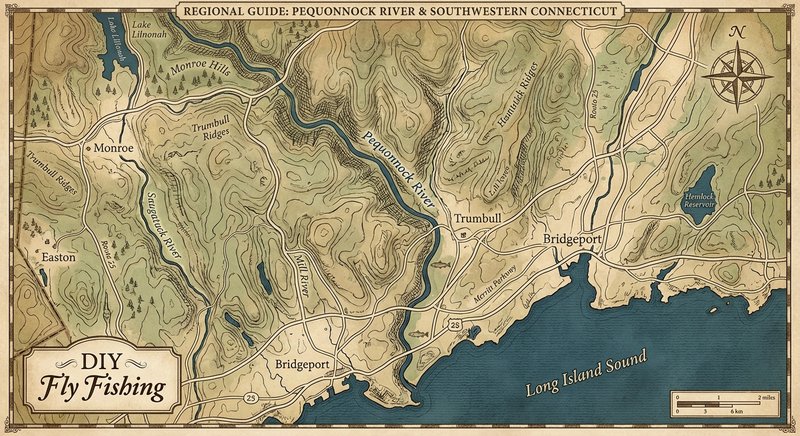
Pequonnock River
Fly fishing in Connecticut · Beginner · Best seasons: Spring, Fall
Target Species
Brown Trout, Rainbow Trout
About This Water
Fairfield County stream with trout. Trumbull area fishing.
Fishing Recommendations
The Pequonnock River in Fairfield County is one of Southwest Connecticut’s most accessible and rewarding trout streams. While it flows through suburban and eventually urban landscapes, the middle stretches—particularly through Trumbull—offer a surprisingly scenic "pocket water" experience that feels miles away from the nearby Merritt Parkway.
🎣 Location Overview
The Pequonnock is a relatively small, freestone river. It is characterized by a high gradient in its upper reaches, featuring a series of plunges, small pools, and rocky runs. What makes it special is its accessibility; it flows through several public parks, most notably Old Mine Park and Beardsley Park.
For the fly angler, the stretch through Trumbull is the "crown jewel." Here, the river is shaded by a heavy canopy, keeping water temperatures stable longer into the spring. It is a classic "technical" small stream where short casts and precise presentations are rewarded.
🐟 Target Species & Behavior
The river is heavily stocked by the CT DEEP with Rainbow Trout and Brown Trout.
- Rainbow Trout: These are the primary targets in the spring. They tend to hold in the faster, highly oxygenated water at the heads of pools or in the "riffle-corners." They are aggressive and often move to the fly.
- Brown Trout: You will find the larger holdover Browns in the deeper, undercut banks or beneath submerged logs. They are more nocturnal and cautious, often requiring a stealthy approach and lighter tippet.
- Feeding Behavior: Early in the season, they are opportunistic feeders on stoneflies and midge larvae. As the water warms in May, they focus heavily on caddis and small mayflies.
📅 Best Times to Fish
Optimal Seasons
- Spring (April – June): This is the peak. The state stocks the river heavily in late March and April. The water levels are usually ideal, and the insect life is most active.
- Fall (October – November): Once water temperatures drop, the river receives a second wind. The DEEP often does a fall stocking, and the resident Browns become more aggressive as they prepare for spawning.
Best Times of Day
- Spring: Mid-day (11:00 AM – 3:00 PM) is best, as the sun warms the water enough to trigger insect hatches.
- Late Spring/Fall: Early morning and the "magic hour" just before dusk.
Prime Windows
Watch the USGS gauges for nearby rivers (like the Mill or Saugatuck). You want the water to be receding after a rain—slightly "tea-colored" but not blown out.
🪰 Recommended Flies & Techniques
Top Fly Patterns
- Nymphs: Pheasant Tail (#14-18), Gold-Ribbed Hare’s Ear (#12-16), and Prince Nymphs. For high water, use a Mop Fly or a Squirmy Wormy in pink or red.
- Dry Flies: Elk Hair Caddis (Tan/Olive #14-18), Blue Winged Olive (#18-22), and Adams (#14-18).
- Streamers: Woolly Buggers (Black or Olive #8-12) and Mickey Finns.
Effective Techniques
- Tight-Line Nymphing: Because the river is narrow and rocky, "Euro-style" or tight-line nymphing is incredibly effective. It allows you to get flies deep into the small pockets without your line getting caught in conflicting currents.
- The "Dapping" Method: In the brushy areas of Old Mine Park, you may not have room for a backcast. Use a long rod to simply drop a dry fly over a log or into a pocket.
- Downstream Swinging: Swinging a small wet fly or streamer through the tail-outs of pools is a great way to find active Rainbows.
💡 Pro Tips & Local Knowledge
- The "Hike-In" Advantage: Most anglers congregate near the parking lots at Old Mine Park. If you walk the Pequonnock River Valley Trail (the rail-trail) for 15–20 minutes in either direction, you will find less-pressured fish and more "wild" feeling water.
- Small Stream Stealth: The water is often clear. Wear earthy tones (no white hats!) and keep a low profile. If you can see the fish, they have likely already seen you.
- Target the "Micro-Eddies": In the faster sections, look for rocks the size of a toaster. There is almost always a trout sitting in the soft water right behind them.
- Wait for the "Drop": After a heavy CT rain, the Pequonnock clears faster than the larger Housatonic. It is a great "Plan B" river when larger systems are too high to wade.
⚠️ Important Information
- Access:
- Old Mine Park (Trumbull): Excellent parking and wading access.
- Tait Road/Whitney Ave: Access points for the middle sections.
- Beardsley Park (Bridgeport): More open water, better for traditional casting, though more urban.
- Regulations:
- A Connecticut Fishing License and a Trout & Salmon Stamp are required for all anglers 16 and older.
- Check the current CT DEEP Digital Fishing Guide for specific creel limits, as the Pequonnock is generally managed under statewide regulations but can have specific reach-based rules.
- Safety: The rocks in the Pequonnock are notoriously slippery ("Greased Bowling Balls"). Studded wading boots and a wading staff are highly recommended.
Bug Hatches & Matching Flies
| Hatch | Type | Peak months | Time of day | Hook sizes | Matching flies |
|---|---|---|---|---|---|
| Blue Winged Olive Baetis spp. | mayfly | March, April, October, November | Afternoon | #18-22 | BWO Sparkle Dun #18-20, RS2 #20-22, Pheasant Tail #18-22 |
| Early Black Stonefly Taeniopteryx nivalis | stonefly | February, March | Mid-day | #14-18 | Black Stimulator #16, Early Black Stone Nymph #14-18 |
| Grannom Caddis Brachycentrus | caddis | April | Morning/Afternoon | #14-16 | Elk Hair Caddis #14-16, LaFontaine's Deep Sparkle Pupa #14-16 |
| Hendrickson Ephemerella subvaria | mayfly | April, May | Afternoon | #12-14 | Hendrickson Dark #12-14, Red Quill #12-14, Hendrickson Nymph #12-14 |
| Sulphur Ephemerella invaria/dorothea | mayfly | May, June | Evening | #16-18 | Sulphur Parachute #16-18, Sulphur Snowshoe Emerger #16-18 |
| Tan Caddis Hydropsyche | caddis | May, June, July | Morning/Evening | #16-18 | Tan Elk Hair Caddis #16-18, Hydropsyche Larva #16-18 |
| Light Cahill Stenonema ithaca | mayfly | June, July | Evening | #14-16 | Light Cahill #14-16, Gold Ribbed Hare's Ear #14-16 |
| Terrestrials (Ants/Beetles) Formicidae/Coleoptera | terrestrial | July, August, September | Afternoon | #12-18 | Black Foam Ant #16-18, Fat Albert #12-14, Crowe Beetle #14-16 |
| Midges Chironomidae | midge | January, February, March, December | All Day | #20-26 | Griffith's Gnat #20-24, Zebra Midge #20-22 |