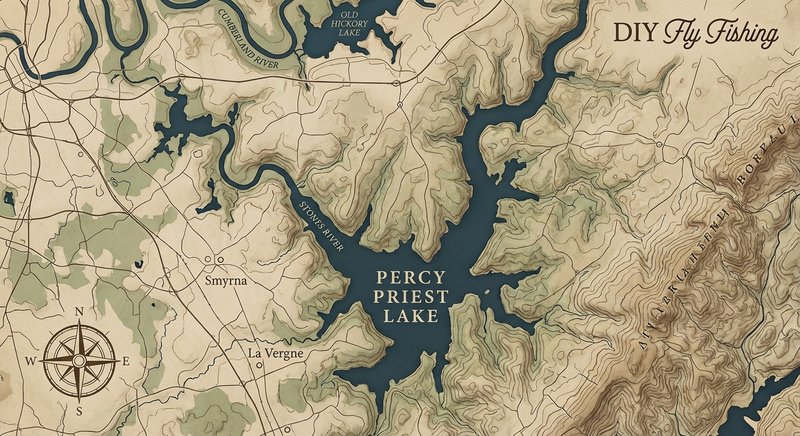
Percy Priest Lake
Fly fishing in Tennessee · Beginner · Best seasons: Spring, Summer, Fall
Target Species
Largemouth Bass, Crappie, Catfish
About This Water
Nashville area reservoir with good largemouth bass. Popular recreational destination.
Fishing Recommendations
Welcome to the "Music City" backcountry. As a guide, I often tell folks that J. Percy Priest Lake is one of the most underrated fly fishing destinations in the Southeast. While it's a massive 14,000-acre reservoir just minutes from downtown Nashville, it offers an incredible "urban wild" experience with limestone bluffs, hidden coves, and a diverse forage base.
Here is your comprehensive guide to fly fishing Percy Priest.
🎣 Location Overview
Percy Priest is a highland reservoir managed by the Army Corps of Engineers. What makes it special for the fly angler is its limestone geology. The lake is characterized by jagged rock walls, expansive shallow flats, and hundreds of "fish attractors" (brush piles) submerged throughout.
Unlike the muddy rivers nearby, Priest can offer surprisingly good clarity in the mid-to-lower sections, allowing for sight-fishing opportunities on the flats. It is a "working man’s lake"—busy on weekends with boaters, but a goldmine for the fly fisher who knows how to navigate its fingers and creek arms.
🐟 Target Species & Behavior
Largemouth Bass
The king of the lake. In Priest, these fish are keyed in on Gizzard Shad and Bluegill.
- Behavior: They move shallow in the spring to spawn and again in the fall to chase bait. During summer, they retreat to the "ledges" (drop-offs from 5ft to 15ft) or hide deep in the water willow and water-starwort beds.
Crappie (Black and White)
Often ignored by fly anglers, but Priest is a premier crappie destination.
- Behavior: They are structure-oriented. Look for them around submerged timber, docks, and the Corps-placed brush piles. They feed primarily on tiny minnows and midge larvae.
Catfish (Channel and Flathead)
Yes, you can catch them on a fly!
- Behavior: In the late spring/early summer, Channel cats move into the rocky shallows to spawn. They are surprisingly predatory and will strike a well-presented streamer or a weighted nymph dragged along the bottom.
📅 Best Times to Fish
Spring (March - May) - The Prime Window
- Focus: This is the best time for all three species. Bass move into the back of the "hollows" (coves).
- Window: Early morning and late evening. As the water hits 60°F, the bite explodes.
Summer (June - August)
- Focus: The "Night Bite" or "Low Light."
- Window: 5:00 AM to 8:00 AM is critical. Once the sun hits the water, the fish go deep. Focus on the shaded sides of the limestone bluffs.
Fall (September - November)
- Focus: The Shad Kill/Migration.
- Window: Mid-day can be excellent here. As the water cools, bass follow massive schools of shad into the creek arms like Stewart’s Creek or Suggs Creek.
🪰 Recommended Flies & Techniques
For Largemouth Bass
- Patterns:
- Game Changers (White/Silver): To mimic the Gizzard Shad.
- Poppers (Frog or Bluegill): Use hard-body foam poppers near the shoreline grass early in the morning.
- Dahlberg Divers: Exceptional for fishing over submerged vegetation.
- Technique: Use an 8-weight rod with a weight-forward floating line for poppers, or a sink-tip line (150-200 grain) to get streamers down to the 6–10 foot ledge mark.
For Crappie
- Patterns:
- Clouser Minnows (Size 8-10): White/Pink or Chartreuse/White.
- Wooly Buggers (Size 10-12): Olive or Black.
- Technique: Use a 3-weight or 4-weight rod. Use a "count down" method—cast, count to five, and use a slow, rhythmic strip-pause-strip.
For Catfish
- Patterns:
- Heavy Lead-Eyed Buggers: Black or Dark Brown.
- Crawfish patterns: Weighted heavily to stay on the bottom.
- Technique: Drag the fly slowly across rocky points in 4–8 feet of water. If you feel a "heavy" sensation, set the hook!
💡 Pro Tips & Local Knowledge
- The "Mud Line" Strategy: After a heavy rain, find where the muddy water from the creeks meets the clear water of the main lake. Bass sit right on that line to ambush disoriented baitfish.
- Focus on the Islands: Areas like Pritchard Island or Pig Island offer flats that are perfect for wading or poling a skiff. The windward side of these islands often stacks up shad.
- The "Hole in the Wall": Local secret—focus on the areas where the old stone walls from the pre-dam farmland still exist underwater. These act as highways for bass moving from deep to shallow water.
- Avoid the "Main Lake" Chop: Priest can get very windy. If the wind is over 10mph, tuck into the Fate Sanders area or Hamilton Creek for protected water.
⚠️ Important Information
Access
- Motorized: Numerous ramps (Seven Points, Fate Sanders, Cook Resort).
- Kayak/Wading: Hamilton Creek Marina offers great kayak access. Vivrett Creek is a fantastic spot for those wanting to wade the shallows during low-water periods.
Regulations
- A Tennessee Fishing License is required (available online via TWRA).
- Size Limits: Be aware of the "Slot Limit" for Bass on Priest. As of current regs, there is a 15-inch minimum for Largemouth. Check the TWRA website for the most up-to-date creel limits.
Safety
- Boat Traffic: During summer weekends, the wake from large boats can be dangerous for kayakers and float-tubers. Stick to the "No Wake" coves or fish during the weekdays.
- Submerged Rocks: If you are operating a boat, be extremely careful outside of the marked channels; Priest is notorious for "lower-unit eating" limestone humps that sit just 6 inches below the surface.
Guide’s Final Word: If you want the best day possible, get on the water 30 minutes before sunrise with a white Game Changer tied on. When the mist is rising off the limestone bluffs and the shad start jumping, you’ll see why we love this lake. Tight lines!
Bug Hatches & Matching Flies
| Hatch | Type | Peak months | Time of day | Hook sizes | Matching flies |
|---|---|---|---|---|---|
| Giant Mayfly (Hex) Hexagenia limbata | mayfly | June, July | Dusk/Night | #6-10 | Hexagenia Spinner #6-8, Hex Nymph #8-10, Burrowing Mayfly Emerger #8 |
| Chironomids Chironomidae | midge | March, April, May | All Day | #18-24 | Zebra Midge #18-22, Griffith's Gnat #20-24, Ice Cream Cone Midge #18 |
| Damselflies Enallagma | terrestrial | May, June, July | Late Morning/Afternoon | #10-14 | Marabou Damselfly Nymph #10-12, Adult Damsel #12-14 |
| White Curse Caenis | mayfly | July, August | Early Morning | #20-24 | Caenis Spinner #22-24, Brassie #20-22 |
| Grasshoppers Acrididae | terrestrial | July, August, September | Afternoon | #8-12 | Dave's Hopper #8-12, Rainy's Hopper #10 |
| Black Ants Formicidae | terrestrial | June, July, August | All Day | #14-18 | Black Foam Ant #14-16, Fur Ant #16-18 |
| Dragonflies Anisoptera | terrestrial | June, July, August | Afternoon | #4-8 | Dragonfly Nymph (Olive) #6-8, Adult Dragon Fly #4-6 |
| Cinnamon Caddis Hydropsyche | caddis | May, October | Evening | #14-16 | Elk Hair Caddis (Tan) #14-16, Pupa Emerger #16 |