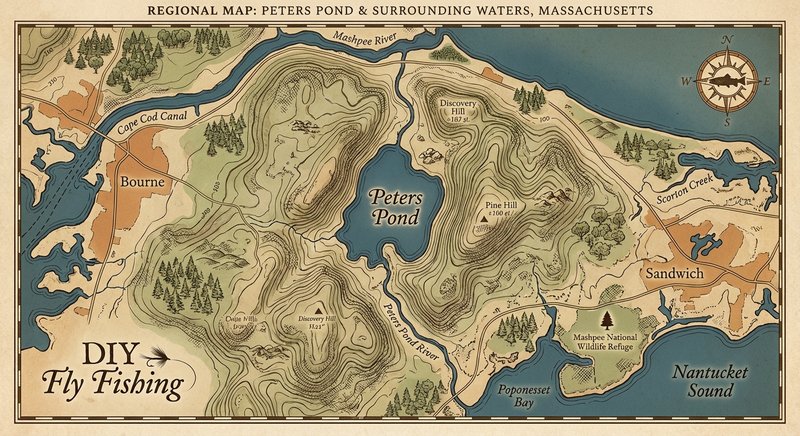
Peters Pond
Fly fishing in Massachusetts · Beginner · Best seasons: Spring, Fall
Target Species
Brown Trout, Rainbow Trout
About This Water
Cape Cod pond with trout. Sandwich area kettle pond.
Fishing Recommendations
Peters Pond in Sandwich, Massachusetts, is widely considered one of the "crown jewels" of Cape Cod trout fishing. As a classic kettle hole pond formed by receding glaciers, it offers deep, cold, oxygenated water that allows trout to thrive even when other local waters warm up.
Here is your comprehensive guide to fly fishing Peters Pond.
🎣 Location Overview
Peters Pond is a 127-acre deep-water kettle pond located in Sandwich. Unlike many shallow coastal ponds, Peters reaches depths of over 50 feet. Its water is exceptionally clear, and the bottom is primarily composed of sand and gravel.
Anglers love Peters Pond because it is one of the most reliably stocked waters in Southeast Massachusetts. It has a well-deserved reputation for producing "holdover" fish—trout that survive the summer and winter to reach impressive sizes. The combination of easy access, beautiful scenery, and the legitimate chance at a 20-inch Brown Trout makes it a premier destination for fly fishers.
🐟 Target Species & Behavior
- Rainbow Trout: These are the primary target and are stocked heavily in both spring and fall. They tend to cruise the upper 5–10 feet of the water column in the spring and are very opportunistic, often seen rising to midges or small terrestrials.
- Brown Trout: Peters is famous for its Browns. Unlike the Rainbows, Browns here tend to be more "structure-oriented" and elusive. They often hold deeper near the drop-offs and become more aggressive as the sun goes down. Large holdover Browns in this pond often switch to a diet of small baitfish (like landlocked alewives or killifish).
- Secondary Species: You may also encounter Smallmouth Bass and the occasional Landlocked Salmon, which are sometimes stocked as surplus.
📅 Best Times to Fish
Optimal Seasons
- Spring (Late March – June): This is the prime window. As soon as the ice melts (if any) and the first stocking occurs, the fish are hungry and shallow.
- Fall (October – November): Once the water temperatures drop back into the 50s, the trout move back to the shorelines. This is the best time to target large, aggressive Brown Trout.
Best Times of Day
- Early Morning/Dusk: Essential for Brown Trout. The "magic hour" just before dark often sees a flurry of surface activity.
- Overcast Days: Because the water is so clear, bright sun can drive fish deep. Low-light conditions or a "Cape Cod chop" (light wind) on the water will give you the best results.
🪰 Recommended Flies & Techniques
Top Fly Patterns
- Streamers:
- Woolly Bugger (Size 6-10) in Black, Olive, or White (to mimic baitfish).
- Mickey Finn or Grey Ghost (Traditional New England patterns).
- Sculpin Patterns (weighted to get down the drop-offs).
- Nymphs:
- Pheasant Tail (Size 14-18).
- Zebra Midge (Size 18-22) in Red or Black.
- Hare’s Ear (Size 14-16).
- Dry Flies:
- Adams or Parachute Adams (Size 16-20) for midge hatches.
- Elk Hair Caddis (Size 14-16).
Effective Techniques
- The "Slow Strip" Streamer Retrieve: Using an intermediate sinking line, cast across the drop-offs and use a slow, erratic strip to mimic a disoriented baitfish.
- Indicator Nymphing: In the spring, suspending a Zebra Midge or Pheasant Tail 4–6 feet under a small indicator can be deadly near the boat ramp or the town beach area.
- Float Tube/Kayak Trolling: If you have a watercraft, slowly rowing or paddling while trailing a streamer 40–50 feet behind you is a highly effective way to locate schools of fish.
💡 Pro Tips & Local Knowledge
- Watch the Drop-offs: The most productive water isn't necessarily the middle of the pond; it’s where the shallow sandy flats suddenly plunge into the deep blue water. Trout patrol these edges like a highway.
- The "Sandwich Glass" Effect: On dead-calm days, the water is so clear the fish can be extremely spooky. Use long leaders (9–12 feet) and fluorocarbon tippet down to 5X or 6X to avoid being seen.
- Focus on the Northwest Shore: The wind often blows from the southwest, pushing insects and warmer surface water toward the northern and eastern banks. Fish will follow the food.
- Stocking Schedule: Check the MassWildlife Trout Stocking webpage. Fishing right after a truck arrives is easy, but waiting 3–4 days allows the fish to "color up" and start feeding on natural prey.
⚠️ Important Information
- Access:
- Oakcrest Cove Land: There is good public access and a boat ramp off Quaker Meeting House Road.
- Sandwich Town Beach: Located at the northern end; great for wading in the off-season, but be mindful of swimmers during the summer months.
- Regulations:
- A valid Massachusetts Freshwater Fishing License is required for everyone 15 and older.
- Peters Pond is subject to standard state trout regulations (typically a 3-fish daily limit, no minimum length), but many fly anglers practice catch and release to preserve the holdover population.
- Wading Safety: The bottom is generally firm sand, making it great for wading. However, be careful of the "kettle drop"—the shelf can be very steep, and it's easy to take a step into water over your head.
Guide’s Final Word: Peters Pond is a technical but rewarding fishery. If the bite is slow, go smaller on your flies and deeper with your line. The big Browns are there—you just have to outsmart them. Good luck!
Bug Hatches & Matching Flies
| Hatch | Type | Peak months | Time of day | Hook sizes | Matching flies |
|---|---|---|---|---|---|
| Chironomids (Midges) Chironomidae | midge | April, May, September | All Day | #18-24 | Zebra Midge #18-22, Griffith's Gnat #20-24, Chironocone #16-20 |
| Speckled Spinner (Callibaetis) Callibaetis ferrugineus | mayfly | May, June, September | Late Morning | #12-16 | Callibaetis Spinner #14-16, Hare's Ear Nymph #14-16, Parachute Adams #14-18 |
| Spotted Sedge Hydropsyche | caddis | May, June | Evening | #14-18 | Elk Hair Caddis #14-16, LaFontaine's Deep Sparkle Pupa #14-16 |
| Giant Michigan Mayfly (Hex) Hexagenia limbata | mayfly | June, July | Dusk/Night | #6-10 | Hexagenia Dry #6-8, Hexagenia Nymph #8-10 |
| Blue-Winged Olive Baetis | mayfly | April, October, November | Afternoon | #18-22 | BWO Parachute #18-22, RS2 #20-22 |
| Damselfly Enallagma | terrestrial | June, July, August | Mid-day | #10-14 | Marabou Damsel Nymph #10-12, Adult Damsel #12-14 |
| Black Carpenter Ants Camponotus pennsylvanicus | terrestrial | June, August | Afternoon | #12-16 | Black Foam Ant #12-16, Chernobyl Ant #12-14 |
| Cinnamon Caddis Ceraclea | caddis | July, August | Late Evening | #16-20 | X-Caddis #16-18, Tan Soft Hackle #16-18 |