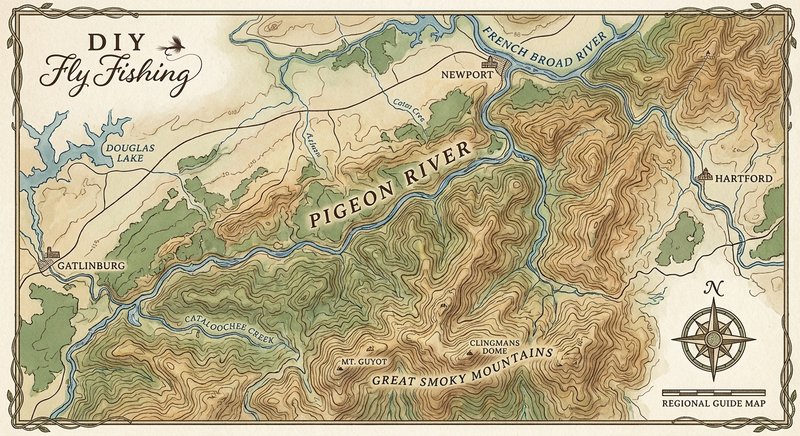
Pigeon River
Fly fishing in Tennessee · Beginner · Best seasons: Spring, Summer, Fall
Target Species
Smallmouth Bass, Rainbow Trout
About This Water
Recovering river with improving trout and bass populations. Near Great Smoky Mountains.
Fishing Recommendations
Welcome to the Pigeon River, one of the most underrated fly fishing gems in the Southeast. Located in East Tennessee, right on the doorstep of the Great Smoky Mountains National Park, the Pigeon offers a unique "split personality" experience. It transitions from a cold-water trout fishery near the North Carolina border to a world-class Smallmouth Bass destination as it flows toward Newport.
As a guide, I can tell you that the Pigeon has made a miraculous recovery over the last few decades and now boasts some of the highest fish-per-mile counts in the region.
🎣 Location Overview
The Pigeon River is a tailwater-influenced system, controlled by the Walters Dam (Waterville). What makes it special is its diversity and ruggedness.
- The Upper Section (Hartford/Waterville): Cold, oxygenated water makes this "Trophy Trout" territory. It’s a boulder-choked, high-gradient stretch that feels like a mountain stream on steroids.
- The Lower Section (Hartford to Newport): As the water warms and the river widens, it becomes a Smallmouth Bass factory.
- The Water: Expect classic freestone characteristics—deep runs, massive boulders, and "ledge-rock" shelves that provide perfect ambush points for predators.
🐟 Target Species & Behavior
Smallmouth Bass (The Main Attraction)
The "Bronzebacks" here are aggressive and powerful due to the constant current.
- Behavior: They hold behind large boulders (in the "soft" water) and along the deep ledge rock shelves that run diagonal to the current.
- Feeding: They are highly opportunistic. Their diet consists heavily of Crayfish, Hellgrammites (dobsonfly larvae), and Shiners.
Rainbow Trout
While there are wild fish, the Tennessee Wildlife Resources Agency (TWRA) stocks the upper stretches heavily.
- Behavior: They hold in the "seams" where fast water meets slow water. Because the Pigeon is a high-volume river, trout will often be found tighter to the banks than you might expect to escape the heaviest current.
- Feeding: They focus on aquatic insects: Caddis, Stoneflies, and Midges.
📅 Best Times to Fish
Optimal Seasons
- Spring (April - June): This is the prime window. Smallmouth wake up and feed aggressively pre-spawn, and the trout are highly active during the spring insect hatches (Grannom Caddis and Yellow Sallies).
- Summer (July - August): Best for Topwater Smallmouth. The mornings and evenings are magic. Note: This is also peak rafting season (see Pro-Tips).
- Fall (September - November): My personal favorite. The crowds vanish, the water clears, and the Smallmouth gorge themselves on baitfish to prepare for winter.
The "Rafting Window"
The Pigeon is one of the most commercially rafted rivers in the US. On scheduled release days (usually Tuesday, Wednesday, Thursday, and Saturday in summer), the water rises significantly around 11:30 AM. Fish early (6:00 AM – 11:00 AM) or late after the water drops.
🪰 Recommended Flies & Techniques
For Smallmouth Bass
- Topwater: Boogle Bugs (Chartreuse or Black), Murdich Minnows, or foam poppers.
- Subsurface: Clouser Minnows (Olive/White), Near Nuff Crayfish, and Gamechangers.
- The "Secret Weapon": A Black Hellgrammite pattern (size 4-6). Smallmouth in the Pigeon treat these like candy.
For Rainbow Trout
- Nymphs: Frenchies (size 14-16), Pat’s Rubber Legs (Black or Coffee), and Pheasant Tails.
- Dries: Elk Hair Caddis (size 14-18) and Yellow Sallies (size 14-16).
- Streamers: Black Wooly Buggers or White Zonkers to mimic injured baitfish.
Techniques
- The "Swing and Strip": Cast your streamer across and slightly downstream, let it swing into the soft water behind a boulder, and give it two sharp strips.
- High-Sticking: Due to the heavy pockets, "high-stick" nymphing (keeping your fly line off the water) is essential to prevent drag.
💡 Pro Tips & Local Knowledge
- Mind the Ledges: The Pigeon has unique geological "fingers" of rock running across the bottom. Don’t just fish the banks; the biggest Smallmouth often sit in the deep "cracks" in the middle of the river.
- The Rafting Effect: When the dam releases and the water starts to rise, the fish often go on a "feeding frenzy" for 20 minutes as insects are washed off the rocks. Don't leave immediately; fish the rising water with a heavy streamer!
- Wading Safety: The Pigeon is slippery. The rocks are covered in fine silt and algae. Studded felt boots and a wading staff are non-negotiable here.
⚠️ Important Information
Access Points
- Waterville/Hartford: Excellent access for trout near the powerhouse and the various rafting outposts.
- Greenway Park (Newport): Good access for Smallmouth.
- Pigeon River Boat Ramp: Located off I-40, great for launching rafts or drift boats.
Regulations & Permits
- A Tennessee Fishing License is required (available online via TWRA).
- If you are fishing the "Trophy Section" near the state line, check for specific size and creel limits, as they can change.
- Check the Release Schedule: Before you go, check the Brookfield Renewable Energy website or call the water release hotline to see when the dam is spilling.
Special Consideration: Water Color
The Pigeon can stain easily after a heavy rain. If the water looks like "chocolate milk," head further upstream toward the dam or fish very large, dark-colored (Black/Purple) flies that create a strong silhouette.
Tight lines, and enjoy the "Dirty Bird"—as the locals affectionately call it!
Bug Hatches & Matching Flies
| Hatch | Type | Peak months | Time of day | Hook sizes | Matching flies |
|---|---|---|---|---|---|
| Blue Winged Olive Baetis spp. | mayfly | March, April, October, November | Late Morning/Afternoon | #18-22 | RS2 #18-22, Parachute Adams #18-22, Pheasant Tail #18-20 |
| Sulphur Ephemerella invaria | mayfly | May, June | Late Afternoon/Evening | #14-18 | Sulphur Parachute #14-18, Split Case Sulphur #16, CDC Sulphur Emerger #16-18 |
| Tan Caddis Hydropsyche | caddis | April, May, September | All Day/Evening | #14-18 | Elk Hair Caddis #14-18, Holy Grail #14-16, Pupa-tator #16 |
| Golden Stonefly Acroneuria spp. | stonefly | June, July | Morning/Afternoon | #8-12 | Pat's Rubber Leg #8-12, Chubby Chernobyl (Gold) #8-12, Golden Stone Nymph #10-12 |
| Zebra Midge Chironomidae | midge | January, February, December | All Day | #18-24 | Zebra Midge (Black/Silver) #18-22, Griffith's Gnat #20-24, Morgan's Midge #20-22 |
| Isonychia Isonychia bicolor | mayfly | August, September, October | Afternoon/Evening | #10-12 | Iso Parachute #10-12, Prince Nymph #10-14, Isonychia Wet Fly #12 |
| Terrestrials Formicidae / Coleoptera | terrestrial | July, August, September | Afternoon | #12-18 | Black Foam Beetle #14-16, Cinnamon Ant #16-18, Dave's Hopper #10-12 |
| March Brown Maccaffertium vicarium | mayfly | April | Mid-day/Afternoon | #12-14 | March Brown Dry #12-14, Gold Ribbed Hare's Ear #12-14, March Brown Wet #14 |