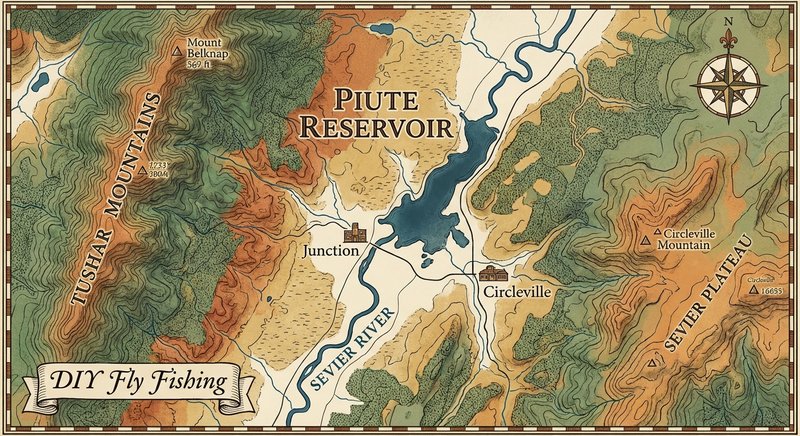
Piute Reservoir
Fly fishing in Utah · Beginner · Best seasons: Spring, Summer, Fall
Target Species
Rainbow Trout
About This Water
Central Utah reservoir with good rainbow fishing. Beautiful red rock scenery.
Fishing Recommendations
As an expert guide who has spent years traversing the high-desert fisheries of the Intermountain West, I can tell you that Piute Reservoir is one of those "sleeper" spots. Located on the Sevier River in south-central Utah, it often gets overshadowed by the more famous Panguitch or Fish Lake, but for the angler who knows how to read stillwater, it offers some of the most consistent and hard-fighting Rainbow Trout in the region.
Here is your comprehensive guide to fly fishing Piute Reservoir.
🎣 Location Overview
Piute Reservoir is a high-altitude desert impoundment situated at roughly 5,900 feet. It is characterized by its stark, beautiful scenery—surrounded by sagebrush-covered hills and the towering Tushar Mountains to the west.
What makes it special is the nutrient-rich water of the Sevier River drainage. This creates a highly productive biomass of midges, scuds, and damselflies. Unlike alpine lakes that are crystal clear and sterile, Piute has that "green" tint of a productive fishery. It is relatively shallow compared to other reservoirs, meaning the fish remain active in the littoral zones (near the shore) for much of the year.
🐟 Target Species & Behavior
While there are Smallmouth Bass and the occasional Brown Trout, the Rainbow Trout are the stars of the show here.
- Behavior: Piute Rainbows are known for being "cruisers." They patrol the shallow shelves and weed edges looking for easy meals. Because the reservoir is prone to irrigation drawdowns, the fish are highly adaptable and move frequently to find optimal oxygen and temperature levels.
- Feeding Habits: They are opportunistic. In the spring, they focus on midges and leeches. As the water warms, they transition to damselfly migrations and callibaetis hatches. By fall, they are aggressive, bulking up for winter on baitfish and scuds.
📅 Best Times to Fish
Spring (Late March – May)
- The Window: This is "Ice-Out" season. As soon as the ice recedes, the fish are hungry and close to the bank.
- Conditions: Look for overcast days. The fish will be in 2–6 feet of water.
Summer (June – August)
- The Window: Early mornings and late evenings are mandatory.
- Conditions: Mid-day can be tough as fish head to the deeper channels near the dam to find cooler water. July brings the Damselfly migration, which can lead to explosive shallow-water action.
Fall (September – November)
- The Window: The "Second Spring." As water temps drop, the fish return to the shallows.
- Conditions: This is the best time for trophy-sized fish. They become aggressive and will chase larger streamers.
🪰 Recommended Flies & Techniques
The "Chironomid" (Midge) Rig
Stillwater fly fishing at Piute is dominated by midge fishing.
- Patterns: Zebra Midges (Red or Black, size 16-20), Ice Buddies, and Chan’s Chironomids.
- Technique: Use a long leader (12–15 feet) under a slip-indicator. Suspend your fly about 12 inches off the bottom.
The "Damsel" Strip
During June and July, damselfly nymphs migrate toward the shore to hatch.
- Patterns: Marabou Damsel Nymphs (Olive, size 12-14).
- Technique: Use an intermediate sinking line. Cast toward weed beds and use a "tweak-tweak-pause" retrieve.
Streamer Therapy
When the wind picks up (as it often does at Piute), switch to streamers.
- Patterns: Woolly Buggers (Olive or Black with a bit of flash), Balanced Leeches, and thin-mints.
- Technique: Fish these on a sinking tip along the rocky outcrops near the dam.
💡 Pro Tips & Local Knowledge
- Focus on the Inlets: The north end, where the Sevier River enters, is a goldmine. The moving water brings in oxygen and a steady stream of food. It is often shallower here, so be stealthy.
- The "Piute Wind": The wind usually kicks up around 11:00 AM. Instead of leaving, use it to your advantage. The wind pushes "plankton" and insects toward the windward shore, and the trout follow. Fish the "choppy" water; the fish feel safer and are less spooky.
- Float Tubes & Kayaks: While you can fish from the bank near the State Park area, a float tube is a game-changer. It allows you to stay just outside the weed line and cast back toward the shore—exactly where the cruisers are patrolling.
⚠️ Important Information
Access
- Piute State Park: Located on the north and west sides. There is a nominal day-use fee.
- Boat Ramps: There is a main ramp on the west side, but be cautious during late summer as low water levels can make launching large boats difficult.
Regulations & Permits
- License: A valid Utah Fishing License is required.
- Limits: Standard state limits typically apply (4 trout), but always check the current Utah Big Game & Fishing Proclamation as rules can change annually regarding bait and harvest.
Special Considerations
- Water Levels: Piute is an irrigation reservoir. By August, it can be drawn down significantly. Check the USGS water levels before you head out. If it's too low, the fish concentrate in the old river channel.
- Sun Protection: There is zero shade. Bring high-SPF sunscreen and a good pair of polarized sunglasses to spot those cruising rainbows.
Guide’s Final Word: Piute is a "working man’s" reservoir. It’s not always easy, but if you master the slow-strip of a damselfly or the patience of a midge under an indicator, you’ll find some of the fattest, hardest-pulling Rainbows in the Sevier River valley. Tight lines!
Bug Hatches & Matching Flies
| Hatch | Type | Peak months | Time of day | Hook sizes | Matching flies |
|---|---|---|---|---|---|
| Chironomids Family Chironomidae | midge | April, May, September, October | All Day | #12-22 | Zebra Midge #16-20, Chrono-Cone #12-16, Griffith's Gnat #18-22 |
| Callibaetis Callibaetis spp. | mayfly | June, July, August | Morning/Early Afternoon | #12-16 | Callibaetis Spinner #14-16, Hare's Ear Nymph #12-16, Pheasant Tail #14-16 |
| Damselfly Enallagma spp. | terrestrial | June, July | Mid-day | #10-14 | Marabou Damsel #10-12, Adult Damsel #12-14, Damsel Nymph (Olive) #12-14 |
| Spotted Sedge Hydropsyche | caddis | July, August | Evening | #14-18 | Elk Hair Caddis #14-16, LaFontaine's Deep Sparkle Pupa #14-18, Peacock Caddis #16-18 |
| Grasshoppers Melanoplus spp. | terrestrial | August, September | Afternoon | #8-12 | Parachute Hopper #10-12, Joe's Hopper #8-12, Morrish Hopper #10 |
| Blue-Winged Olive Baetis spp. | mayfly | April, October | Mid-day | #18-22 | RS2 #18-22, BWO Parachute #18-20, JujuBaetis #18-22 |
| Trico Tricorythodes | mayfly | August, September | Morning | #20-24 | Trico Spinner #20-24, Trico Parachute #20-22 |
| Black Ants Formicidae | terrestrial | July, August | All Day | #14-18 | Cinnamon Ant #14-16, Black Foam Ant #14-18, Carpenter Ant #12-14 |