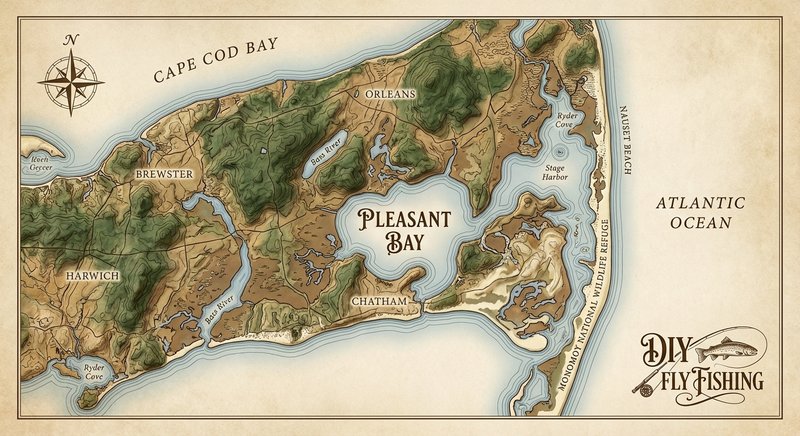
Pleasant Bay
Fly fishing in Massachusetts · Intermediate · Best seasons: Summer, Fall
Target Species
Striped Bass, Bluefish, False Albacore
About This Water
Cape Cod bay with striped bass. Chatham area flats fishing.
Fishing Recommendations
Welcome to Pleasant Bay, the largest contiguous bay on Cape Cod and arguably one of the finest saltwater fly fishing destinations on the Atlantic coast. As a guide, I consider this "The Promised Land" for sight-fishing. Its vast expanse of shallow sand flats, eelgrass beds, and intricate tidal channels offers an experience more akin to Caribbean bonefishing than traditional Northeastern "surf casting."
Here is your comprehensive guide to fly fishing Pleasant Bay.
🎣 Location Overview
Pleasant Bay is a massive, salt-water estuary bordered by the towns of Chatham, Orleans, and Harwich. It is protected from the open Atlantic by the shifting sands of North Beach Island and South Beach.
What makes it special is the clarity and depth. The bay is predominantly shallow, with crystal-clear water over white sand flats. This creates a world-class sight-fishing environment. Anglers can stalk striped bass in knee-deep water, watching a 30-inch fish track a fly from twenty feet away. The dynamic nature of the "Chatham Breach" (the inlet to the ocean) ensures a constant flow of cold, oxygenated, bait-rich water, making it a sanctuary for fish even during the heat of mid-summer.
🐟 Target Species & Behavior
Striped Bass (Stripers)
The stars of the show. In the early season, "schoolies" (12–22 inches) dominate the salt marshes. As the water warms, larger "flats fish" (30+ inches) move onto the sand to sun themselves and hunt. They are often found "tailing" in the eelgrass or "cruising" the edges of drop-offs.
Bluefish
Known locally as "yellow-eyed devils," these are aggressive, hard-fighting predators. They frequent the deeper channels of the bay and the turbulent water near the inlets. They are less selective than bass but will test your equipment to its limit.
False Albacore (Albies)
These are late-season visitors (late August through October). While they primarily stay on the "outside" (the ocean side of the barrier beach), they frequently push through the Chatham Breach into the lower bay on high tides, chasing rain bait. They are high-speed tunas that require precision casts and lightning-fast retrieves.
Primary Forage: Sand eels (the "french fries" of the ocean), silversides, green crabs, and juvenile menhaden (pogy).
📅 Best Times to Fish
Seasons
- Late May – June: The "Spring Run." The most aggressive feeding window as fish migrate north.
- July – August: Peak sight-fishing on the flats. Best for stalking large individual bass in skinny water.
- September – October: The "Fall Run." Cooling temperatures trigger massive bait migrations and surface blitzes. This is your best window for False Albacore.
Time of Day & Tides
- The "Magic Hour": First light is legendary in Pleasant Bay. Low wind and low light allow you to see "pushes" of water from moving fish.
- Tidal Flow: In Pleasant Bay, the moving tide is everything. The last two hours of the incoming and the first two hours of the outgoing are usually best.
- Sun Angle: For sight fishing, you want the sun at your back, ideally between 10:00 AM and 2:00 PM, to cut through the surface glare.
🪰 Recommended Flies & Techniques
Top Fly Patterns
- Sand Eel Imitations: Mushmouths, Epoxy Sand Eels, or Ray’s Fly. These should be your go-to.
- The Clouser Minnow: Chartreuse/White or Tan/White. Essential for getting down in the channels.
- Crab Patterns: Strong’s Olive Crab or Merkin-style crabs. Use these for striped bass tailing on the flats.
- Topwater: Gurglers or Bob’s Bangers. Nothing beats the explosion of a bluefish or striper on the surface.
- Albie Specials: Albie Whore or Mushmouth in pink/white or silver (size 2 to 4).
Techniques
- The Sight Cast: Stealth is mandatory. Approach fish slowly. Cast 3–5 feet in front of a cruising fish and use short, erratic strips.
- The Two-Handed Strip: Essential for False Albacore. Tuck the rod under your arm and strip with both hands to create maximum speed.
- Dead Drifting: In the tidal creeks, drifting a crab or shrimp pattern with the current can be incredibly effective for "lazy" big bass.
💡 Pro Tips & Local Knowledge
- The "Chatham Breach" Factor: The area where the bay meets the Atlantic is extremely dangerous due to shifting shoals and massive currents. If you are in a boat, be highly cautious. If wading, never get caught on a sandbar with a rising tide behind you.
- Wade Stealth: If you are wading the flats (like those off Crows Pasture or Jackknife Beach), move like a heron. Vibration travels through the sand; if you splash, the fish will vanish before you see them.
- Follow the Birds: If you see terns or gulls diving frantically, there is bait being pushed to the surface. Get there as fast as possible, but cut your engine 100 yards out and drift in.
- Match the Hatch: Pleasant Bay stripers can be notoriously "picky." If they are keyed in on 2-inch silversides, a 6-inch Clouser will be ignored. Always carry a variety of sizes.
⚠️ Important Information
Access
- Jackknife Beach (Orleans/Chatham line): Excellent wading access to expansive flats.
- Strong Island: Accessible by kayak or boat; offers some of the best "remote" feeling fishing in the bay.
- The River (Chatham): The narrow stretch leading toward the breach. High current, high reward.
Regulations & Permits
- MA Saltwater Fishing Permit: Required for all anglers 16 and older. It’s cheap and available online.
- Striped Bass Regulations: Massachusetts has strict "Circle Hook" requirements for bait, but for fly anglers, the main concern is the Slot Limit. Check current year regulations (usually 1 fish between 28" and 31") if you plan to harvest, though catch-and-release is highly encouraged on the flats.
- Parking: Parking at town beaches often requires a resident sticker during the summer days. Plan to fish before 8:00 AM or after 4:30 PM to avoid ticketing, or use public landings.
Safety
The flats of Pleasant Bay can be soft. If you feel yourself sinking into "black mud," turn back. Always carry a waterproof handheld VHF or a phone in a dry bag, as the weather can change instantly on the Cape.
Bug Hatches & Matching Flies
| Hatch | Type | Peak months | Time of day | Hook sizes | Matching flies |
|---|---|---|---|---|---|
| Cinder Worm Alitta succinea | midge | May, June | Evening | #10-14 | Red-Haired Stepchild #12, V-Rib Cinder Worm #10-14 |
| Salt Marsh Midge Chironomidae | midge | April, May, September | Morning/Evening | #18-24 | Zebra Midge #18-22, Griffith's Gnat #20-24 |
| Flying Ant Formicidae | terrestrial | August, September | Afternoon | #16-20 | Black Foam Ant #16-18, Cinnamon Ant #18 |
| Greenhead Fly Tabanus nigrovittatus | terrestrial | July, August | Afternoon | #10-14 | Deer Hair Greenhead #12, Madam X #10-14 |
| Salt Marsh Grasshopper Melanoplus spp. | terrestrial | August, September | Afternoon | #8-12 | Joe's Hopper #10-12, Rainy's Hopper #8-10 |
| Blue Winged Olive Baetis | mayfly | May, October | Afternoon | #18-22 | BWO Sparkle Dun #20, Pheasant Tail Nymph #18-22 |
| Cinnamon Caddis Hydropsyche | caddis | June, July | Evening | #14-16 | Elk Hair Caddis #14-16, LaFontaine's Emerger #16 |
| Japanese Beetle Popillia japonica | terrestrial | July, August | Afternoon | #12-14 | Foam Beetle #12-14, Coffee's Sparkle Beetle #14 |