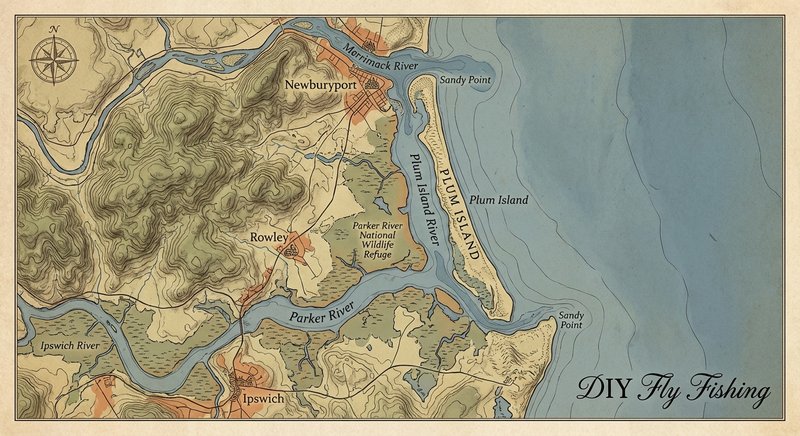
Plum Island
Fly fishing in Massachusetts · Intermediate · Best seasons: Spring, Summer, Fall
Target Species
Striped Bass, Bluefish
About This Water
Barrier beach with excellent striped bass surf fishing. Parker River Refuge.
Fishing Recommendations
Welcome to the North Shore. I’m glad you’re asking about Plum Island. As a guide, I consider this one of the most dynamic and productive saltwater fly fishing destinations in the Northeast. It’s a 11-mile long barrier island that offers a perfect "triple threat": a massive river mouth (the Merrimack), expansive ocean beaches, and a sprawling, nutrient-rich salt marsh system (Plum Island Sound).
Here is your professional briefing for fishing Plum Island.
🎣 Location Overview
Plum Island is a fly fisher’s playground because of its structural diversity. To the north, you have the mouth of the Merrimack River, one of the largest freshwater outputs in New England, which creates a massive "conveyor belt" of bait. To the west lies the Great Marsh, a labyrinth of tidal creeks and sod banks. To the east are the Atlantic beaches, characterized by shifting sandbars, deep troughs, and heavy surf.
What makes it special is the current. The tidal exchange here is massive (8–10 feet). This movement of water acts like a dinner bell for predators, flushing bait out of the marshes and concentrating them in "pinch points." Whether you prefer sight-fishing on sandy flats or swinging big streamers in heavy river currents, Plum Island has a beat for you.
🐟 Target Species & Behavior
Striped Bass (Stripers)
The primary target. In the spring (May/June), "schoolies" arrive first, followed by the "cows" (large migratory females).
- Behavior: They are opportunistic but current-dependent. They hold in the "seams" where fast water meets slow water, waiting to ambush bait.
- Diet: Early season is focused on sand eels and silversides. Mid-summer brings Atlantic Menhaden (pogy) and river herring. Fall is all about the "peanut" bunker (juvenile menhaden).
Bluefish
The "yellow-eyed devils" usually show up in mid-to-late summer when the water warms.
- Behavior: Aggressive, fast-moving, and destructive. Look for "blitzes" where the surface boils as they shred baitfish.
- Diet: Anything that moves. They will often bite the tails off stripers' prey just for sport.
📅 Best Times to Fish
- Spring (May - June): The "Arrival." Focus on the Merrimack River mouth and the warmer waters of the back marshes. This is the best time for high numbers of fish.
- Summer (July - August): The "Night Game." As water temperatures rise, big fish become nocturnal. Fish the oceanfront at night or the deep, cold channels of the river mouth during the day.
- Fall (September - October): The "Run." This is peak season. Fish are migrating south and feeding heavily. Surface blitzes are common along the ocean beaches and Sandy Point.
Prime Windows:
- Tides: The outgoing tide is generally king here. It flushes bait out of the marsh and river. Specifically, the last two hours of the drop and the first hour of the flood are most productive.
- Time of Day: Low light is your friend. Dawn and dusk are prime, but for the biggest fish, 11:00 PM to 3:00 AM is when the trophies come out to play in the shallows.
🪰 Recommended Flies & Techniques
Top Fly Patterns
- Sand Eel Imitations: Long, slender flies like the Surf Candy or Mushmouth in olive/white or chartreuse/white. Essential for the oceanfront.
- Clouser Minnow: The "Leatherman" of flies. Chartreuse/white or blue/white. The weighted eyes help get the fly down in the heavy Merrimack currents.
- Hollow Fleyes / Beast Flies: For the big "cows." These large, 8–10 inch profiles mimic pogies or herring but are tied to be light enough to cast.
- Gurglers & Poppers: For the early morning surface bite. Nothing beats a striper exploding on a topwater slider.
Techniques
- The "Swing": At the Merrimack mouth, use a fast-sinking integrated line (350–450 grain). Cast 45 degrees up-current, let it sink, and let the current swing the fly across the seams.
- Sight Casting: On the low-tide flats of the Parker River (inside the refuge), you can wade out and sight-fish for cruising bass in knee-deep water. Use a floating or intermediate line here.
- The "Two-Handed Strip": When fishing the surf, tuck the rod under your arm and use both hands to strip the line fast. This mimics a panicked baitfish.
💡 Pro Tips & Local Knowledge
- The "Captain's Fishing Parties" Area: Near the North End (the jetties), look for where the river current hits the jetty rocks. The turbulence creates a "washing machine" effect that disorients bait.
- Sandy Point (The South End): This is a magical spot. At low tide, you can walk out onto the bars. As the tide comes in, it creates "rips" that look like river rapids. Stripers sit right in those rips. Warning: Watch the tide behind you; you can get cut off from the shore quickly.
- Structure is Sub-surface: Use polarized glasses. On the oceanfront, look for "dark water" (troughs) between the beach and the outer sandbars. Bass use these as highways to travel the coast.
- The "Bird" Indicator: If you see terns or gulls hovering and diving, drop everything and get there. They are seeing the bait pushed up by fish.
⚠️ Important Information
Access
- The North End: Park at the public lots near the Captain's Fishing Parties. This provides access to the Merrimack River jetties.
- The Refuge: The Parker River National Wildlife Refuge covers the southern two-thirds of the island. There are several parking lots (Lot 1 through Lot 7).
- Note: Lot 7 (Sandy Point) is the most famous for fishing but fills up by 8:00 AM in the summer.
Regulations & Permits
- MA Saltwater Fishing Permit: Required for everyone 16 and older. It’s cheap and available online via the MassFishHunt website.
- Refuge Access: If you plan to fish at night within the Wildlife Refuge, you must obtain a Night Fishing Seashore Permit in advance. They are strictly enforced.
- Striped Bass Limits: Check current Massachusetts Division of Marine Fisheries (DMF) regs. It is currently a slot limit (usually 1 fish between 28" and less than 31"). Many fly anglers practice 100% catch and release.
Special Considerations
- Safety: The Merrimack River mouth is one of the most dangerous inlets on the East Coast. Do not wade out too far on the jetties if the swell is high.
- Piping Plovers: In late spring and summer, parts of the refuge beaches are closed to protect nesting birds. Always check the Refuge website for current closures before driving out.
- The "Greenheads": In July, the salt marsh flies (Greenheads) are brutal. They aren't deterred by DEET. Wear long sleeves or fish the ocean side where the breeze keeps them away.
Tight lines, and watch that tide!
Bug Hatches & Matching Flies
| Hatch | Type | Peak months | Time of day | Hook sizes | Matching flies |
|---|---|---|---|---|---|
| Salt Marsh Midge Chironomidae | midge | April, May, September, October | All Day | #18-24 | Zebra Midge #18-22, Griffith's Gnat #20-24 |
| Greenhead Fly Tabanus nigrovittatus | terrestrial | July | Daytime | #10-14 | Deer Hair Greenhead #10-12, Black Foam Beetle #12 |
| Blue Winged Olive Baetis vagans | mayfly | May, September, October | Afternoon | #18-22 | BWO Sparkle Dun #20-22, Pheasant Tail Nymph #18-20 |
| Cinnamon Caddis Hydropsyche | caddis | June, July, August | Evening | #14-16 | Elk Hair Caddis #14-16, Pupa Emerger #14-16 |
| Coastal Black Ant Formicidae | terrestrial | August, September | Afternoon | #14-18 | Black Foam Ant #14-18, Flying Ant #16 |
| Salt Marsh Mosquito Aedes sollicitans | midge | June, July, August | Evening/Dawn | #18-22 | Mosquito Dry #18-20, Brassie #20-22 |
| Sand Fly (No-See-Um) Ceratopogonidae | midge | July, August | Evening | #22-26 | CDC Midge Emerger #24, Cluster Midge #20 |
| Dune Grasshopper Melanoplus | terrestrial | August, September | Afternoon | #8-12 | Dave's Hopper #10-12, Charlie Boy Hopper #8-10 |
| Japanese Beetle Popillia japonica | terrestrial | July, August | Daytime | #12-14 | Japanese Beetle Foam #12-14, Coffee's Sparkle Beetle #14 |