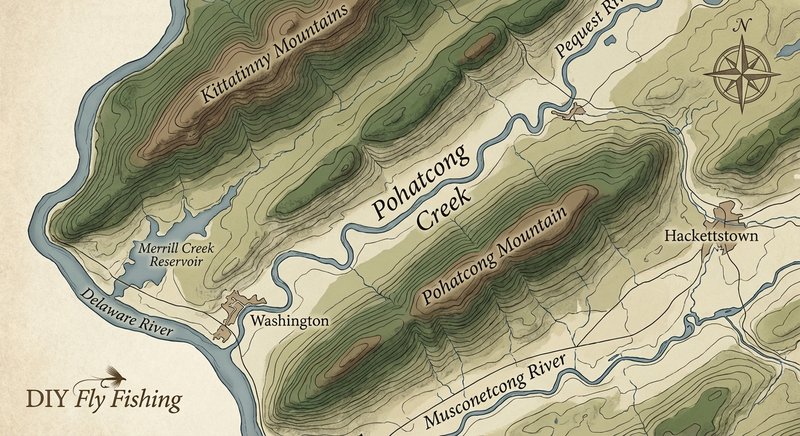
Pohatcong Creek
Fly fishing in New Jersey · intermediate · Best seasons: spring, summer
Target Species
Brown Trout, Rainbow Trout
About This Water
Warren County limestone-influenced stream. Good hatches and wild brown trout population.
Fishing Recommendations
As an expert guide who has spent many seasons navigating the limestone-influenced waters of the Garden State, I can tell you that Pohatcong Creek (often called "The Poey") is one of New Jersey's most underrated gems. While crowds flock to the nearby Musconetcong or Pequest, the Pohatcong offers a more intimate, technical, and rewarding experience for the discerning fly angler.
Here is your comprehensive guide to fly fishing the Pohatcong Creek.
🎣 Location Overview
The Pohatcong Creek is a tributary of the Delaware River, winding through the rolling farmland of Warren County. What makes this creek special is its limestone influence. Much of the stream flows through a limestone valley, which provides a high mineral content and relatively stable water temperatures.
The creek transitions from a small, brushy "blue-line" stream in its upper reaches to a classic pool-and-riffle stream as it flows through Washington and down toward the Delaware. It features crystalline water, lush aquatic vegetation (elodea and watercress), and a surprising amount of "big fish" water tucked away in suburban and agricultural pockets.
🐟 Target Species & Behavior
- Rainbow Trout: These are primarily stocked by the state. They are aggressive and tend to hold in the faster, oxygenated water at the heads of pools or in the main current of riffles.
- Brown Trout: The star of the Pohatcong. While many are stocked, the creek has a significant population of wild, stream-born browns, especially in the sections above Washington.
- Behavior: Wild browns are notoriously "spooky." They hug undercut banks, hide beneath overhanging silky dogwoods, and are highly sensitive to overhead shadows.
- Feeding: Due to the limestone chemistry, the creek is rich in scuds and cressbugs. The fish are accustomed to foraging on the bottom, but they will look up for prolific hatches.
📅 Best Times to Fish
Optimal Seasons
- Spring (April – June): This is the prime window. Water levels are usually stable, and the major insect hatches occur now.
- Summer (July – Early September): Unlike many NJ freestone streams that get too warm, the Pohatcong’s spring-fed nature keeps certain stretches fishable. However, you must carry a thermometer; if the water hits 68°F, stop fishing to protect the trout.
Best Times of Day
- Spring: 10:00 AM to 4:00 PM (when the water warms slightly and triggers hatches).
- Summer: "Trico" time. Be on the water at dawn. Evening rises for Sulphurs and Caddis can also be legendary.
🪰 Recommended Flies & Techniques
Top Fly Patterns
- Nymphs:
- The Pohatcong Special: Scud or Cressbug patterns (Size 14-18) in gray or olive. These are year-round staples.
- Pheasant Tail (Beadhead or Flashback): Size 16-20. Represents the ubiquitous BWOs.
- Zebra Midge: Black or Red (Size 18-22). Essential for picky fish in slow pools.
- Dry Flies:
- Sulphurs: Size 16-18 (Late May/June).
- Elk Hair Caddis: Tan or Olive (Size 14-18).
- Tricos: Size 22-24 (Summer mornings).
- Streamers:
- Black or Olive Woolly Bugger: Size 8-12. Great for high water or targeting large, aggressive browns near undercut banks.
Effective Techniques
- Tight-Line (Euro) Nymphing: This is the most effective way to fish the Pohatcong. The many riffles and pocket waters are perfect for a tactical nymphing setup with a long leader.
- The "Reach Cast": Because the current can be complex with micro-drags, a solid reach cast is necessary when dry fly fishing to ensure a natural drift before the line pulls the fly.
- Light Presentation: Use 6X or even 7X tippet for wild browns in the summer. They have plenty of time to inspect your fly in the clear, slow-moving pools.
💡 Pro Tips & Local Knowledge
- Focus on the "Pockets": Many anglers walk past the small, knee-deep pockets of water. In the Pohatcong, a wild brown will often hold in a pocket no bigger than a hula-hoop if there is a rock or log providing cover.
- The "Washington Stretch": The water flowing through the Washington area parks offers excellent access, but for wild fish, head upstream toward Mansfield or downstream toward Broadway.
- Stealth is Mandatory: The creek is often narrow. If you splash into the water or wear bright clothing, the fish will be gone before you pull line off your reel. Keep a low profile and wade as little as possible.
- The "Scud Shake": If things are slow, find a patch of aquatic weeds, give them a gentle kick, and watch the scuds scatter. Then, drift a scud pattern right through that lane.
⚠️ Important Information
Access Information
- Public Access: Key spots include Heritage Park in Mansfield, various bridges along Route 57, and the Pohatcong Native Grasslands Preserve.
- Private Property: Much of the Pohatcong flows through private farmland. Always look for "Posted" signs. New Jersey law requires permission to fish on private property unless it is unposted, but the "Golden Rule" applies—be respectful.
Regulations & Permits
- A valid New Jersey Fishing License and Trout Stamp are required for anyone 16 and older.
- The Pohatcong is subject to Statewide Trout Regulations. Be aware of the "Opening Day" closures in April and the spring stocking dates when the creek is closed to fishing (usually certain Thursdays).
- Check the NJ Fish & Wildlife website for the most current stocking schedule and boundary specific rules.
Safety Note
The rocks in the Pohatcong can be surprisingly slippery due to the limestone-rich silt and algae. Studded wading boots and a wading staff are highly recommended, even in the shallower sections.
Bug Hatches & Matching Flies
| Hatch | Type | Peak months | Time of day | Hook sizes | Matching flies |
|---|---|---|---|---|---|
| Blue Winged Olives Baetis | mayfly | March, April, October, November | Mid-day/Afternoon | #18-22 | RS2 #20-22, Parachute Blue Winged Olive #18-22, Pheasant Tail #18-20 |
| Sulphurs Ephemerella invaria/dorothea | mayfly | May, June | Evening | #14-18 | Sulphur Parachute #16-18, Hare's Ear Nymph #14-16, Sulphur Snowshoe Emerger #16-18 |
| Tan Caddis Hydropsyche | caddis | April, May, June | Afternoon/Evening | #14-18 | Elk Hair Caddis (Tan) #14-16, LaFontaine's Deep Sparkle Pupa #14-16, X-Caddis #14-18 |
| Little Black Stoneflies Taeniopteryx | stonefly | February, March | Mid-day | #14-18 | Early Black Stone #16-18, Prince Nymph #14-16, Zebra Midge #18-20 |
| Tricos Tricorythodes | mayfly | July, August, September | Early Morning | #22-26 | Trico Spinner #22-24, Trico Parachute #24-26, WD-40 #22-24 |
| Light Cahills Stenacron | mayfly | June, July | Late Evening | #12-14 | Light Cahill #12-14, Cream Usual #14, Gold Ribbed Hare's Ear #12-14 |
| Terrestrials Formicidae / Coleoptera | terrestrial | July, August, September | All Day | #12-18 | Cinnamon Ant #16-18, Black Foam Beetle #14-16, Dave's Hopper #12 |
| Midges Chironomidae | midge | January, February, December | Anytime | #20-24 | Griffith's Gnat #20-22, Zebra Midge (Black/Silver) #20-24, Top Secret Midge #22-24 |