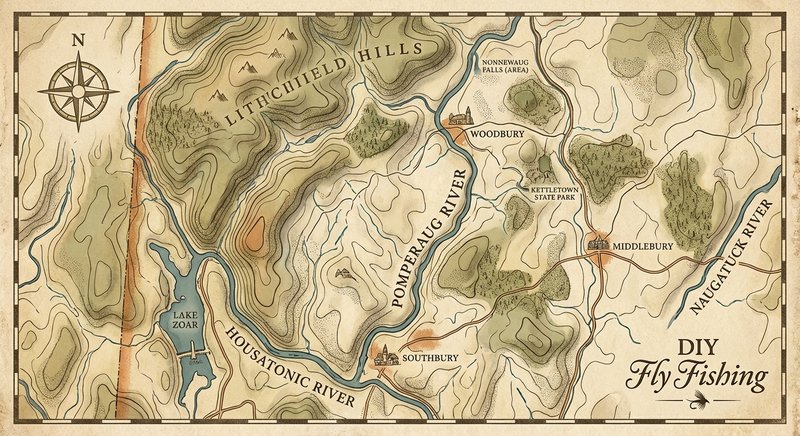
Pomperaug River
Fly fishing in Connecticut · Beginner · Best seasons: Spring, Fall
Target Species
Brown Trout, Rainbow Trout
About This Water
New Haven County stream with brown trout. Good early season fishing.
Fishing Recommendations
Welcome to the Pomperaug River, one of Connecticut’s most productive and charming freestone streams. As a guide in the Northeast, I consider the Pomperaug a "sleeper" river—it often gets overshadowed by the nearby Farmington or Housatonic, but for the discerning angler, it offers incredible hatches and classic New England water.
Here is your comprehensive guide to fly fishing the Pomperaug.
🎣 Location Overview
The Pomperaug River is formed by the confluence of the Nonnewaug and Weekeepeemee Rivers in Woodbury and flows roughly 13 miles south through Southbury into Lake Zoar.
What makes the Pomperaug special is its alkaline water chemistry. Unlike many acidic New England streams, the Pomperaug flows through a limestone-influenced valley. This creates a high biomass of aquatic insects and crustaceans, leading to faster fish growth and more consistent hatches. The river is characterized by classic pool-run-riffle sequences, undercut banks, and large glacial boulders. It feels intimate, requiring stealth and precise casting rather than long-distance bombs.
🐟 Target Species & Behavior
- Brown Trout: The "kings" of the Pomperaug. While the state stocks heavily, the river’s deep holes and undercut banks allow for a decent number of holdover fish. They are wary and tend to hold tight to structure or in the deep shadows of overhanging hemlocks during the day.
- Rainbow Trout: Generally more aggressive and found in the oxygenated "bubble line" at the heads of pools or in the faster riffles.
- Behavioral Note: Because of the river's high productivity, these fish can be "snobby." They are used to seeing a lot of natural food (scuds and sowbugs), so your imitation needs to be spot-on in terms of size and profile.
📅 Best Times to Fish
Spring (April – June)
This is the "Golden Era" on the Pomperaug.
- April: High water usually calls for heavy nymphs and streamers.
- May: The peak. The legendary Hendrickson hatch occurs here in early to mid-May.
- June: Transition to caddis and light Cahills.
Fall (September – November)
As water temperatures drop, the river comes alive again.
- September: Great for terrestrial fishing (ants and beetles).
- October/November: The Brown Trout become aggressive as they prepare for the spawn. This is the best time for streamer fishing.
Prime Windows
- Spring: 10:00 AM – 4:00 PM (Waiting for the water to warm slightly to trigger hatches).
- Fall: Midday is most productive.
- Summer Caution: The Pomperaug is sensitive to heat. If water temps exceed 68°F, please stop fishing to protect the trout.
🪰 Recommended Flies & Techniques
Dry Flies
- Hendrickson (Red Quill) #12-14: Essential for May.
- Tan or Olive Elk Hair Caddis #14-18: A staple from late spring through fall.
- Blue Winged Olives (BWO) #18-22: Vital for overcast, drizzly days in both spring and fall.
- Parachute Adams #14-20: The ultimate searcher pattern for this river.
Nymphs
- Pheasant Tail #14-18: Mimics the prolific Mayfly nymphs.
- Ray Charles or Scud Patterns #14-16: Because of the alkaline water, scuds are a primary year-round food source. Use grey or olive.
- Zebra Midge #18-22: Deadly in the slower tailouts.
Streamers
- Woolly Bugger (Black or Olive) #6-10: Best fished on a swing or with a "strip-strip-pause" retrieve near undercut banks.
- Black Nose Dace: Excellent for mimicking the local baitfish.
Presentation Tips
The Pomperaug is not a massive river. A 9-foot 4-weight or 5-weight rod is perfect. Use long, fine leaders (9ft to 12ft 5X or 6X) for dry fly work, as the water can be exceptionally clear in the pools.
💡 Pro Tips & Local Knowledge
- The "Three Rivers" Secret: The area near Three Rivers Park in Woodbury (where the Nonnewaug and Weekeepeemee meet) is a high-traffic area but for a reason—the mixing of waters creates a highly oxygenated, nutrient-rich environment that holds a high density of fish.
- Focus on the Pockets: Many anglers walk right past the "pocket water" (small soft spots behind rocks in fast current). On the Pomperaug, a well-placed nymph in a pocket the size of a hula-hoop often yields the best fish of the day.
- The "Woodbury Shuffle": When wading, you will naturally kick up rocks. Keep an eye downstream; trout will often move in behind you to grab the nymphs you've dislodged. (While "shuffling" on purpose is frowned upon, it proves how much these fish rely on nymphs).
⚠️ Important Information
Access
- Hollow Park (Woodbury): Great public access with plenty of parking and a mix of water types.
- Three Rivers Park: Excellent starting point for beginners.
- Southbury Stretches: Check for CT DEEP "Fishing Access" signs along Route 172 and near the I-84 overpasses.
Regulations
- Trout Management Area (TMA): The Pomperaug has specific sections designated as a TMA. In these areas, it is typically Catch and Release Only from September 1 through the second Saturday in April.
- License: You must have a valid Connecticut Fishing License and a Trout & Salmon Stamp.
- Check the Map: Always refer to the CT DEEP Interactive Fishing Map for current boundaries and season dates.
Guide’s Final Word: The Pomperaug is a river of nuance. Slow down, observe the banks for mink and kingfishers (they'll tell you where the fish are), and match the hatch. Tight lines!
Bug Hatches & Matching Flies
| Hatch | Type | Peak months | Time of day | Hook sizes | Matching flies |
|---|---|---|---|---|---|
| Hendrickson Ephemerella subvaria | mayfly | April, May | Afternoon | #12-14 | Red Quill #12-14, Hendrickson Emerger #12-14, Pheasant Tail #12-14 |
| Blue-Winged Olive Baetis spp. | mayfly | March, April, September, October | Mid-day/Afternoon | #18-22 | RS2 #18-22, BWO Sparkle Dun #18-22, WD-40 #20-22 |
| Sulphur Ephemerella invaria/dorothea | mayfly | May, June | Evening | #14-18 | Sulphur Parachute #14-18, Sulphur CDC Emerger #14-16, Rusty Spinner #14-18 |
| Tan Caddis Hydropsyche | caddis | May, June, July | Morning/Evening | #14-18 | Elk Hair Caddis #14-18, LaFontaine's Deep Sparkle Pupa #14-16, Holy Grail #14-18 |
| March Brown Maccaffertium vicarium | mayfly | May, June | Afternoon | #10-12 | March Brown American #10-12, Hare's Ear #10-12, March Brown Wet Fly #10-12 |
| Isonychia Isonychia bicolor | mayfly | June, September | Late Afternoon/Evening | #10-12 | Iso Parachute #10-12, Zug Bug #10-14, Prince Nymph #10-12 |
| Light Cahill Stenacron interpunctatum | mayfly | June, July | Evening | #12-14 | Light Cahill #12-16, Cream Usual #14-16 |
| Trico Tricorythodes | mayfly | July, August, September | Early Morning | #22-24 | Trico Spinner #22-24, Zebra Midge #20-24 |
| Common Terrestrials Formicidae / Gryllidae | terrestrial | July, August, September | All Day | #12-18 | Black Foam Ant #16-18, Crowe Beetle #14-16, Dave's Hopper #12 |