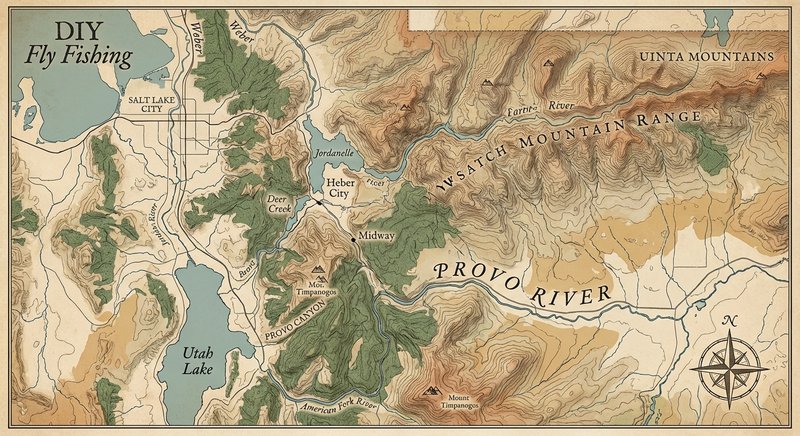
Provo River
Fly fishing in Utah · Intermediate · Best seasons: Spring, Summer, Fall
Target Species
Brown Trout, Rainbow Trout
About This Water
Blue ribbon trout stream near Park City. Three distinct sections with different character.
Fishing Recommendations
Welcome to the Provo River, a crown jewel of Rocky Mountain fly fishing. As an expert guide, I consider the Provo one of the most productive and technically rewarding tailwaters in the United States. Located just a short drive from Salt Lake City and Park City, it offers consistent water temperatures and incredible biomass, supporting upwards of 3,000 to 5,000 fish per mile in its prime stretches.
🎣 Location Overview
The Provo River is divided into three distinct sections, but for the traveling angler, the Middle Provo (between Jordanelle Reservoir and Deer Creek Reservoir) and the Lower Provo (below Deer Creek Dam) are the primary destinations.
- The Middle Provo: This section flows through the stunning Heber Valley. Following a massive restoration project (the "Provo River Restoration Project"), it features a meandering path with classic riffles, deep pools, and side channels. It is a blue-ribbon stream known for its accessibility and massive population of wild Brown Trout.
- The Lower Provo: This section flows through the steep, limestone walls of Provo Canyon. It is a larger, faster tailwater. It stays cooler in the summer and warmer in the winter, making it a year-round factory for healthy fish.
What makes it special is the predictability of the hatches and the transparency of the water, offering sight-fishing opportunities that are rare for a river with this much volume.
🐟 Target Species & Behavior
The Provo is primarily a Brown Trout and Rainbow Trout fishery.
- Brown Trout: The dominant species. They are wild, hardy, and highly educated. In the Middle Provo, they hug the undercut banks and the "seams" where fast water meets slow water. During the fall spawn, they become aggressive, but they are generally "surface-aware" and will rise to even tiny midges.
- Rainbow Trout: Found in both sections but more prevalent in the Lower Provo and near the dams. They tend to hold in the faster, oxygenated "heads" of the riffles.
- Feeding Habits: These fish are "micro-feeders." Because of the high density of small invertebrates (Midges and Sowbugs), they don't always need to move far to eat. Precision and drift are more important than fly size here.
📅 Best Times to Fish
Spring (March – May)
- The Window: This is the time for the legendary Blue Winged Olive (BWO) hatches.
- Conditions: As the snow melts, the Middle Provo remains fishable due to the dam control. Look for overcast days for the best dry fly action.
- Time of Day: 11:00 AM – 4:00 PM.
Summer (June – August)
- The Window: Prime time for Pale Morning Duns (PMDs) and Caddis.
- Conditions: High water flows are common early in summer for irrigation, but the fishing remains excellent.
- Time of Day: Early morning (6:00 AM) or the "Evening Rise" (7:00 PM until dark).
Fall (September – November)
- The Window: My personal favorite. The Brown Trout turn a vibrant gold and become very aggressive.
- Conditions: Lower, clearer flows. The BWO hatch returns, and the scenery in the canyon is world-class.
- Time of Day: Mid-morning through late afternoon.
🪰 Recommended Flies & Techniques
Top Fly Patterns
- Nymphs:
- Sowbugs: (Size 16-20) Gray or Tan. This is the "bread and butter" of the Provo.
- Zebra Midges: (Size 18-22) Black, Red, or Olive with a silver bead.
- Pheasant Tails: (Size 18-22) Slim profile is key.
- Juju Baetis: (Size 20-22) For the BWO emerger stages.
- Dry Flies:
- Parachute Adams: (Size 18-22)
- Mother's Day Caddis: (Size 16-18)
- CDC BWO Emerger: (Size 20-22)
- Streamers:
- Sculpzilla: (Size 4-8) in Olive or Black for the Lower Provo deep holes.
Effective Techniques
- "The Provo Bounce" (Weighting): This is a local nymphing technique. Instead of putting split shot above your flies, many locals use a "bounce rig" where the weight is at the very bottom of the leader, with flies tied on droppers above it. This keeps the flies in the "strike zone" (the bottom 2-4 inches) without snagging as often.
- Long Leaders: Use 9ft to 12ft leaders tapered to 5X or 6X fluorocarbon. These fish are leader-shy.
- Dry-Dropper: In the summer on the Middle Provo, a high-vis Caddis with a small Sowbug dropper 18 inches below is deadly.
💡 Pro Tips & Local Knowledge
- The "Mid-Day Slump": On the Provo, the fish often take a break between 1:00 PM and 3:00 PM in the summer. Use this time to grab lunch in Midway or Heber so you’re fresh for the evening Caddis hatch.
- Focus on the Tailouts: Most anglers fish the "buckets" (the deep holes). Experienced guides focus on the shallow "tailouts" (where the pool thins out before a drop). Big Browns move into these shallows to feed on emergers.
- Stealth Matters: Because the water is clear, avoid "wading deep." Stand back from the bank and fish the water closest to you first. If you can see the fish, they can definitely see you.
⚠️ Important Information
Access
- Middle Provo: Best access is at Riverview Park, the Legacy Bridge, or the Ledges area. There is a well-maintained angler trail along most of this section.
- Lower Provo: Access points are numerous along Hwy 189 in Provo Canyon. Look for the paved pull-outs.
Regulations
- Special Rules: Large portions of both the Middle and Lower Provo are Artificial Flies and Lures Only.
- Limits: Many stretches are "Catch and Release" or have very specific slot limits (e.g., you can only keep two trout under 15 inches). Always check the current Utah Fishing Guidebook before casting.
- Permits: A valid Utah Fishing License is required. You can purchase these easily online via the Utah DWR website or at local shops in Heber or Orem.
Special Considerations
- Waders: The water is cold year-round (tailwater). Even in July, you’ll want chest waders.
- Etiquette: The Provo is popular. If you see someone in a hole, give them plenty of space (at least 50 yards). If you want solitude, be prepared to hike further from the parking lots.
Tight lines, and enjoy one of the finest trout streams in the West!
Bug Hatches & Matching Flies
| Hatch | Type | Peak months | Time of day | Hook sizes | Matching flies |
|---|---|---|---|---|---|
| Midges Chironomidae | midge | January, February, March, April | All Day / Midday in Winter | #18-24 | Zebra Midge #18-22, Griffith's Gnat #20-24, Morgan's Midge #20-22 |
| Blue Winged Olive (BWO) Baetis | mayfly | March, April, October, November | Late Morning to Afternoon | #18-22 | RS2 #18-22, Parachute Adams #18-22, Pheasant Tail #18-20 |
| Pale Morning Dun (PMD) Ephemerella | mayfly | June, July, August | Late Morning to Early Afternoon | #16-18 | PMD Sparkle Dun #16-18, Split Case PMD #16-18, Rusty Spinner #16-18 |
| Mother's Day Caddis Brachycentrus | caddis | May | All Day / Evening | #14-16 | LaFontaine's Deep Sparkle Pupa #14-16, Elk Hair Caddis #14-16, Peacock Caddis #16 |
| Green Drake Ephemera guttulata | mayfly | June, July | Afternoon / Evening | #10-12 | Green Drake Paradrake #10-12, Drake Hairwing Dun #10-12, Green Drake Nymph #10-12 |
| Golden Stonefly Hesperoperla pacifica | stonefly | June, July | Morning / Evening | #8-12 | Pat's Rubber Leg #8-12, Chubby Chernobyl #8-12, Golden Rogue Stone #10-12 |
| Trico Tricorythodes | mayfly | August, September | Early Morning | #22-26 | Trico Spinner #22-26, Sunken Trico Spinner #22-24 |
| Grasshoppers Acrididae | terrestrial | July, August, September | Midday / Afternoon | #8-12 | Dave's Hopper #10-12, Morrish Hopper #8-12, Parachute Hopper #10-14 |