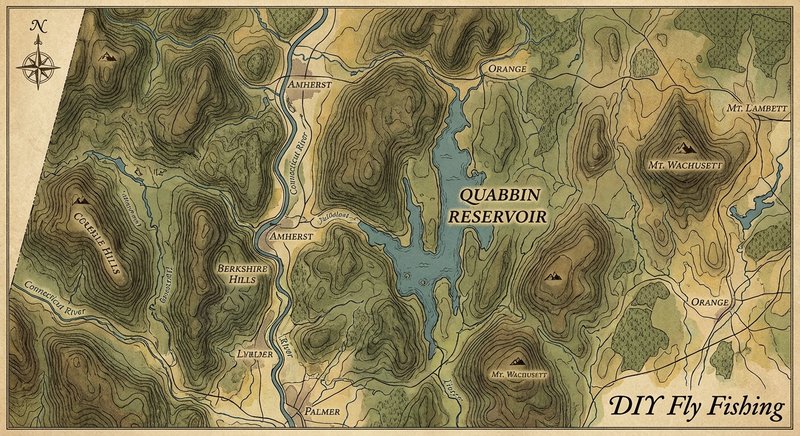
Quabbin Reservoir
Fly fishing in Massachusetts · Intermediate · Best seasons: Spring, Summer, Fall
Target Species
Landlocked Salmon, Lake Trout, Smallmouth Bass
About This Water
Massachusetts' largest reservoir with landlocked salmon and lake trout. Limited access.
Fishing Recommendations
Welcome to the "Accidental Wilderness." As your guide, I can tell you that Quabbin Reservoir is one of the most unique fly fishing destinations in the Eastern United States. Covering 39 square miles with 118 miles of shoreline, this is the primary drinking water supply for Boston. Because development is strictly prohibited, fishing here feels like a trip to the remote wilds of Maine or Canada, right in the heart of Massachusetts.
Here is your comprehensive guide to fly fishing the Quabbin.
🎣 Location Overview
The Quabbin is a massive, deep, oligotrophic (low nutrient, high oxygen) reservoir. The water is exceptionally clear—visibility can exceed 20 feet—which makes it both a blessing and a challenge for fly anglers.
What makes it special is the size and solitude. Motor restrictions and limited access points keep the crowds down. The underwater topography is diverse, featuring flooded roadbeds, stone walls, and foundations from the four towns that were flooded to create the reservoir in the 1930s. For the fly angler, it offers a rare opportunity to target cold-water pelagic species (Salmon/Lakers) and world-class Smallmouth Bass in the same day.
🐟 Target Species & Behavior
Landlocked Salmon
These are the "silver bullets" of the Quabbin. They are descendants of Atlantic Salmon and behave similarly.
- Behavior: They are pelagic, meaning they roam open water following schools of Landlocked Smelt, their primary food source.
- Hold: They prefer temperatures between 50°F and 60°F. In spring, they are right on the surface. As the water warms, they drop to the thermocline (usually 30–50 feet down).
Lake Trout (Lakers)
Quabbin holds a massive population of wild-reproducing Lake Trout.
- Behavior: They are bottom-oriented predators.
- Hold: In early spring, they can be found in 10–20 feet of water near rocky points. In summer, they retreat to the deepest holes (80+ feet), making them difficult—but not impossible—to reach with specialized fly gear.
Smallmouth Bass
Quabbin is arguably the best Smallmouth fishery in the Northeast.
- Behavior: Aggressive and structure-oriented.
- Hold: They love the rocky "inside" corners, submerged stone walls, and boulder fields. During the spawn (late May/June), they are visible on nests in the sandy flats.
📅 Best Times to Fish
- Spring (Mid-April to Early June): The Golden Window. This is when the Salmon and Lake Trout are in the upper 15 feet of the water column. Fly anglers have the best chance at a "Quabbin Grand Slam" now.
- Summer (July to August): Best for Smallmouth Bass in the early morning and late evening. Salmon fishing requires heavy sinking lines (Type 6 or 7) or "trolling" flies behind a boat.
- Fall (September to October 15): As the water cools, Salmon and Lakers move shallow again. This is the best time for trophy Lake Trout as they move toward rocky shoals to spawn.
Pro Timing: Overcast days with a "Quabbin Chop" (light wind) are superior. The fish are less spooky in the crystal-clear water when the surface is broken.
🪰 Recommended Flies & Techniques
For Salmon & Lake Trout
- Patterns:
- Streamers: Grey Ghost, Black Ghost, Mickey Finn, and Joe’s Smelt.
- Modern Patterns: Game Changers (white/silver), Sparkle Minnows, and Clouser Minnows (Blue/White).
- Technique: "Trolling the fly" is highly effective here. Use a full sinking line, let out 70+ feet of line behind a rental boat, and move at a slow walking pace. If casting, use a fast, erratic strip to mimic a panicked smelt.
For Smallmouth Bass
- Patterns:
- Topwater: Boogle Bugs, Deer Hair Poppers (Mornings/Evenings).
- Subsurface: Woolly Buggers (Olive/Black), Near Nuff Crayfish, and Hellgrammite patterns.
- Technique: Target submerged stone walls. Cast your fly past the wall and strip it so it "thumps" over the rocks. Smallmouth here are extremely visual; use long fluorocarbon leaders (9–12 ft).
💡 Pro Tips & Local Knowledge
- The "Gate" Strategy:
- Gate 8 (Pelham): Best for Smallmouth and access to deep western channels.
- Gate 31 (New Salem): Renowned for Lake Trout and large bays.
- Gate 43 (Hardwick): Access to the deepest water; best for late-season Salmon.
- Find the Smelt: If you see loons diving or gulls working the surface, the smelt are there. The Salmon will be right underneath them.
- The "Drop-Off": Quabbin Smallmouth love "shelf" transitions. Look for areas where the depth goes from 5 feet to 20 feet instantly.
- No Lead: This is critical. Massachusetts law and Quabbin-specific rules prohibit the use of lead weights or lead-jig heads. Use tungsten or tin.
⚠️ Important Information
- Access: You cannot just launch a kayak anywhere. You must use one of the three designated Boat Launch Areas (Gate 8, 31, or 43).
- Boat Decontamination: If bringing your own boat, it must undergo a strict Quabbin-specific decontamination process and be "Quabbin Sealed." Most fly anglers choose to rent the 14-foot motorboats available at the gates.
- Permits: You need a valid Massachusetts Fishing License PLUS a Quabbin Fishing Permit (available at the gates for a small daily fee or a season pass).
- Regulations: The season typically runs from the third Saturday in April to October 15th.
- Safety: The Quabbin is huge and can get windy fast. Always keep an eye on the weather; the "Quabbin Chop" can turn into dangerous swells quickly.
Guide’s Final Word: Bring a 6-weight rod for the bass and an 8-weight with a sinking tip for the Salmon. Stealth and observation are your best tools in this clear water. Tight lines!
Bug Hatches & Matching Flies
| Hatch | Type | Peak months | Time of day | Hook sizes | Matching flies |
|---|---|---|---|---|---|
| Chironomids (Midges) Chironomidae | midge | April, May, September | All Day | #18-24 | Zebra Midge #18-22, Griffith's Gnat #20-24, Palomino Midge #20-22 |
| Giant Michigan Mayfly (Hex) Hexagenia limbata | mayfly | June, July | Dusk/Night | #6-10 | Hexagenia Spinner #6-8, Hexagenia Nymph #6-10, Paradrake #8-10 |
| Speckled Spinner (Callibaetis) Callibaetis | mayfly | May, June, September | Morning/Afternoon | #12-16 | Callibaetis Cripple #14-16, Hare's Ear Nymph #12-16, Callibaetis Spinner #14-16 |
| Flying Ants Formicidae | terrestrial | August, September | Afternoon | #14-18 | Black Flying Ant #14-18, Cinnamon Ant #16-18 |
| White Curse (Caenis) Caenis | mayfly | July, August | Early Morning | #22-26 | Caenis Spinner #24-26, Micro-midge Pupae #22-24 |
| Grannom Caddis Brachycentrus | caddis | April, May | Afternoon | #12-16 | Elk Hair Caddis #14-16, Pupa-can #14-16, Peacock Caddis #12-14 |
| Slate Drake Isonychia bicolor | mayfly | June, September | Evening | #10-14 | Iso Nymph #10-12, Slate Drake #12-14, Zug Bug #10-14 |
| Trico Tricorythodes | mayfly | July, August, September | Early Morning | #20-24 | Trico Spinner #20-24, RS2 #20-22 |