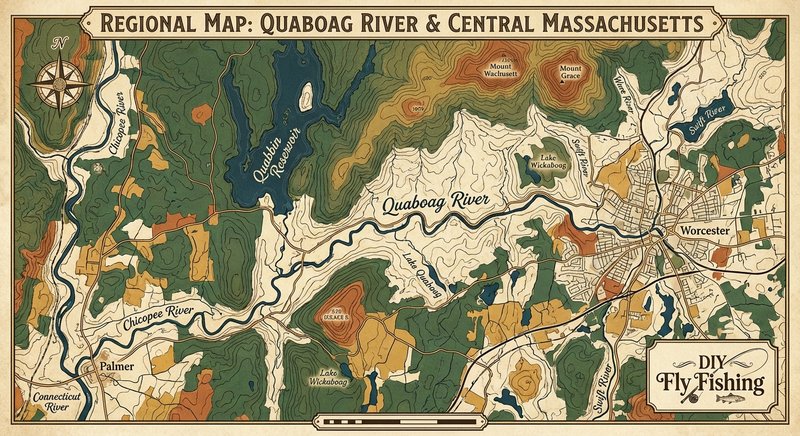
Quaboag River
Fly fishing in Massachusetts · Beginner · Best seasons: Spring, Summer, Fall
Target Species
Brown Trout, Largemouth Bass
About This Water
Central Massachusetts river with trout and bass. Good public access.
Fishing Recommendations
The Quaboag River in Central Massachusetts is a hidden gem that offers a "tale of two rivers" experience. It transitions from a slow-moving, marshy lowland stream into a classic, rocky New England freestone river. This diversity allows anglers to target trophy Largemouth Bass and elusive Brown Trout often within a few miles of each other.
🎣 Location Overview
The Quaboag River flows roughly 25 miles from Quaboag Pond in Brookfield down to its confluence with the Ware and Swift Rivers in Palmer to form the Chicopee River.
What makes it special is the drastic change in character. The Upper Quaboag (Brookfield to West Brookfield) is characterized by deep, slow-moving water, lily pads, and timber—prime habitat for warm-water species. As the river moves through Warren and West Warren, the gradient increases significantly. Here, you’ll find the "trout water": a series of riffles, deep pools, and pocket water flowing over a substrate of cobble and boulders. It is a scenic, somewhat rugged river that offers a sense of solitude despite its proximity to local towns.
🐟 Target Species & Behavior
Brown Trout
- Behavior: The Quaboag is stocked annually with Brown Trout, and thanks to the deep pools and cold-water tributaries, a fair number of "holdovers" survive and grow to impressive sizes. These fish are wary. They hold in the "cushion" in front of large boulders, under heavy bank overgrowth, or in the deep tail-outs of pools during low light.
- Feeding: They are opportunistic. In the spring, they focus on aquatic insects (Mayflies and Caddis). As they grow, they become highly piscivorous, targeting dace, shiners, and even small crayfish.
Largemouth Bass
- Behavior: Found predominantly in the upper, slower reaches. These fish are ambush predators. They tuck tightly into the shade of lily pads, downed logs, and bridge abutments.
- Feeding: They are aggressive. They key in on frogs, large aquatic insects (like Dragonflies), and the abundant sunfish population. In the Quaboag, they are known to strike large streamers and topwater patterns with explosive force.
📅 Best Times to Fish
- Spring (April – June): This is the Prime Trout Window. Once the spring runoff subsides, the trout are active and hungry. Mayfly hatches (Hendricksons and March Browns) occur in May.
- Summer (July – August): This is Bass Season. As water temperatures rise, trout become lethargic and should be left alone to avoid stress. Focus on the upper river for Bass during the "golden hours" (dawn and dusk) when topwater action is at its peak.
- Fall (September – October): A fantastic time for both. As temperatures drop, Brown Trout become aggressive before their spawning period. Bass feed heavily to bulk up for winter. The foliage along the Quaboag during this time is world-class.
🪰 Recommended Flies & Techniques
For Brown Trout
- Nymphing: A two-fly rig is standard. Use a size 12-14 Bead-head Hare's Ear as a lead fly with a size 18 Zebra Midge or Pheasant Tail dropper.
- Dry Flies: During hatches, use Adams (14-16), Elk Hair Caddis (12-16), or Light Cahills.
- Streamers: This is the best way to find the big holdovers. Swing a Black or Olive Woolly Bugger or a Muddler Minnow through deep runs.
For Largemouth Bass
- Topwater: Deer Hair Poppers or Foam Frogs in green/chartreuse. Cast these right against the bank or into "holes" in the lily pads.
- Sub-surface: Gamechangers or Clouser Minnows in white/chartreuse or silver/black to mimic local baitfish. Crayfish patterns bounced along the bottom of deeper slow pools are deadly.
💡 Pro Tips & Local Knowledge
- The Warren Run: Focus your trout efforts on the stretch through the town of Warren. There is excellent pocket water behind the old mills. Use a "high-stick" nymphing technique here to avoid the complex micro-currents.
- The "Slow Water" Stealth: When fishing the upper sections for Bass, the water is often glassy. Long casts and a stealthy approach are necessary. If you’re in a kayak, try to drift into position rather than paddling aggressively.
- The Pike Factor: Be aware that the Quaboag also holds Northern Pike in the slower, weedy sections. If you find yourself getting bitten off frequently, switch to a bite-guard or wire tippet and upsize your streamers.
- Temperature Check: In mid-summer, the trout water can get warm. If the water temp hits 68°F (20°C), stop fishing for trout. Move upstream and target the bass instead to protect the fishery.
⚠️ Important Information
- Access:
- Trout Water: Public access is available along Route 67 in Warren and West Warren. Look for pull-offs near the river.
- Bass Water: The Quaboag Wildlife Management Area offers excellent access. There is a popular boat launch on Route 148 in Brookfield for those with canoes or kayaks.
- Regulations: A standard Massachusetts Freshwater Fishing License is required. While many sections are open year-round, always check the MassWildlife website for current stocking dates and any specific catch-and-release zones.
- Safety: The lower river can be slippery and rocky. Studded wading boots and a wading staff are highly recommended. Be mindful of private property—while the riverbed is generally accessible, always respect "No Trespassing" signs on the banks.
Bug Hatches & Matching Flies
| Hatch | Type | Peak months | Time of day | Hook sizes | Matching flies |
|---|---|---|---|---|---|
| Blue Winged Olive Baetis / Pseudocloeon | mayfly | April, May, September, October | Mid-day | #18-22 | RS2 #20-22, Parachute BWO #18-22, BWO Emerger #18-20 |
| Hendrickson Ephemerella subvaria | mayfly | April, May | Afternoon | #12-14 | Red Quill #12-14, Hendrickson Nymph #12-14, Hendrickson Emerger #14 |
| Grannom Caddis Brachycentrus | caddis | April, May | Morning/Afternoon | #14-16 | Peacock Caddis #14-16, Pupa-X #14-16, Deep Sparkle Pupa #14-16 |
| March Brown Maccaffertium vicarium | mayfly | May, June | Afternoon | #10-12 | March Brown Dry #10-12, Hare's Ear Nymph #10-14, March Brown Wet #12 |
| Sulphur Ephemerella dorothea | mayfly | May, June | Evening | #14-18 | Sulphur Parachute #16-18, Sulphur Spinner #14-18, Pheasant Tail #14-18 |
| Light Cahill Stenacron interpunctatum | mayfly | June, July | Evening | #12-14 | Light Cahill Dry #12-14, Gold Ribbed Hare's Ear #12-14 |
| Trico Tricorythodes | mayfly | July, August, September | Morning | #22-26 | Trico Spinner #22-24, Sunken Trico #24 |
| Spotted Sedge Hydropsyche | caddis | June, July, August | Evening | #14-18 | Elk Hair Caddis #14-16, LaFontaine Sparkle Pupa #14-18, Hydropsyche Larva #14-16 |
| Terrestrials Formicidae / Coleoptera | terrestrial | July, August, September | Anytime | #12-18 | Cinnamon Ant #16-18, Black Beetle #12-16, Chernobyl Ant #12 |