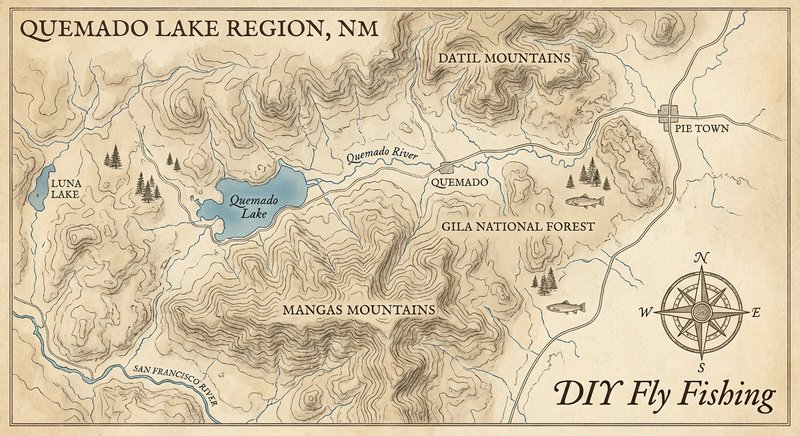
Quemado Lake
Fly fishing in New Mexico · Beginner · Best seasons: Spring, Summer, Fall
Target Species
Rainbow Trout, Tiger Musky
About This Water
Western New Mexico lake with excellent trout fishing. Less crowded than northern lakes.
Fishing Recommendations
Welcome to the high country of Catron County. As your guide, I’m excited to walk you through one of New Mexico’s most unique stillwater fisheries. Quemado Lake is a high-altitude reservoir (7,860 feet) nestled in the Gila National Forest. It isn't your typical trout pond; it is a complex ecosystem that offers a rare "duality" for fly anglers: delicate trout fishing and the heart-pounding pursuit of the "fish of ten thousand casts."
🎣 Location Overview
Quemado Lake is a 131-acre man-made reservoir surrounded by pinon-juniper and ponderosa pine hills. What makes this water special is its management history. Originally a premier trout lake, it became infested with stunted white suckers and invasive goldfish. To solve this, the state introduced Tiger Musky (a sterile hybrid of Northern Pike and Muskellunge).
The result is a fascinating fishery where you can spend the morning sight-casting to rising Rainbows and the afternoon throwing massive streamers for 40-inch apex predators. The water is relatively shallow (maximum depth around 25-30 feet) and features extensive weed beds that provide the primary structure for both species.
🐟 Target Species & Behavior
Rainbow Trout
- Behavior: These are primarily stocked fish, but due to the lake's productivity, they grow quickly and can "hold over" to reach 16–20 inches.
- Feeding: They focus heavily on Chironomids (midges), Damselflies, and Scuds. Because of the goldfish population, larger trout also become highly piscivorous (fish-eaters).
- Holdings: Look for them along the dam face and in the channels between weed beds.
Tiger Musky
- Behavior: The "Tiger" is an ambush predator. They are notoriously moody and "follow" flies frequently without striking.
- Feeding: They were put here to eat suckers and goldfish. They also eat the stocked trout.
- Holdings: They live on the edges of the weed lines. They love to sun themselves in the shallows on cold but sunny mornings, making them targets for sight-casting—if you’re stealthy.
📅 Best Times to Fish
Spring (May – June)
- The Window: This is the prime season. As the ice melts and the water warms into the 50s, both species become hyper-active.
- Trout: Look for massive midge hatches.
- Musky: They move into the shallows to soak up sun. This is your best chance to see them.
Summer (July – August)
- The Window: Early mornings and late evenings are mandatory.
- Conditions: The lake can experience algae blooms in late summer, and water temps can stress trout. Focus your efforts near the dam (deeper/cooler water) or during the "monsoon" rains which oxygenate the surface.
Fall (September – October)
- The Window: Second peak season. As temperatures drop, Muskies feed aggressively to bulk up for winter.
- Conditions: The "turnover" can make fishing tough for a week, but once the water stabilizes, the trout fishing is excellent with streamers.
🪰 Recommended Flies & Techniques
For Rainbow Trout
- Nymphing (The "Static" Hang): Use a long leader (12–15 ft) under an indicator.
- Flies: Size 18-22 Zebra Midges (black/silver, red), Ice Cream Cones, and Scuds (olive or orange).
- The "Damsel" Strip: In June, the damselfly migration is legendary.
- Flies: Size 12-14 Marabou Damsel Nymphs in bright olive. Use a slow, rhythmic twitch near weed edges.
- Dry Fly: Evening midge or midge clusters.
- Flies: Griffith’s Gnat or Parachute Adams (Size 18-22).
For Tiger Musky
- The "Big Meat" Technique: You need an 8 to 10-weight rod and a wire leader.
- Flies: 6–10 inch articulated streamers. Game Changers, Pike Bunnies, or Dahlberg Divers.
- Colors: Gold/Orange (to mimic goldfish) or Rainbow Trout patterns.
- Presentation: Fast, erratic strips. Always, always perform a "Figure-8" at the end of every cast. Muskies often follow the fly to the boat/tube and will strike when the fly changes direction at the surface.
💡 Pro Tips & Local Knowledge
- The Goldfish Factor: Because there are thousands of invasive goldfish in Quemado, orange is a "confidence color." An orange Woolly Bugger or a goldfish-patterned streamer often out-fishes everything else.
- Float Tubes are King: Shore access is decent, but the best weed lines are just out of reach for most shore casters. A float tube or kayak allows you to parallel the weed edges, keeping your fly in the "strike zone" longer.
- The "Stealth" Musky: If you spot a Musky sunning in the shallows, do not cast at it. Cast 10 feet past it and strip the fly across its nose.
- Weather: A "choppy" surface is actually better for Musky fishing. It breaks up their window of vision and makes them less suspicious of your leader.
⚠️ Important Information
- Access: Located about 20 miles south of the town of Quemado via NM-117 and NM-32. There are developed campgrounds (Piñon and Juniper) and a boat ramp.
- Regulations:
- Tiger Musky: Catch and Release ONLY. It is illegal to keep them. They are the "workhorses" that keep the lake healthy.
- Trout: Current bag limit is 5 fish per day (check current NM Department of Game & Fish proclamations as these can change).
- Safety: This is high country. Lightning storms move in fast during the summer afternoons. If you hear thunder, get off the water immediately.
- Boats: Electric motors only. Internal combustion engines are prohibited on the water.
Guide’s Final Note: Quemado is a game of patience. You might go hours without a hit, and then a 40-inch Tiger Musky will try to take the rod out of your hand. Keep your hooks sharp and your eyes on the weed line!
Bug Hatches & Matching Flies
| Hatch | Type | Peak months | Time of day | Hook sizes | Matching flies |
|---|---|---|---|---|---|
| Chironomids Chironomidae | midge | March, April, May, October | All Day | #16-22 | Zebra Midge #18-22, Ice Cream Cone #16-18, Griffith's Gnat #18-22 |
| Callibaetis Callibaetis spp. | mayfly | June, July, August | Late Morning/Early Afternoon | #12-16 | Parachute Adams #14-16, Callibaetis Spinner #14-16, Pheasant Tail Nymph #14-16 |
| Damselflies Enallagma spp. | terrestrial | June, July | Morning/Afternoon | #10-14 | Marabou Damsel #10-14, Adult Damsel #12-14, Gummi Damsel #12 |
| Scuds Gammarus lacustris | midge | April, May, September, October | All Day | #12-16 | Ray Charles #14-16, Scud (Olive/Orange) #12-16 |
| Dragonflies Anisoptera | terrestrial | July, August | Afternoon | #4-10 | Dragonfly Nymph #6-10, Woolly Bugger (Olive) #6-10 |
| Caddisflies Hesperophylax spp. | caddis | July, August, September | Evening | #12-16 | Elk Hair Caddis #12-16, LaFontaine's Emerger #14-16 |
| Grasshoppers Acrididae | terrestrial | August, September | Late Morning/Afternoon | #8-12 | Dave's Hopper #10-12, Joe's Hopper #8-12, Morrish Hopper #10 |
| Water Boatmen Corixidae | midge | September, October | Afternoon | #14-18 | Water Boatman #14-16, Prince Nymph #14-18 |