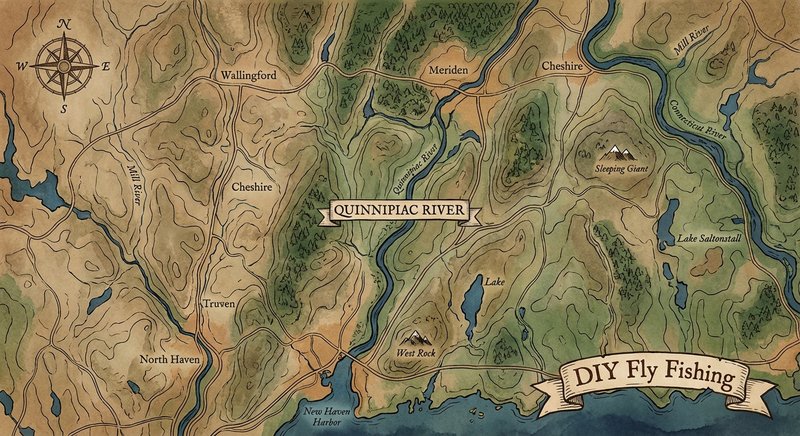
Quinnipiac River
Fly fishing in Connecticut · Beginner · Best seasons: Spring, Fall
Target Species
Brown Trout, Rainbow Trout
About This Water
New Haven County stream with stocked trout. Urban fishing opportunity.
Fishing Recommendations
The Quinnipiac River is one of Connecticut’s most storied and misunderstood waterways. While it flows through the industrial heart of the state, the upper sections—particularly the Quinnipiac River Gorge—offer a surprisingly scenic and productive trout fishery. For the fly angler, the "Q" is a place of finesse, technical nymphing, and rewarding dry-fly action in a suburban oasis.
🎣 Location Overview
The Quinnipiac is a lowland river, characterized by a mix of slow, meandering pools, sandy bottoms, and concentrated "gorge" sections where the gradient increases. The primary focus for trout anglers is the Trout Management Area (TMA) located in Meriden and Cheshire.
What makes this water special is its resilience. Once heavily impacted by industry, conservation efforts have turned the upper Quinnipiac into a viable trout habitat. It’s a "technical" river; the water is often clear and slow-moving, requiring stealth and long leaders. Anglers love it because it feels secluded despite being minutes from major highways, and it holds fish well into the season due to the canopy cover in the Gorge.
🐟 Target Species & Behavior
- Brown Trout: The stars of the river. You will find both recently stocked fish and wary "holdovers" that have survived a season or two. Browns here love structure—look for them tucked under overhanging banks, behind submerged shopping carts (a reality of urban fishing), or in the deep shadows of the Gorge walls.
- Rainbow Trout: Generally more aggressive and found in the faster "pocket water" and riffles at the heads of pools. They tend to move more than the browns and will often key in on bright attractors or active hatches.
Feeding Behavior: Because the river has a high biomass of aquatic insects and crustaceans, the fish are well-fed. They can be selective. In the slower sections, they have plenty of time to inspect your fly, making a natural drift and light tippet (6X) essential.
📅 Best Times to Fish
- Spring (April – June): This is the prime window. The DEEP (Department of Energy and Environmental Protection) stocks heavily in early spring. As the water warms into the 50s, the insects become active.
- Fall (Late September – November): As water temperatures drop, the trout become active again. The state often does a "second season" stocking in the TMA, and the resident browns become more aggressive as they prepare for their spawning cycle.
- Time of Day: In the spring, mid-day is excellent as the sun warms the water. In the late spring and early summer, focus on the "Evening Rise" (the last 90 minutes of daylight).
- Conditions: The Quinnipiac can get murky after heavy rain due to urban runoff. The best fishing is when the water is "receding and clearing"—roughly 24 to 48 hours after a rainstorm.
🪰 Recommended Flies & Techniques
Nymphing (The High-Percentage Play)
Since the Quinnipiac isn't a massive river, "Tight Line" or Euro-nymphing is incredibly effective in the Gorge.
- Pheasant Tail (Sizes 16–20): Imitates the ubiquitous Mayfly nymphs.
- Zebra Midge (Sizes 18–22): Essential for winter and early spring.
- Pat’s Rubber Legs: Good for high-water situations to move fish.
Dry Flies (The Morning/Evening Thrill)
- Blue Winged Olives (BWO): Sizes 18–22. Essential on cloudy, drizzly days in both Spring and Fall.
- Tan/Grey Caddis: Sizes 14–16. Fish these with a "skittering" motion in the riffles.
- Sulphurs: Sizes 16–18. Look for these in late May and June.
Streamers (For the Big Browns)
- Woolly Buggers (Black or Olive): Size 8–10. Swing these through the deep pools or strip them along the undercut banks.
💡 Pro Tips & Local Knowledge
- The Gorge Trail: Access the river via the Quinnipiac River Gorge Trail off Oregon Rd in Meriden. Walking the paved trail allows you to scout the water from above before dropping down into the river.
- Stealth is Mandatory: Because the water can be shallow and slow, heavy wading will spook every fish in the pool. Stay low, wear drab colors, and try to cast from the bank whenever possible.
- The "Scud" Secret: The Quinnipiac has a high population of scuds (freshwater shrimp). Using a size 16-18 orange or olive scud pattern as a dropper nymph can be a "cheat code" when the fish are being picky.
- Bridge Pools: Fish near the historic "Red Bridge." The deeper water under and just downstream of bridges provides thermal cover and protection for the largest fish in the river.
⚠️ Important Information
- Access: The best access is at Quinnipiac River Park and the Red Bridge area in Meriden. There is also access off Route 68 in Cheshire/Wallingford.
- Regulations: The section from the Hanover Pond Dam downstream to the Route 15 (Merritt Parkway) bridge is a Trout Management Area (TMA).
- Catch and Release ONLY from September 1st through early April (check current DEEP yearbooks for specific dates).
- Barbless hooks are highly recommended to protect the fish.
- Permits: A valid Connecticut Fishing License and a Trout & Salmon Stamp are required for all anglers age 16 and older.
- Wading Safety: The bottom can be slippery and, in some areas, quite silty. A wading staff is recommended, especially in the rocky sections of the Gorge.
Bug Hatches & Matching Flies
| Hatch | Type | Peak months | Time of day | Hook sizes | Matching flies |
|---|---|---|---|---|---|
| Blue-Winged Olive (BWO) Baetis spp. | mayfly | April, May, September, October | Afternoon | #18-22 | RS2 #18-22, Parachute BWO #18-20, Pheasant Tail #18-22 |
| Tan Caddis Hydropsyche | caddis | May, June, July | Evening | #14-18 | Elk Hair Caddis #14-16, LaFontaine's Deep Sparkle Pupa #14-18, Holy Grail #16-18 |
| Sulfur Ephemerella invaria | mayfly | May, June | Late Afternoon/Evening | #14-18 | Sulfur Parachute #16-18, Sulfur Cripple #14-16, Frenchie #14-16 |
| Light Cahill Stenacron interpunctatum | mayfly | June, July | Evening/Dusk | #12-14 | Light Cahill Dry #12-14, Gold Ribbed Hare's Ear #12-14 |
| Midges Chironomidae | midge | March, April, October, November | Morning/Afternoon | #20-26 | Zebra Midge #20-24, Griffith's Gnat #20-22, Mercury Midge #20-22 |
| Trico Tricorythodes | mayfly | July, August, September | Early Morning | #22-26 | Trico Spinner #22-26, Trico Parachute #22-24 |
| Terrestrials (Ants and Beetles) Formicidae / Coleoptera | terrestrial | July, August, September | Mid-day/Afternoon | #12-18 | Black Foam Ant #16-18, Hi-Viz Beetle #14-16, Cinnamon Ant #16-18 |
| Blue Quill Paraleptophlebia | mayfly | April, May | Mid-day | #16-18 | Blue Quill Dry #16-18, Dark Hendrickson #16 |