Race Point
Fly fishing in Connecticut · Advanced · Best seasons: Spring, Summer, Fall
Target Species
Striped Bass, Bluefish, False Albacore
About This Water
Fishers Island Sound with trophy striped bass. Strong currents and big fish.
Fishing Recommendations
It is important to clarify a geographic distinction for the traveling angler: While the most famous "Race Point" is located at the tip of Cape Cod, Massachusetts, the area known to Connecticut fly anglers as The Race (and the adjacent Race Point on Fishers Island) is one of the most productive and technically challenging saltwater fly fishing destinations in the Northeast.
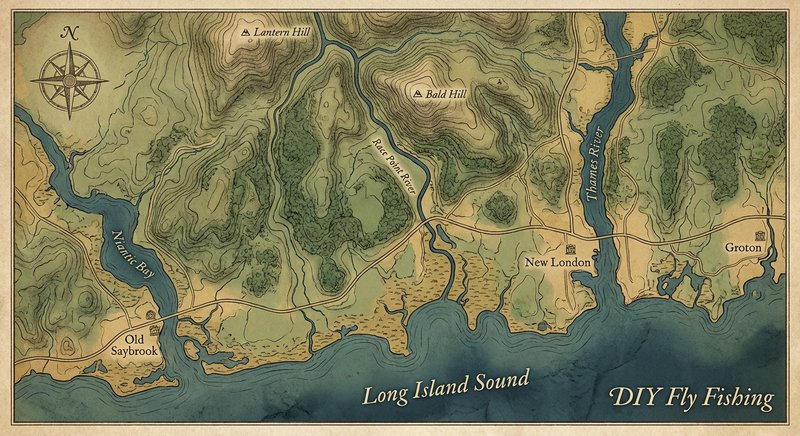
Though Fishers Island is technically New York State, it is primarily accessed by anglers launching from Stonington, Noank, and New London, Connecticut. This area is the gateway to "The Race"—a massive funnel where Long Island Sound meets the Atlantic Ocean.
🎣 Location Overview
The "Race Point" area and the adjacent "Race" represent a legendary marine crossroads. What makes this area special is the extreme bathymetry. The water depths fluctuate wildly from 250 feet to 30 feet in a very short distance. As the massive tides of Long Island Sound squeeze through this gap, they create a "conveyor belt" of nutrients.
Anglers love this area for its structure. You are fishing over massive boulder fields, sharp ledges, and powerful rips. The water is exceptionally clean and oxygenated, attracting massive schools of baitfish and the predators that follow them. It is high-octane, big-water fly fishing that requires respect for the power of the ocean.
🐟 Target Species & Behavior
Striped Bass (Rockfish)
- Behavior: Bass here are structure-oriented. They hold on the "up-current" side of submerged ledges or in the soft water behind massive boulders.
- Feeding: They focus on Sand Eels, Atlantic Menhaden (Bunker), and Scup. In the spring, they focus on smaller "rain bait."
Bluefish
- Behavior: Known as "yellow-eyed demons," these fish are often found in the "white water" of the rips. They are aggressive surface feeders but will dive deep when the sun is high.
- Feeding: They will eat anything that moves, often chopping through schools of Butterfish or Bunker.
False Albacore (Albies)
- Behavior: The "Ferrari of the Sound." They appear in late summer/fall. They are erratic, fast, and highly visual. They don't "hold" in one spot but roam the current seams looking for bait.
- Feeding: Highly selective. They usually key in on tiny Bay Anchovies (anchovy "rain").
📅 Best Times to Fish
- Spring (May - June): The migration begins. This is the best time for "schoolie" bass and the arrival of larger "cows" following the bunker schools.
- Summer (July - August): Best for early morning or night fishing. Large Bass move into the deeper, cooler water of the Race. Bluefish are ubiquitous during the day.
- Fall (September - October): The Prime Window. This is the "Fall Blitz." Water temperatures drop, bait migrates out, and False Albacore arrive. This is the peak of fly fishing activity.
- Tides: The moving tide is mandatory. The two hours before and after a tide change (high or low) are usually the most productive. The "slack" tide often sees the bite shut off completely.
🪰 Recommended Flies & Techniques
Top Fly Patterns
- Bob’s Banger (Popper): For aggressive surface-feeding Bluefish and Bass in the early morning.
- Lefty’s Deceiver (White/Chartreuse): The gold standard for imitating larger baitfish like bunker or herring.
- Clouser Deep Minnow: Essential for getting the fly down in the heavy currents of the Race.
- Epoxy/Silicone Minnows: Crucial for False Albacore; they perfectly mimic the translucent look of a Bay Anchovy.
- Hollow Fleyes: For large profile flies that are easy to cast when targeting trophy Striped Bass.
Techniques
- Intermediate & Sinking Lines: Because of the heavy current, a floating line is rarely used except for surface blitzes. A 300-to-400 grain sinking tip is often necessary to get the fly into the strike zone near the boulders.
- The "Swing": Cast across the current and let the fly swing through the rip, similar to Atlantic Salmon fishing. Strip the fly as it reaches the "seam" between fast and slow water.
- Two-Handed Strip: When fishing for Albies, tuck the rod under your arm and use both hands to strip the fly as fast as humanly possible. You cannot outrun a hungry Albie.
💡 Pro Tips & Local Knowledge
- Watch the Birds: "Working birds" (Terns and Gulls) are your best fish finders. Terns usually indicate smaller bait (Albies/Schoolie Bass), while Gulls often hover over larger kills (Bluefish/Large Bass).
- The "Seam" is Key: Don't just cast blindly into the fast water. Look for where the water changes texture—this is the "seam" where predators sit to conserve energy while waiting for bait to be swept past.
- Stealth Matters: Despite the churning water, boat hull slap and engine noise can spook fish, especially Albies. If you see a blitz, cut the engine and drift into the fish rather than driving over them.
- Heavy Gear: Use 9wt or 10wt rods. You aren't just fighting the fish; you are fighting the tide. A 9wt is the "all-around" tool for this area.
⚠️ Important Information
- Access: This is primarily a boat or kayak fishery. While there is limited shore access on Fishers Island (accessible via ferry from New London), most fly anglers launch from the Barn Island State Boat Launch in Stonington, CT.
- Regulations: If you are fishing the Race or the south side of Fishers Island, you may cross into New York waters. Ensure you have both a Connecticut Saltwater Registry and a New York Saltwater Registry (both are generally free/low cost but mandatory).
- Safety: The Race is dangerous for inexperienced boaters. The "standing waves" can reach 4–6 feet on a wind-against-tide day even when the rest of the Sound is flat. Always check the marine forecast for "The Race" specifically.
- Conservation: Striped Bass regulations are strict (slot limits). Handle fish with wet hands and keep them in the water as much as possible, especially during the warm summer months.
Bug Hatches & Matching Flies
| Hatch | Type | Peak months | Time of day | Hook sizes | Matching flies |
|---|---|---|---|---|---|
| Blue Winged Olive Baetis / Pseudocloeon | mayfly | April, May, September, October | Late Morning/Afternoon | #18-24 | BWO Sparkle Dun #20-22, Pheasant Tail Nymph #18-22, RS2 #20-24 |
| Hendrickson Ephemerella subvaria | mayfly | April, May | Afternoon | #12-14 | Hendrickson Dark #12-14, Red Quill #14, Hendrickson Wet Fly #12-14 |
| Sulfur / Pale Evening Dun Ephemerella invaria / dorothea | mayfly | June, July | Late Afternoon/Evening | #14-18 | Sulfur Parachute #16-18, Sulfur Cripple #14-18, Sulfur Spinner #16-18 |
| Isonychia Isonychia bicolor | mayfly | June, September | Evening | #10-12 | Iso Parachute #10-12, Prince Nymph #10-12, Isonychia Wet #10-12 |
| Little Black Caddis Chimarra | caddis | April, May | Morning/Afternoon | #16-20 | Zebra Midge (Black) #18-20, CDC Little Black Caddis #16-18, Black Elk Hair Caddis #18 |
| Trico Tricorythodes | mayfly | July, August, September | Morning | #22-26 | Trico Spinner (Female) #22-26, Trico Drowned Spinner #24-26, Griffith's Gnat #22-24 |
| Winter Caddis Taeniopteryx | caddis | January, February | Mid-day | #18-24 | Winter Caddis Adult #20-24, Pupa (Cream/Tan) #20-22 |
| Ants and Beetles Formicidae / Coleoptera | terrestrial | July, August | All Day | #12-20 | Cinnamon Ant #16-18, Black Foam Beetle #14-16, Flying Ant #18-20 |