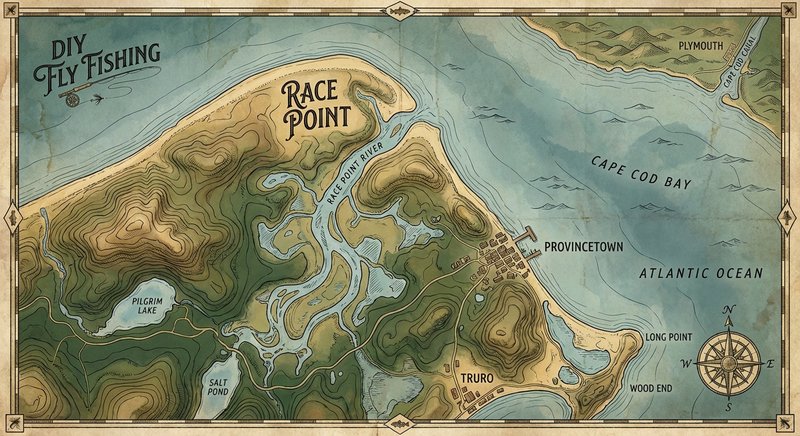
Race Point
Fly fishing in Massachusetts · Intermediate · Best seasons: Summer, Fall
Target Species
Striped Bass, Bluefish, False Albacore
About This Water
Provincetown area with striped bass and bluefish. Cape Cod National Seashore.
Fishing Recommendations
Welcome to the "Edge of the World." As a fly fishing guide, there are few places I find more exhilarating than Race Point in Provincetown, Massachusetts. Located at the very tip of Cape Cod, this is where the Atlantic Ocean meets Cape Cod Bay in a violent, nutrient-rich collision.
Here is your comprehensive guide to fly fishing one of the most iconic saltwater destinations in the Northeast.
🎣 Location Overview
Race Point is a dynamic, high-energy environment defined by its massive sand dunes and incredibly steep drop-offs. Unlike the shallow flats of Brewster or Chatham, Race Point features a "beach-break" morphology where the water goes from ankle-deep to 30 feet deep just yards from shore.
What makes it special: The "Race" refers to the powerful rip currents created by the meeting of the tides. This current acts as a conveyor belt for baitfish, turning the point into a massive feeding station. It is one of the few places in New England where you can catch a "cow" Striped Bass or a hard-tail False Albacore within a double-haul of the dry sand.
🐟 Target Species & Behavior
Striped Bass (Stripers)
The primary draw. At Race Point, bass are often "cruising the lip." They hold in the deep trough just feet from the sand, waiting for the current to wash sand eels or juvenile herring over the drop-off. They are highly migratory here; you’ll see "schoolies" (18-24") as well as "cows" (40"+).
Bluefish
Known as "Yellow-eyed Devils," they frequent these waters in massive schools during the summer. They are aggressive, surface-oriented, and will destroy any fly they can get their teeth on.
False Albacore (Little Tunny)
The "Ferraris" of the surf. They typically arrive in late August and September. They move at incredible speeds, slashing through schools of "rain bait" (anchovies). They are notoriously finicky and require precise presentations and high-speed retrieves.
📅 Best Times to Fish
Optimal Seasons
- Summer (June – August): Best for consistent Striped Bass and Bluefish. The night bite is legendary during the heat of July.
- Fall (September – October): The "Fall Run." This is peak season for False Albacore and migrating Striped Bass. The energy on the beach during a September "blitz" is unmatched.
Best Times of Day
- Low Light: Dawn and dusk are prime. Stripers lose their inhibitions and move into very shallow water.
- Night: For the biggest bass, fishing large dark streamers at night is the "pro move."
Prime Windows & Conditions
- The Tides: The outgoing tide is generally preferred at the Point, as it flushes bait out of the harbor and the bay into the Atlantic.
- Wind: A light North or Northeast wind can push bait toward the shore, but a heavy blow makes fly casting nearly impossible due to the "mung" (suspended seaweed).
🪰 Recommended Flies & Techniques
Top Fly Patterns
- Sand Eel Clouser Minnow: (Chartreuse/White or Olive/White). The sand eel is the primary forage at Race Point.
- Mushmouth / Epoxy Minnow: Vital for False Albacore; matches the small "rain bait."
- Hollow Fleye / Deceiver: Large profiles (7-10 inches) for big fall Stripers.
- Gurglers / Bob's Banger: For heart-stopping topwater action when Bluefish or Bass are crashing the surface.
Effective Techniques
- The "Deep Trough" Swing: Use a Fast Sinking Line (350–450 grain). Cast at a 45-degree angle up-current, let it sink into the trough, and strip as it swings in front of you.
- The Two-Handed Strip: For False Albacore, tuck the rod under your arm and use both hands to retrieve the fly as fast as humanly possible. You cannot outrun a hungry Albie.
Presentation Tips
- Watch the Lip: Do not walk right up to the water's edge immediately. Bass often cruise in the first 3 feet of water. Cast parallel to the beach before wading in.
💡 Pro Tips & Local Knowledge
- The "Mung" Factor: Check the water before rigging up. If the water is full of red seaweed (mung), the fly fishing will be frustrating. If it's thick, move further south toward Herring Cove or around the bend toward High Head.
- Read the Birds: If you see terns hovering and dipping, they are over Sand Eels. If you see gulls screaming and diving, there are likely Bluefish pushing larger bait to the surface.
- Line Management: A stripping basket is mandatory. The heavy surf and wind will tangle your line around your legs or bury it in the sand instantly without one.
- Gear: Use a 9-weight rod for general duty, but bump up to a 10-weight if the wind is howling or if big Bluefish are present. Ensure your reel has a sealed drag; the salt and sand here are brutal on equipment.
⚠️ Important Information
Access
- Race Point Beach: Located at the end of Route 6 in Provincetown. There is a large parking lot (Cape Cod National Seashore).
- OSV Permits: Many locals use Over-Sands Vechicle (OSV) permits to drive 4x4 trucks onto the beach. If you are on foot, be prepared for a long, soft-sand hike. It’s a workout!
Regulations & Permits
- Saltwater Permit: You must have a Massachusetts Recreational Saltwater Fishing Permit.
- Striper Limits: Regulations change annually. As of 2024, there is a strict slot limit (typically 1 fish between 28" and less than 31"). Check the Mass DMF website before keeping any fish.
Special Considerations
- Great White Sharks: This is a high-activity area for Great Whites. Avoid wading past your knees, and never wade out if seals are nearby. If you hook a fish, land it quickly and do not linger in the water.
- Hydration: There is zero shade on the outer beach. Pack more water than you think you need.
Tight lines, and enjoy the salt! There is no place on earth quite like the "Tip of the Cape."
Bug Hatches & Matching Flies
| Hatch | Type | Peak months | Time of day | Hook sizes | Matching flies |
|---|---|---|---|---|---|
| Cinder Worm Alitta succinea | midge | May, June | Evening | #10-14 | Red Cinder Worm #12, Gamechanger Worm #10 |
| Black Carpenter Ant Camponotus pennsylvanicus | terrestrial | June, July | Afternoon | #12-16 | Black Foam Ant #14-16, Flying Ant #12-14 |
| Japanese Beetle Popillia japonica | terrestrial | July, August | Afternoon | #10-14 | Foam Beetle #12, Coffee's Sparkle Beetle #10-14 |
| Coastal Midge Chironomidae | midge | May, September | Morning/Evening | #18-22 | Zebra Midge #18-20, Griffith's Gnat #20-22 |
| Salt Marsh Mosquito Aedes sollicitans | terrestrial | July, August | Evening/Night | #18-24 | CDC Mosquito #20-22 |
| Greenhead Fly Tabanus nigrovittatus | terrestrial | July | Afternoon | #10-14 | Deer Hair Fly #12, Floating Terrestrial #10-12 |
| Sand Hopper Talitridae | terrestrial | June, July, August | Night/Evening | #12-16 | Ray's Fly #14, Scud Pattern #12-16 |
| Maritime Grasshopper Trimerotropis maritima | terrestrial | August, September | Afternoon | #8-12 | Joe's Hopper #10-12, Dave's Hopper #8-10 |