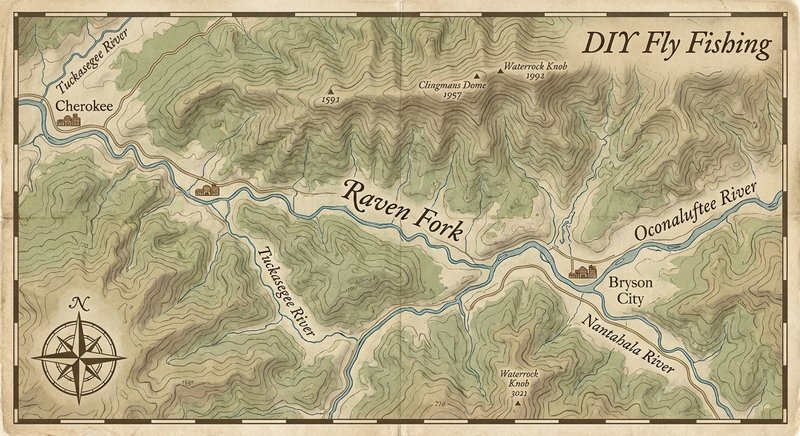
Raven Fork
Fly fishing in North Carolina · Intermediate · Best seasons: Spring, Summer, Fall
Target Species
Rainbow Trout, Brown Trout, Brook Trout
About This Water
Trophy water managed by Eastern Band of Cherokee. Large rainbows and browns.
Fishing Recommendations
As an expert guide in the Blue Ridge Mountains, I consider the Raven Fork to be one of the crown jewels of Southern Appalachian fly fishing. Located on the Qualla Boundary (Cherokee Indian Reservation), this river offers a unique "big water" feel that is rare in the high-country East.
Here is your comprehensive guide to fishing the Raven Fork.
🎣 Location Overview
The Raven Fork is a legendary freestone river flowing through the heart of Cherokee, NC. While it originates deep within the Great Smoky Mountains National Park, the most famous section is the 2.2-mile "Trophy Trout" Catch and Release fly fishing only section.
What makes this water special is the size of the fish. Unlike the small "wild and scenic" streams nearby where a 10-inch fish is a trophy, the Raven Fork is stocked with massive Rainbows, Browns, and Brookies—many exceeding 20 inches and some pushing the 10-pound mark. The river is characterized by large boulders, deep plunge pools, and wide, glassy runs. It is high-gradient water that requires careful wading but rewards anglers with some of the largest trout in the Southeast.
🐟 Target Species & Behavior
- Rainbow Trout: These are the most active fish in the system. They tend to hold in the faster oxygenated water at the heads of pools and in the "seams" where fast and slow water meet. They are aggressive and prone to spectacular aerial displays.
- Brown Trout: The "kings" of the deep pools. Large Raven Fork Browns are notorious for hiding under the massive boulders during the bright parts of the day. They are predatory and more likely to strike during low light or when there is a bit of "color" (turbidity) in the water.
- Brook Trout: While the lower sections feature large stocked "Donkey" Brookies, the upper reaches toward the National Park boundary hold smaller, vibrant wild Brook Trout. They are opportunistic feeders but can be spooky in the crystal-clear water.
Behavior Note: These fish see a lot of flies. They are "educated" trout. They will often inspect a fly closely; if your drift isn't natural or your tippet is too thick, they will refuse.
📅 Best Times to Fish
Optimal Seasons
- Spring (March – May): The absolute prime time. Water temperatures rise, and the major hatches (Quill Gordons, March Browns, Hendricksons) begin. This is when the fish are most active and willing to rise to a dry fly.
- Fall (October – November): A favorite for many guides. The Brown Trout become aggressive as they prepare for the spawn. The surrounding foliage is stunning, and the "delayed harvest" stocking schedule often means high fish densities.
- Summer (June – August): Best in the early mornings. As the sun hits the water, the temperature rises, and fish head for the deep, cool oxygenated pockets. Focus on terrestrial patterns (beetles, ants) during this time.
Best Times of Day
- Low Light Windows: The 90 minutes after sunrise and the 90 minutes before sunset are the "golden hours." This is when the largest fish move out of the deep holes into shallower water to feed.
🪰 Recommended Flies & Techniques
Top Fly Patterns
- Nymphs: Sexy Walt’s Worm (size 12-16), Pheasant Tail (size 14-18), Girdle Bugs (Pat’s Rubber Legs) in coffee/black (size 8-12), and Mop Flies (cream or chartreuse) for high-water days.
- Dry Flies: Parachute Adams (size 14-20), Elk Hair Caddis (size 14-16), and Stimulators (size 10-14) for the pocket water.
- Streamers: White or Olive Woolly Buggers, Sex Dungeon (small), and Sparkle Minnows.
Effective Techniques
- Tight-Line (Euro) Nymphing: This is the most effective way to fish the Raven Fork. Because of the complex currents around the boulders, a traditional indicator often creates drag. A long rod (10ft 3wt or 4wt) allows you to keep the line off the water and feel the subtle takes of large fish.
- Streamer Stripping: On overcast days, swinging or stripping streamers through deep holes can entice a trophy Brown Trout.
- Dry-Dropper: In the summer, use a high-vis dry fly (like a Hopper or Stimulator) with a small bead-head nymph 18-24 inches below it.
💡 Pro Tips & Local Knowledge
- Go Small and Thin: When the water is low and clear, drop down to 6X or even 7X fluorocarbon tippet. These big fish are leader-shy.
- The "Boulder" Strategy: Don't just fish the pools. Many of the biggest fish sit in the "cushion" right in front of large submerged boulders.
- Watch the Water Level: The Raven Fork is a freestone stream. After a heavy rain, it can become dangerous to wade. Check the USGS gauges; if it's "blown out," head to the smaller tributaries.
- Stealth Matters: Because the water is often gin-clear, avoid wearing bright colors. Approach pools from downstream and stay low to avoid casting a shadow over the fish.
⚠️ Important Information
Access & Regulations
- Tribal Permit Required: You cannot fish the Raven Fork with a standard NC State Fishing License alone. You must purchase a Cherokee Tribal Fishing Permit.
- Trophy Trout Permit: If you are fishing the Catch and Release section, you must also purchase the specific "Catch & Release" permit in addition to the daily tribal permit.
- Regulations: In the Trophy Trout section, it is Fly Fishing Only, Catch and Release Only. You must use single-hook artificial lures. No bait, no treble hooks.
Special Considerations
- Wading Safety: The rocks in the Raven Fork are notoriously slick. Felt-soled boots with studs are highly recommended. A wading staff is not a sign of weakness here; it's a necessity.
- Respect the Land: You are on Sovereign Tribal Land. Follow all posted signs, pack out your trash, and be respectful of the local community and customs.
Permits can be purchased online at FishCherokee.com or at local fly shops in the town of Cherokee.
Bug Hatches & Matching Flies
| Hatch | Type | Peak months | Time of day | Hook sizes | Matching flies |
|---|---|---|---|---|---|
| Quill Gordon Epeorus pluralis | mayfly | March, April | Mid-day | #12-14 | Quill Gordon Dry #12-14, Hare's Ear #12-14 |
| Blue Winged Olive Baetis | mayfly | March, April, October, November | Afternoon | #18-22 | Parachute Adams #18-22, Pheasant Tail #18-20 |
| March Brown Maccaffertium vicarium | mayfly | April, May | Afternoon | #10-14 | March Brown Dry #10-12, Gold Ribbed Hare's Ear #10-14 |
| Yellow Sally Isoperla | stonefly | May, June, July | Late Afternoon/Evening | #14-16 | Yellow Stimulator #14-16, Iron Lotus (Yellow) #14-16 |
| Golden Stonefly Acroneuria | stonefly | May, June | Evening/Night | #8-12 | Girdle Bug (Pat's Rubber Leg) #8-12, Golden Stone Dry #8-10 |
| Grannom Caddis Brachycentrus | caddis | April | All Day | #14-16 | Elk Hair Caddis (Olive) #14-16, Holy Grail #14-16 |
| Light Cahill Stenacron | mayfly | June, July | Evening | #14-16 | Light Cahill Dry #14-16, Cream Midge #16-18 |
| Terrestrials Formicidae / Cicadellidae | terrestrial | July, August, September | All Day | #12-18 | Black Foam Ant #16-18, Joan Wulff’s Hoppers #12-14 |
| Midges Chironomidae | midge | January, February, December | Anytime | #20-24 | Zebra Midge #20-24, Griffith's Gnat #20-22 |