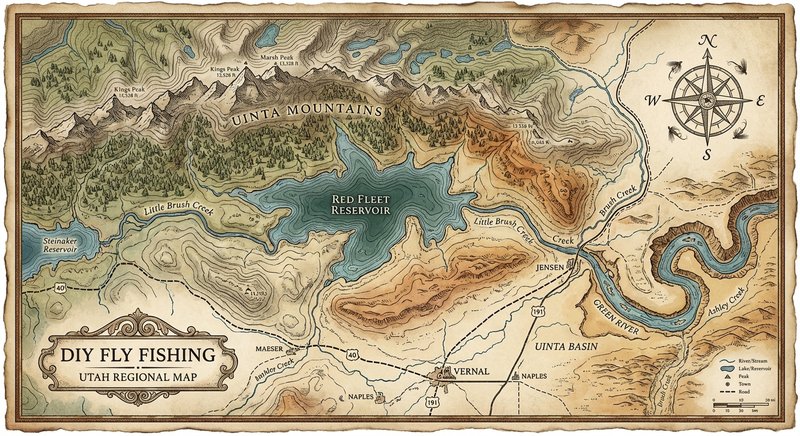
Red Fleet Reservoir
Fly fishing in Utah · Beginner · Best seasons: Spring, Summer, Fall
Target Species
Rainbow Trout, Brown Trout, Bluegill
About This Water
Near Vernal with dinosaur tracks nearby. Rainbow and brown trout in red rock setting.
Fishing Recommendations
Welcome to the "Little Lake Powell" of the North. As your guide, I can tell you that Red Fleet Reservoir is one of the most visually stunning stillwater fisheries in Utah. Located just north of Vernal, it is defined by its brilliant red Navajo sandstone cliffs and emerald-green water.
While it is a popular spot for boaters and dinosaur enthusiasts, fly anglers who understand its unique structure can have incredibly productive days targeting trout and panfish.
🎣 Location Overview
Red Fleet Reservoir is a high-desert gem. What makes it special for the fly angler is the underwater topography. Because it is a flooded canyon, you have a mix of shallow, sandy coves and sheer vertical rock walls that drop off into 50+ feet of water.
The water is generally clear, which allows for sight-fishing in the shallows during the right light conditions. It’s a "technical" stillwater—meaning you need to pay attention to your depth and the wind—but the reward is hard-fighting fish in a landscape that looks like a painting.
🐟 Target Species & Behavior
Rainbow Trout
The backbone of the reservoir. These are frequently stocked but quickly become "wild" in their behavior.
- Behavior: They cruise the shorelines in the spring and fall. In the heat of summer, they retreat to the thermocline (deeper, cooler water).
- Feeding: They focus on midges, damselflies, and scuds.
Brown Trout
The "ghosts" of Red Fleet. There are some truly large Browns here for the patient angler.
- Behavior: They love the shadows. Look for them along the sheer cliff faces and submerged rocky outcrops. They are predatory and much more likely to hit a larger meal.
- Feeding: Small trout, crayfish, and large leeches.
Bluegill
Red Fleet has a thriving population of Bluegill that provide non-stop action during the summer months.
- Behavior: They congregate in the brushy, shallower northern coves.
- Feeding: Opportunistic. They will rise for small terrestrials or hit tiny nymphs suspended under a dry fly.
📅 Best Times to Fish
- Spring (Late March – May): Prime Time. As the ice recedes, trout move into the shallows to feed aggressively. This is the best time for shore anglers to find Rainbows within casting distance.
- Summer (June – August): Best for Bluegill and early morning trout. By 10:00 AM, the sun hits the water, and trout move deep. This is when you switch to "top-water" Bluegill fishing in the coves.
- Fall (September – November): The second peak. As water temperatures drop, Brown trout become more aggressive and move toward the shorelines and inlets.
- Optimal Window: The first two hours of light and the "Golden Hour" before sunset. The wind often dies down in the evening, creating a glass-like surface perfect for spotting rises.
🪰 Recommended Flies & Techniques
The "Red Fleet" Fly Box
- Chironomids (Midges): Sizes 14–20 in Zebra Midge (black/silver) or "Ice Cream Cone" patterns.
- Balanced Leeches: Sizes 8–12 in Olive, Black, or Maroon.
- Woolly Buggers: Size 6–10. Pro Tip: Use a "Thin Mint" or a white/silver pattern to mimic small forage fish.
- Soft Hackles: Size 14–16. Great for when fish are mid-water column.
- Terrestrials: Foam Ants or Beetles for Summer Bluegill.
Techniques
- Indicator Nymphing: This is the most effective way to fish the coves. Suspend a Balanced Leech or Chironomid 6–12 feet under a slip indicator. The wave action provides all the movement you need.
- The "Strip and Pause": Using a sink-tip line, cast streamers toward the cliff walls. Let them sink for 10–15 seconds, then use erratic strips to mimic a wounded baitfish. Browns will often hit on the "pause."
- Dry-Dropper: Excellent for Bluegill. Use a high-visibility Stimulator on top and a tiny Bead-head Copper John 18 inches below.
💡 Pro Tips & Local Knowledge
- Target the "Transitions": Don’t just fish the middle of a cove. Look for where the sandy bottom transitions into rocky talus. Fish use these edges as highways.
- The Dinosaur Trackway Area: The area near the famous dinosaur tracks has excellent structure. It’s a bit of a hike, but the fishing pressure is lower, and the drop-offs are steep.
- Watch the Wind: Red Fleet can get "whitecaps" quickly. If the wind picks up from the West, the fish often move to the windward shore to eat insects being blown into the water—but be careful if you are in a float tube or kayak.
- Go Small for Bluegill: If you find the Bluegill are "short-striking" your fly, switch to a size 20 Zebra Midge. Their mouths are small, and a tiny fly increases your hook-up rate significantly.
⚠️ Important Information
- Access: Access is primarily through Red Fleet State Park. There is a daily use fee. The park offers a great boat ramp and developed shore access.
- Watercraft: While you can fish from the shore, a kayak, SUP, or float tube is a massive advantage here. It allows you to hug the cliff walls where shore anglers can't reach.
- Regulations: You need a valid Utah Fishing License. Red Fleet has specific rules regarding the possession of certain species (like Walleye, which were historically managed there). Always check the latest Utah Big Game & Fishing Guidebooks.
- Safety: The desert sun is brutal. There is very little shade on the water. Bring high-SPF sunblock, a wide-brimmed hat, and twice as much water as you think you’ll need.
Guide’s Final Word: Red Fleet isn't a "numbers" lake like some of the high-mountain reservoirs, but the quality of the fish and the sheer beauty of the red rocks make it a bucket-list destination for any Utah fly angler. Tight lines!
Bug Hatches & Matching Flies
| Hatch | Type | Peak months | Time of day | Hook sizes | Matching flies |
|---|---|---|---|---|---|
| Chironomids Chironomidae | midge | April, May, October | All Day | #14-22 | Zebra Midge #18-22, Chanter's Chironomid #14-16, Griffith's Gnat #18-22 |
| Speckled Dun Callibaetis | mayfly | June, July, August | Late Morning | #12-16 | Callibaetis Spinner #14-16, Hare's Ear Nymph #12-16, Parachute Adams #14-16 |
| Damselfly Enallagma | terrestrial | June, July | Morning/Afternoon | #10-14 | Marabou Damsel Nymph #10-12, Adult Damsel #12-14 |
| Scud Gammarus | midge | March, April, November | All Day | #14-18 | Ray Charles #14-16, Flashback Scud #14-18 |
| Water Boatman Corixidae | midge | September, October | Afternoon | #14-16 | Prince Nymph #14-16, Water Boatman #14-16 |
| Traveling Sedge Hesperophylax | caddis | July, August | Evening | #10-14 | Goddard Caddis #10-12, Elk Hair Caddis #12-14 |
| Grasshoppers Acrididae | terrestrial | August, September | Afternoon | #8-12 | Morrish Hopper #8-12, Parachute Hopper #10-12 |
| Dragonfly Anisoptera | terrestrial | June, July, August | Morning/Afternoon | #4-10 | Dragon Mylar Bug #6-10, Woolly Bugger (Olive) #4-8 |