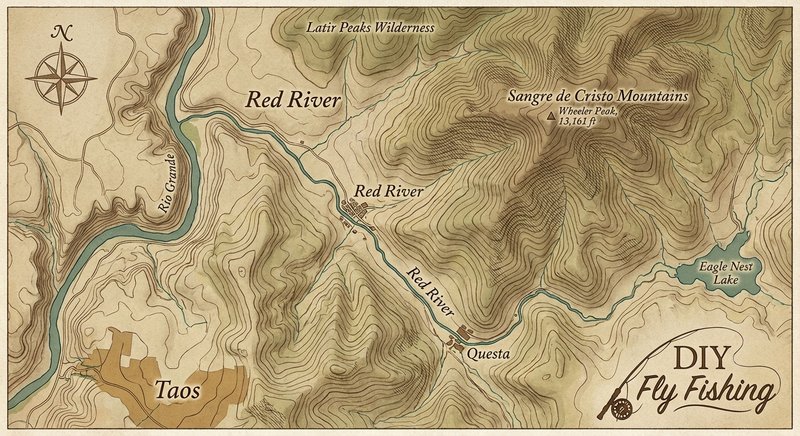
Red River
Fly fishing in New Mexico · Beginner · Best seasons: Spring, Summer, Fall
Target Species
Rainbow Trout, Brown Trout
About This Water
Northern New Mexico stream near the ski town of Red River. Stocked rainbows and wild brown trout.
Fishing Recommendations
The Red River of New Mexico is a hidden gem of the Sangre de Cristo Mountains. While it may share a name with larger, muddier rivers in the South, the New Mexico version is a classic high-alpine freestone stream that transforms into a rugged canyon fishery before joining the Rio Grande.
As your guide, here is the comprehensive breakdown for fishing the Red River.
🎣 Location Overview
The Red River is a tale of three distinct sections, each offering a different experience:
- The Upper Red (Above Town): A high-altitude, meadow-style stream with tight pockets and brushy banks.
- The Town Stretch: Heavily stocked and easily accessible, perfect for families and beginners.
- The Lower Red (The "Wild and Scenic" Canyon): This is the crown jewel. Below the town of Questa, the river plunges into a deep gorge. This section is rugged, remote, and features incredible pocket water and deep pools where the Red meets the Rio Grande.
What makes it special is the Red River Fish Hatchery. The constant outflow of cold, oxygenated water into the lower section creates a "tailwater-like" environment that keeps fish active even when other rivers are overheating in mid-summer.
🐟 Target Species & Behavior
- Rainbow Trout: These are the primary residents. In the town stretch, they are frequent rises to dry flies. In the lower canyon, you’ll find wild, hard-fighting rainbows that hold in the fast "white water" bubbles to intercept nymphs.
- Brown Trout: The lower canyon is home to specimen-sized Browns, especially as you get closer to the Rio Grande confluence (La Junta). They are opportunistic but cautious, often holding under undercut banks or behind large mid-stream boulders.
- Feeding Behavior: These fish are "opportunistic feeders." Because the growing season is short, they rarely turn down a well-presented meal. They focus heavily on stoneflies in the canyon and caddisflies throughout the entire system.
📅 Best Times to Fish
Spring (March – May)
- Conditions: Early spring sees Blue-Winged Olive (BWO) hatches.
- Note: Runoff usually hits in mid-May. The river can get high and murky, but the section directly below the hatchery often stays fishable.
Summer (June – August) — PRIME TIME
- Conditions: Post-runoff (mid-June) is the golden window.
- Best Time of Day: Early morning and late evening for dry fly action. During the heat of the day, fish the shaded canyon walls.
Fall (September – November)
- Conditions: The "brown trout run." Large browns move up from the Rio Grande into the Lower Red to spawn.
- Visuals: The aspens are changing, and the crowds disappear. This is the best time for trophy hunters.
🪰 Recommended Flies & Techniques
Top Fly Patterns
- Dry Flies:
- Parachute Adams (Size 14-18) – The universal soldier.
- Elk Hair Caddis (Size 14-16) – Tan or Olive.
- Stimulators (Size 10-14) – Orange or Yellow; great for high-vis in pocket water.
- Nymphs:
- Pat’s Rubber Legs (Size 8-12) – Essential for the lower canyon.
- Copper John (Size 14-18) – Red or Copper.
- Pheasant Tail (Size 16-20) – Tactical and effective.
- Streamers:
- Woolly Bugger (Size 8-10) – Black or Olive for the deep canyon pools.
Techniques
- Dry-Dropper: This is the most effective way to fish the Red. Use a buoyant Stimulator or Chubby Chernobyl as your "indicator" and hang a weighted nymph 18–24 inches below it.
- High-Sticking/Euro Nymphing: In the lower canyon, the current is complex. Keeping your fly line off the water and "leading" your nymphs through the pockets is the key to success.
- The "Splat" Delivery: During grasshopper season (late summer), don't be afraid to let your terrestrial fly hit the water with a "thud" to get the fish's attention.
💡 Pro Tips & Local Knowledge
- The Hatchery Secret: If the rest of the river is blown out from rain or runoff, head to the stretch immediately downstream of the Red River Fish Hatchery. The water is filtered and temperature-regulated, making it the most consistent spot in the state.
- Stealth in the Canyons: The water in the lower Red is exceptionally clear. Wear earth-toned clothing (greens/browns) and avoid "lining" the fish (casting your fly line directly over their heads).
- The La Junta Hike: To reach the best water where the Red meets the Rio Grande, be prepared for a steep hike. The trail drops about 800 feet in one mile. It’s a workout, but the fishing pressure drops significantly.
- Short Leaders: In the brushy upper sections, use a shorter leader (7.5 feet) to maintain control and avoid getting tangled in the willows.
⚠️ Important Information
- Access:
- Upper Red: Accessible via NM-38.
- Lower Red: Access via the Wild & Scenic River Area (Bureau of Land Management). Parking fees apply at trailheads like Big Arsenic or La Junta.
- Regulations:
- Check the latest New Mexico Department of Game and Fish (NMDGF) proclamation. Some areas are "Special Trout Waters" with barbless hook and lure restrictions.
- Safety: The lower canyon is rugged. Cell service is non-existent. Always carry a whistle, extra water, and bear spray, as black bears are common in the canyon.
- Permits: A valid New Mexico Fishing License and a Habitat Management & Access Validation are required for all anglers 12 and older.
Guide’s Final Word: The Red River isn't about giant tailwater fish; it's about the soul of New Mexico fly fishing. It's beautiful, rugged, and rewards the angler who is willing to hike a little further than the next guy. Tight lines!
Bug Hatches & Matching Flies
| Hatch | Type | Peak months | Time of day | Hook sizes | Matching flies |
|---|---|---|---|---|---|
| Blue Winged Olive (BWO) Baetis spp. | mayfly | March, April, September, October | Mid-day | #18-22 | Parachute Adams #18-22, RS2 #20-22, Pheasant Tail Nymph #18-20 |
| Pale Morning Dun (PMD) Ephemerella spp. | mayfly | June, July, August | Late Morning/Early Afternoon | #16-18 | PMD Sparkle Dun #16-18, Frenchie #16-18, Barr's PMD Emerger #16-18 |
| Mother's Day Caddis Brachycentrus occidentalis | caddis | May | Afternoon | #14-16 | Elk Hair Caddis (Dark) #14-16, Peacock Caddis #14-16, Holy Grail Caddis #14-16 |
| Golden Stonefly Hesperoperla pacifica | stonefly | June, July | Morning/Evening | #8-12 | Chubby Chernobyl (Gold) #8-12, Pat's Rubber Leg Stone #8-12, 20 Incher #10-12 |
| Yellow Sally Isoperla spp. | stonefly | July, August | Late Afternoon/Evening | #14-16 | Yellow Stimulator #14-16, Yellow Sally Nymph #14-16, Little Yellow Fellow #16 |
| Western March Brown Rhithrogena morrisoni | mayfly | April, May | Mid-day | #12-14 | March Brown Para-Wulff #12-14, Hares Ear Nymph #12-14, Soft Hackle March Brown #14 |
| Trico Tricorythodes spp. | mayfly | August, September | Early Morning | #20-24 | Trico Spinner #22-24, Sunken Trico #22-24 |
| Grasshoppers Orthoptera | terrestrial | August, September | Afternoon | #10-14 | Parachute Hopper #10-14, Amy's Ant #12-14, Morrish Hopper #10-12 |
| Midges Chironomidae | midge | January, February, March, December | All Day/Mid-day in Winter | #18-24 | Zebra Midge #18-22, Griffith's Gnat #20-22, Top Secret Midge #20-24 |
| Spotted Sedge Hydropsyche spp. | caddis | July, August | Evening | #14-18 | Elk Hair Caddis (Tan) #14-18, LaFontaine's Deep Sparkle Pupa #14-16, X-Caddis #16-18 |