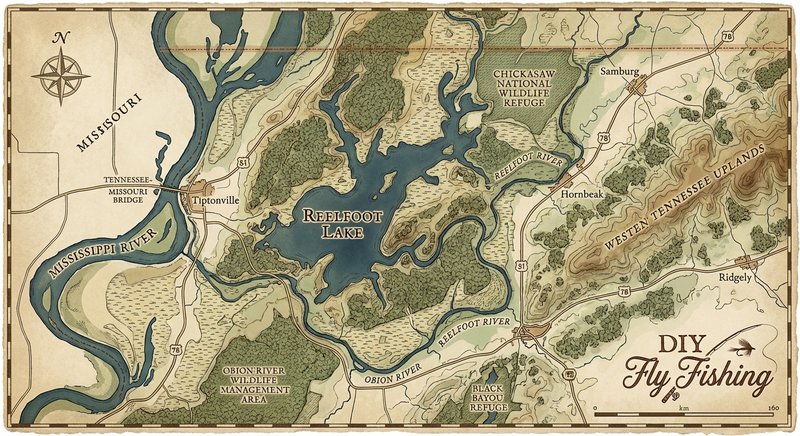
Reelfoot Lake
Fly fishing in Tennessee · Beginner · Best seasons: Spring, Summer, Fall
Target Species
Crappie, Largemouth Bass, Bluegill
About This Water
Natural lake formed by 1811 earthquake. Excellent crappie and bass fishing in cypress trees.
Fishing Recommendations
Welcome to Reelfoot Lake, one of the most unique and hauntingly beautiful fisheries in the United States. As a guide, I tell people that Reelfoot isn't just a lake; it’s a flooded forest. Located in the northwest corner of Tennessee, this "earthquake lake" offers a warm-water fly fishing experience that feels like stepping back in time.
Here is your comprehensive guide to fly fishing the "mighty Reelfoot."
🎣 Location Overview
Reelfoot Lake was created by the New Madrid earthquakes of 1811–1812, which were so powerful they briefly caused the Mississippi River to flow backward, filling a depressed area of forest.
What makes it special: It is a shallow, cypress-filled basin. The average depth is only 5 feet, with a maximum of 18 feet. It is characterized by thousands of standing cypress trees, submerged "knees," and dense lily pad fields (locally called "bonnets"). For the fly angler, it is a target-rich environment. Every single cast is directed at visible structure.
🐟 Target Species & Behavior
Largemouth Bass
Reelfoot bass are "ambush specialists." Because the lake is so shallow and filled with cover, these fish don't roam much. They tuck into the shade of cypress trunks or under the canopy of lily pads. They feed on shad, bluegill, and a massive population of crawfish and dragonflies.
Bluegill (Sunfish)
Reelfoot is legendary for "Bream" fishing. The bluegill here grow to "dinner plate" sizes. During the spawn, they congregate in "beds" in the sandy pockets between cypress roots. They are aggressive and will strike anything that looks like a terrestrial insect or a small nymph.
Crappie
While traditionally a gear-fisherman’s prize at Reelfoot, crappie are excellent fly rod targets in the spring. They suspend around submerged brush piles and cypress knees. They are highly light-sensitive and move shallower as the sun goes down or on overcast days.
📅 Best Times to Fish
- Spring (Late March – May): The Prime Window. This is when the crappie move shallow to spawn, followed immediately by the largemouth and bluegill. The water temperature is perfect, and the vegetation hasn't become too choked yet.
- Summer (June – August): Best for "topwater" bluegill and bass action. However, you must fish the "Golden Hours" (dawn and dusk). Mid-day heat pushes fish deep into the shade of the cypress trees.
- Fall (September – October): As the water cools, bass become aggressive again to bulk up for winter. The lake is much quieter, and the fall colors on the cypress trees are spectacular.
🪰 Recommended Flies & Techniques
Top Fly Patterns
- For Bass:
- Hard-Body Poppers (Size 2-4): Yellow, Frog, or White/Red.
- Dahlberg Divers: Essential for diving just under the surface then floating back up.
- Weedless Bunny Leeches: In black or olive for fishing deep in the roots.
- For Bluegill:
- Bream Boogle Bugs: These are the gold standard for Reelfoot bluegill.
- Rubber-Legged Spiders: Size 10-12 in black, yellow, or white.
- Bead-head Hare’s Ear Nymph: Fished 18 inches under a small strike indicator.
- For Crappie:
- Flies that mimic Minnows: Small Clouser Minnows (Size 6) or Woolly Buggers in white/chartreuse.
Effective Techniques
- The "Vertical Drop": Because of the stumps, long casts are often a liability. Use a 7-8 weight rod for bass to "hoist" them out of cover. Drop your fly inches from a cypress trunk, let it sit until the rings disappear, then give it one sharp twitch.
- The Pocket Pick: Target the small "potholes" inside lily pad fields. You need an accurate cast and a weedless fly to keep from snagging the stems.
- Dapping: In thick timber, you may only have 5 feet of fly line out. Simply "dap" your fly around the knees, mimicking an insect falling from the tree.
💡 Pro Tips & Local Knowledge
- Weedless is Mandatory: If your fly doesn't have a mono weed guard, you will spend your day untangling from cypress knees and lily pads. Even "weedless" flies will snag occasionally.
- The "Reelfoot Chop": The lake is shallow, meaning wind can whip up dangerous waves (whitecaps) very quickly. If the wind picks up over 15 mph, get to the leeward side of an island or off the water.
- Identify "Live" Trees: Fish prefer living cypress trees over dead stumps because the root systems (knees) are more complex and provide better oxygen and cover.
- Watch the "Bonnets": Look for movement in the lily pads. If you see a pad shake, a bass is likely hunting dragonflies underneath. Cast your popper right to that spot.
⚠️ Important Information
Access
- Blue Bank: Great access point with a resort and docks.
- Samburg: The main hub on the lake with multiple ramps.
- Airpark Area: Located on the northern end; offers some of the most scenic "swamp" fishing.
Regulations & Permits
- Tennessee Fishing License: Required for all anglers.
- Reelfoot Preservation Permit: In addition to a state license, you must purchase a Reelfoot Preservation Permit (Type 089). This goes toward the upkeep of this unique ecosystem.
- Creel Limits: Be sure to check the current TN Wildlife Resources Agency (TWRA) limits, as they can change seasonally for crappie.
Special Considerations
- Boating Hazard: Reelfoot is notorious for destroying outboard motors. There are underwater stumps everywhere. Do not go on plane unless you are in a marked "boat run." Even then, be cautious. A kayak or a flat-bottomed boat with a "stump jumper" motor is the preferred vessel here.
- Bugs: In the summer, the mosquitoes and "Reelfoot gnats" can be intense. Bring heavy-duty repellent.
Bug Hatches & Matching Flies
| Hatch | Type | Peak months | Time of day | Hook sizes | Matching flies |
|---|---|---|---|---|---|
| Giant Mayfly (Hex) Hexagenia limbata | mayfly | June, July | Evening/Night | #6-10 | Hexagenia Spinner #6-8, Hex Nymph #8-10, Bubble Back Hex Emerger #8 |
| Chironomids (Bloodworms) Chironomidae | midge | March, April, May | All Day | #14-22 | Zebra Midge #16-20, Ice Midge #18-22, Griffith's Gnat #18-20 |
| Speckled Duns Callibaetis | mayfly | May, June, September | Late Morning | #14-16 | Callibaetis Spinner #14-16, Hare's Ear Nymph #14-16, Parachute Adams #14-16 |
| Cypress Ants Camponotus pennsylvanicus | terrestrial | June, July, August | Afternoon | #12-16 | Black Foam Ant #12-16, Chernobyl Ant #10-14 |
| White Curse Caenis | mayfly | July, August | Early Morning | #20-24 | Caenis Spinner #22-24, RS2 #20-22 |
| Long-horned Caddis Oecetis | caddis | May, June | Evening | #14-18 | Elk Hair Caddis (Tan) #14-18, LaFontaine's Sparkle Pupa #16 |
| Damselflies Enallagma | terrestrial | June, July, August | Midday | #10-14 | Marabou Damsel Nymph #10-12, Braided Butt Damsel #12-14 |
| Grasshoppers Melanoplus | terrestrial | August, September | Afternoon | #8-12 | Dave's Hopper #8-12, Joe's Hopper #10-12 |